Yoga Teacher Training: Discover the Best Destinations Beyond Guatemala
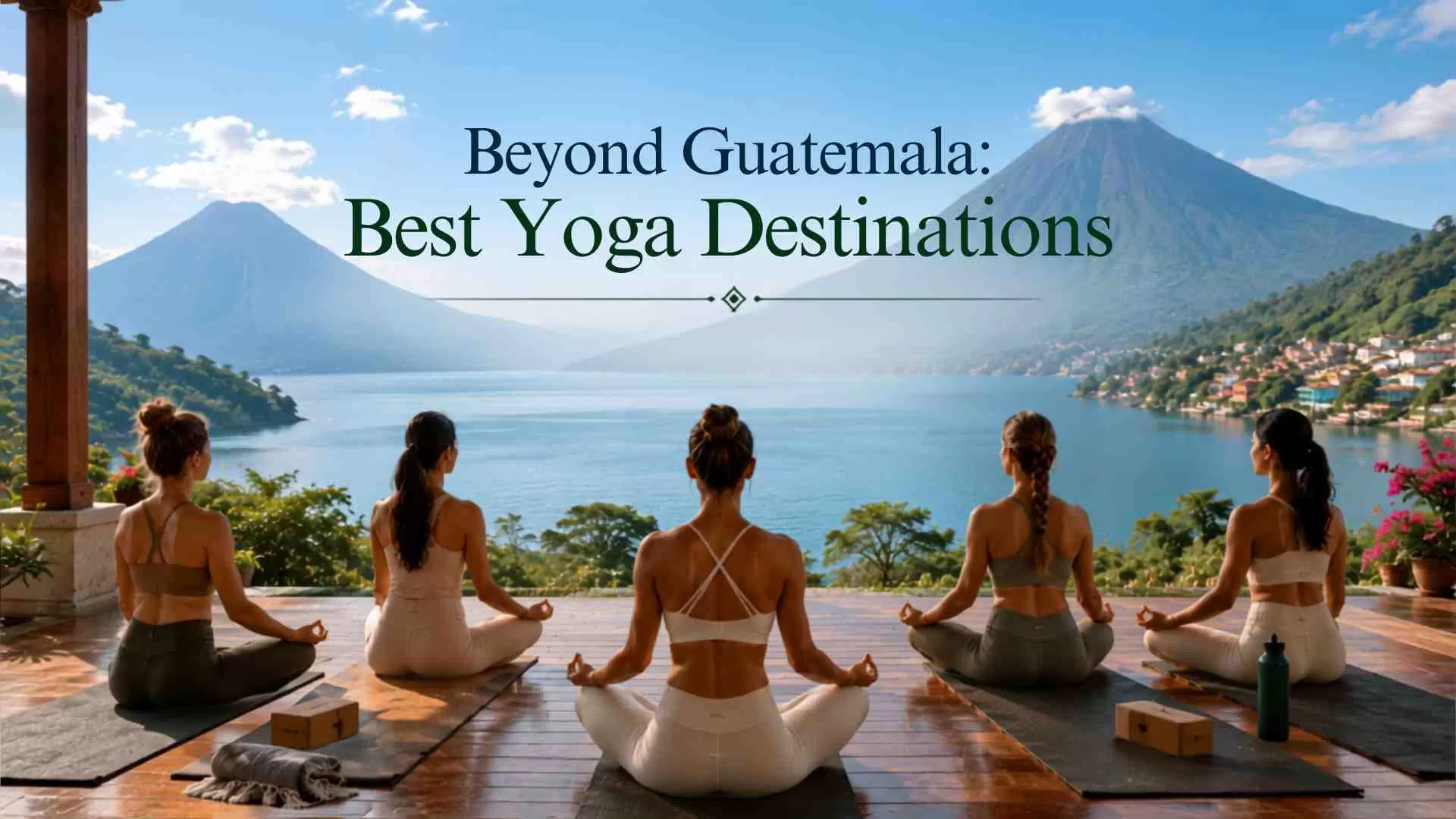
With its calm water and ring of mountains, Lake Atitlán in Guatemala is a lovely spot to train. But here is the honest part most guides skip: it is just one of many yoga teacher training destinations, and depending on what you want, it may not be the best fit for you. You should check out other countries before choosing one just because the pictures look nice. You can avoid a lot of doubt later by comparing things now.
That's what this article is here for. We look at why it's worth looking beyond a Guatemala yoga teacher training, which countries are leading the way, how much courses actually cost when you factor in lodging and meals, and the differences between the 100, 200 and 300-hour levels. The purpose is simple: to help you choose the place that fits your goal, your budget and the kind of experience you want to have, instead of the first gorgeous alternative on your list.
Why Look Beyond a Guatemala Yoga Teacher Training?
Guatemala is a great place to learn how to be a yoga teacher with its peaceful lake and the nearby Mayan culture. But keep in mind that it is one of many places in the world where you can discover how to be a yoga teacher. The best one for you will depend on your goals. What do you really want to get out of the class? That answer likely leads you somewhere else. Before you choose, consider these three things:
- Depth of tradition: Not every country has a family tree like Guatemala.
- Cost per experience: All-inclusive value varies widely from country to country.
- Course range: in the bigger places, there are more levels and styles of courses.
What a Guatemala Yoga Teacher Training Does and Does Not Offer
If you want to become a yoga teacher then Guatemala is a beautiful place with a lot of history and culture to learn about. Often, it doesn't have many course levels, and lodging is an added expense in addition to the fee. It makes sense to compare it to the best place for yoga teacher training.
It helps to know what's important in the choice before you make up your mind. The four things that you should think about are shown in the table below.
| Factor |
Why it matters |
| Tradition and lineage |
Depth of what you learn |
| Total cost |
Fees plus room, meals, flights |
| Course levels offered |
Room to grow later |
| Recognition |
Whether the certificate travels |
After going through those four rows, the strong fits quickly rise to the top. It breaks down a big, confusing choice into a short, easy-to-understand list.Once the reasons are clear, it's easier to see which places are the best.
Which Countries Lead for Yoga Teacher Training Worldwide?
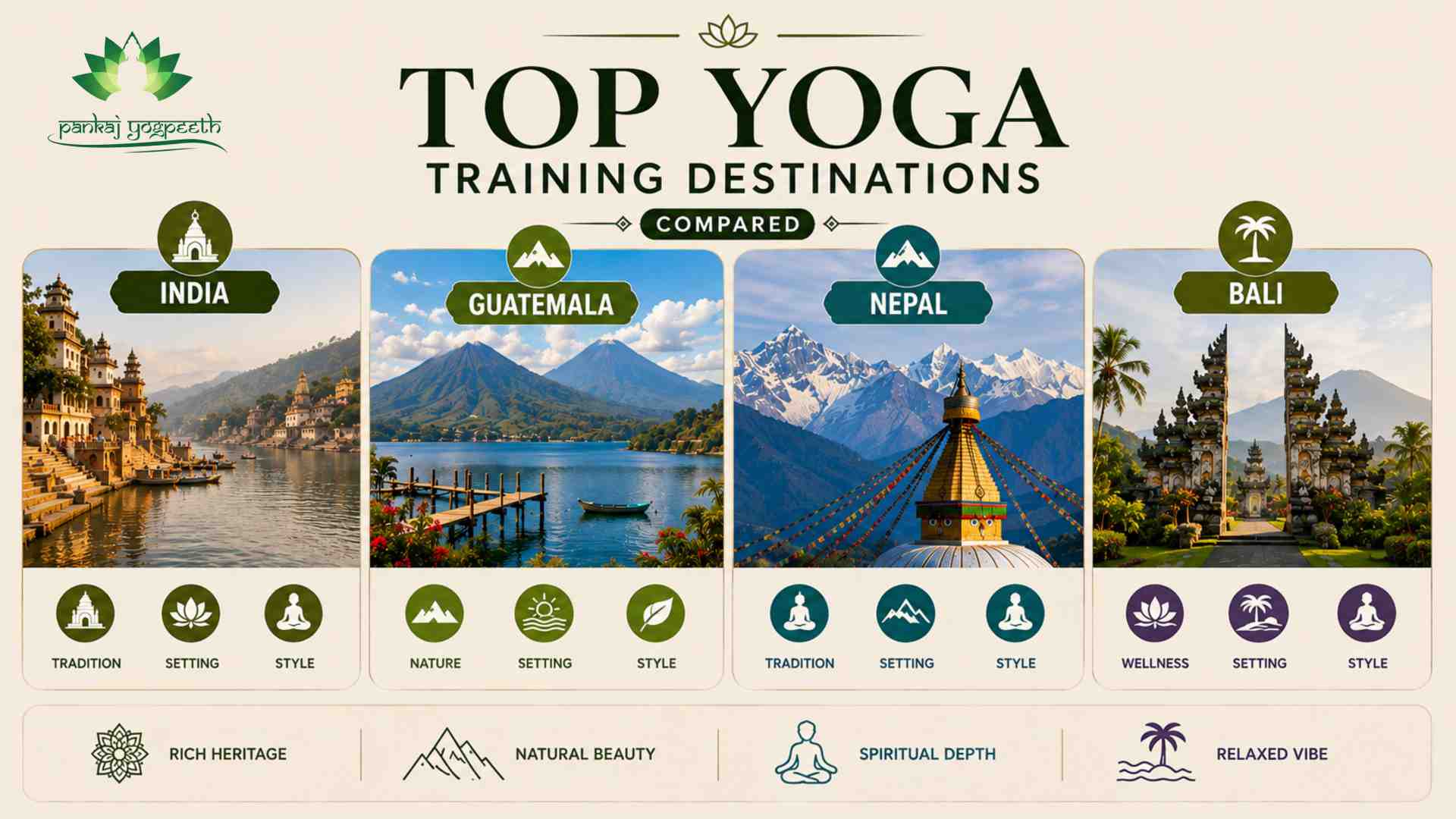
People often talk about the same few places as the best places to learn how to be a yoga teacher. Each one attracts a different type of student. India has the most history and value, Nepal has the peace of the Himalayas, Bali is a great place to relax, and Guatemala has a lakeside city with lots of culture. Which of these really helps you reach your goal? That depends on what you want: depth, comfort, or view.
Top Yoga Teacher Training Destinations Compared
You can see the difference when comparing the best countries for yoga teacher training. The most direct comparison is yoga teacher training in India versus yoga teacher training in Guatemala. India is much cheaper, but it has a longer history and more levels of courses.Compare best vacation spots by price, location and style.
| Destination |
Best for |
200-hour cost |
| India |
Tradition and value |
USD $600–$2,800 |
| Nepal |
Quiet Himalayan setting |
USD $1,000–$2,500 |
| Bali |
Retreat comfort |
USD $2,200–$3,500 |
| Guatemala |
Lakeside, Mayan culture |
USD $2,555–$4,800 (approx. GTQ 20,000–37,500) |
One thing that stands out is that India and Nepal offer the most for a small amount of money. This is why so many students like to train there. The others don't fight price; they fight location and comfort.
The basis for each of these options is cost, so it's worth a closer look.
How Yoga Teacher Training Costs Compare Across Destinations
The real cost of yoga teacher training isn’t usually the number on the website. Guatemalan courses are priced in US dollars, while the local currency is the Guatemalan Quetzal, and lodging and board can cost extra. When working out how much yoga teacher training abroad costs? you have to include those extras. Here’s how to read the real price:
- Course fee only: the headline amount, generally before lodging and board.
- All-inclusive: India and Nepal tend to package hotel and food.
- Extras to add: airfare and separate lodging if not included.
Why Does All-Inclusive Pricing Change the Real Cost?
Add it up, and the answer is easy. The overall course fee with a single board may go above the combined all-inclusive pricing. That’s why the least expensive yoga teacher training places tend to be the ones that offer lodging and meals from the get-go.Here’s what each destination often covers so you can compare like for like.
| Destination |
Room and meals |
Typical extra |
| India |
Usually included |
Flights |
| Nepal |
Usually included |
Flights |
| Guatemala |
Often separate |
Room, board, flights |
| Bali |
Sometimes included |
Flights, some meals |
Look across the table, and the pattern is clear: India and Nepal tend to keep most in one price; Guatemala and Bali like to add lodging or meals on top. The true cost is seen when comparing the complete amount, not just the fee.
And price is not the only thing that dictates what you walk away with; the level of the course counts too.
Which Course Level Fits You: 100, 200 or 300 Hour?
You can tell what a course is for by how many hours it has, so make sure it fits your level. By the way, what level do you need to teach? For most, that's the 200-hour mark, with the other hours on either side of it. Here is a quick outline of each step:
100 hours: A 100-hour yoga teacher training is a quick introduction that lasts between 10 and 14 days. It can be used as a gentle start or as an extra in a single style.
200 hours: The primary requirement and the one that lets you teach is a two hundred hour yoga teacher training. For almost all new teachers, this is where they should start.
300-hour: These are the next level of training for people who already have a 200-hour and want to go further.
Choosing Between a 200-Hour and 300-Hour Course
Once you know your level, this is an easy choice. The 200-hour yoga teacher training gives you the skills to teach, and the 300-hour training builds on what you already know. If you don't already have those hours, start with the 200-hour.Take a quick look at how these three levels compare.
| Course |
Typical length |
Best for |
| 100-hour |
10–14 days |
A first taste |
| 200-hour |
21–30 days |
Becoming a certified teacher |
| 300-hour |
4–6 weeks |
Building on a 200-hour |
The steps are easy to see: start with the 100-hour, then move on to the 200-hour and finally the 300-hour to get even better. A lot of people begin in the middle and move up.The certificate tells you if the course counts abroad based on the level you choose.
International Recognition of Your Yoga Teacher Training Certificate
The good news is that Yoga Alliance-approved yoga teacher training is recognized in most countries, so a certificate gained elsewhere is still valid at home. It's not the country you learned in that makes it travel; it's the registration behind the school. Get that bit right, and the rest falls into place. What to watch for:
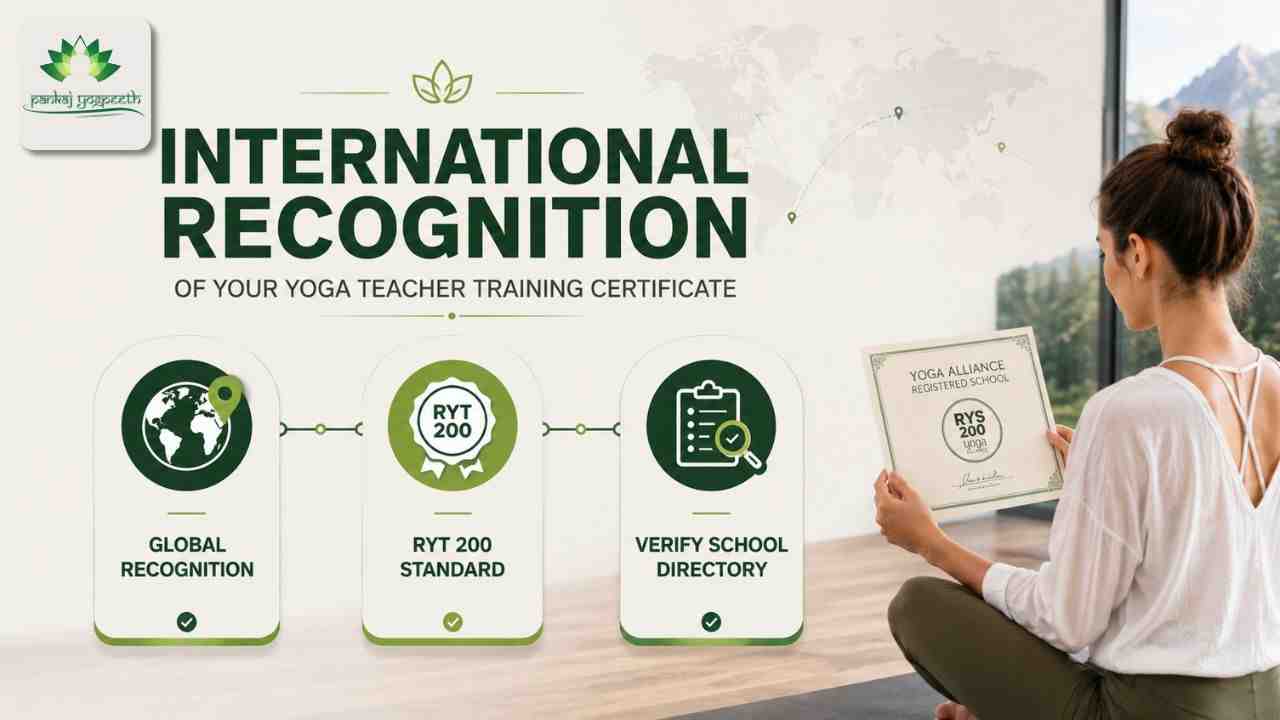
- Registration behind it: The registry, not the country, takes the weight.
- RYT 200 listing: the worldwide standard for a foundation instructor.
- Check the directory yourself: make sure the school is in the directory, not just recognized.
What Does RYT 200 Mean for Teaching Abroad?
The answer is simpler than most people think. With a registered course, you get an RYT 200 that you can teach around the world, no matter what country you got it in. This is why the question of whether yoga teacher training qualifies internationally comes down to one thing: making sure the institution is correctly listed before you register.
With recognition out of the way, one destination is waiting to go deep.
Why India and Nepal Lead for Depth and Tradition
India and Nepal are great places to learn how to be a yoga teacher if you want to get to the bottom of things. This is where the custom started so it has a longer history and the price is often lower here than elsewhere. Is it worth it to go all the way to the source? Yes, the heritage, the daily training, and the value do add up for many trainees. This is the path that most people take:
- Rishikesh: The deepest tradition, Himalayan lineage.
- Varkala, Kerala: A peaceful coastal alternative in India.
- Pokhara, Nepal: A more serene Himalayan setting.
Here’s a quick breakdown of how the three primary options compare.
| Location |
Setting |
Best for |
| Rishikesh |
Himalayan foothills |
Tradition and lineage |
| Varkala |
Kerala coast |
Calm, seaside study |
| Pokhara |
Nepal, lakeside |
Quiet Himalayan retreat |
Read across the table, and each spot has something different to offer, from history in the mountains to peace by a lake. They cover almost every type of trainee.
What Does Pankaj Yogpeeth Offer in India and Nepal?
At their foundation, they offer yoga teacher training in Rishikesh. For a more peaceful setting, Pokhara also offers yoga teacher training in Nepal. The price of a room, food, and course often adds up to less than Guatemala's high prices. Check out the 200-hour yoga teacher training in Rishikesh for real training that takes care of everything.
Now that you know where you want to go, the last step is to learn how to check out any school before you decide to go.
What to Check Before Booking Any Destination
More important than the country you choose is how to pick a yoga school. A bad program can ruin even the most beautiful surroundings. What step do most people forget to take? Instead of trusting a school's certificate on the internet, they look it up in the official directory. Because of that one habit, most of the bad choices are thrown out quickly. Before you pay, read these:
- Registry, not the website: check the official list to make sure the school is correct.
- What is included: room, meals, materials and certificate spelt out first.
- Independent reviews: read across more than a single platform.
How Do You Read Reviews and Refund Terms the Right Way?
Look past the shine to get what you want. Real reviews of yoga teacher training are steady and specific, not a wall of five-star lines, and they can be found on more than one site. Before you join for yoga teacher training, one of the smartest things you can do is look at the return policy. Make sure you get it in writing before you give any money.
Now that all the checks are done, you only have one question left to answer.
Choosing the Right Destination for Your Training
One honest question at the end of the day determines what you want this training to give you: a gentle reset, a certification to teach with, or increased depth in your practice? That way, getting to the right place is no longer a guess; it's clear.
There is a beautiful course in Guatemala by a lake that is full of Mayan culture. For some, the setting is the whole point. India and Nepal, on the other hand, quietly lead the way when it comes to tradition, value, and depth. If you want to take classes at the source, Pankaj Yogpeeth has courses in Rishikesh, Varkala, and Pokhara.
The best place to go is the one that helps you reach your goal, not the one with the most beautiful pictures. Plan your choice and take the first step.