Best Yoga Teacher Training in Thailand: Everything You Need to Know
You searched for yoga teacher training in Thailand for a reason. You could be ready to teach. You might desire to spend 28 days fully immersed in a warm, focused, and life-changing place. You're at the right place either way. Thousands of international students get their 200-hour and 300-hour yoga certifications in Thailand every year. They do this at Yoga Alliance-registered schools in Koh Phangan, Chiang Mai, and other places. They choose Thailand for the value, the immersion, and the quality of teaching.
This guide covers real costs, top locations, programme differences, and what training life actually looks like day to day. But before you pick a school, there's one question worth answering first. Are you actually ready for an intensive residential training?
Is Yoga Teacher Training in Thailand Right for You?
Good question, and the table below answers it faster than anything else. Whether you're asking what is included in yoga teacher training in Thailand, whether beginners can join, or what certification you actually get, here's a quick overview.
| Factor |
200 Hour Programme |
300 Hour Programme |
| Duration |
21–28 days (intensive format) |
28–35 days or split over months |
| Best For |
First-time teachers, career changers, serious practitioners |
Existing 200hr graduates deepening their practice |
| Yoga Alliance Certification |
RYT-200 (Registered Yoga Teacher) |
RYT-500 when combined with 200hr |
| Typical Cost |
$800–$2,500 USD |
$1,200–$3,500 USD |
| Accommodation Included |
Most programmes include room + meals |
Most programmes include room + meals |
| Prior Experience Required |
Minimum 1 year regular practice recommended |
Must hold a valid 200hr certification |
| Open to Beginners |
Yes, many schools welcome beginners |
No, 200hr prerequisite required |
| Best Locations |
Koh Phangan, Koh Samui, Chiang Mai, Bangkok |
Koh Phangan, Chiang Mai, Pai |
| Peak Season |
October–April (cool season) |
October–April (cool season) |
Most of the time, the most intensive yoga teacher training in Thailand is a fully residential program. You live, eat, and practice with other students at the institution. That's what makes it different from anything part-time or online. The point is the immersion. And that's why students learn so quickly.
If you've been doing yoga regularly for at least a year, you can definitely get yoga teacher training in Thailand for beginners. The 200-hour yoga teacher training in Thailand is made just for that first step. You need to have your certification before you can take the 300-hour class, which starts where the 200-hour class ends.Both are Yoga Alliance-certified courses in Thailand, which means your certification is valid wherever you want to teach next.
Why Do Students Choose Thailand for Yoga Teacher Training Each Year?
You could train anywhere. So why does Thailand keep appearing in every yoga forum, directory, and recommendation topic? The beaches aren't the only thing. It goes even deeper than that. When you get affordable yoga teacher training in Thailand, you don't have to cut corners. This is what it really looks like:
- A 200-hour yoga teacher training course in Thailand costs between $1,200 and $1,800, including housing and meals. In the US or UK, the same Yoga Alliance certification costs between $2,500 and $5,000 or more.
- Most good yoga schools in Thailand are registered with Yoga Alliance. This means that your RYT-200 or RYT-500 is recognised around the world, whether you teach in London, Dubai, or Melbourne.
- There are yoga teacher training classes in Thailand year-round, especially on the islands. You don't have to wait months for the next intake.
- Yoga teacher training in Thailand for international students can have a real sense of community, as most groups have students from 30 or more nations. The bonds made during a residential program can persist for years.
And then there's the lifestyle portion, which people don't talk about enough. Thai food is naturally plant-based and nutrient-rich. The pace slows down. Your body actually recovers between sessions. That matters more than you'd think when you're six hours deep into daily training.
This is how affordable yoga teacher training in Thailand is different from a cheap course. But this is where most students get stuck: which part of Thailand do you actually go to? The place makes the experience quite different.
Which Place Is Best for Yoga Teacher Training in Thailand?
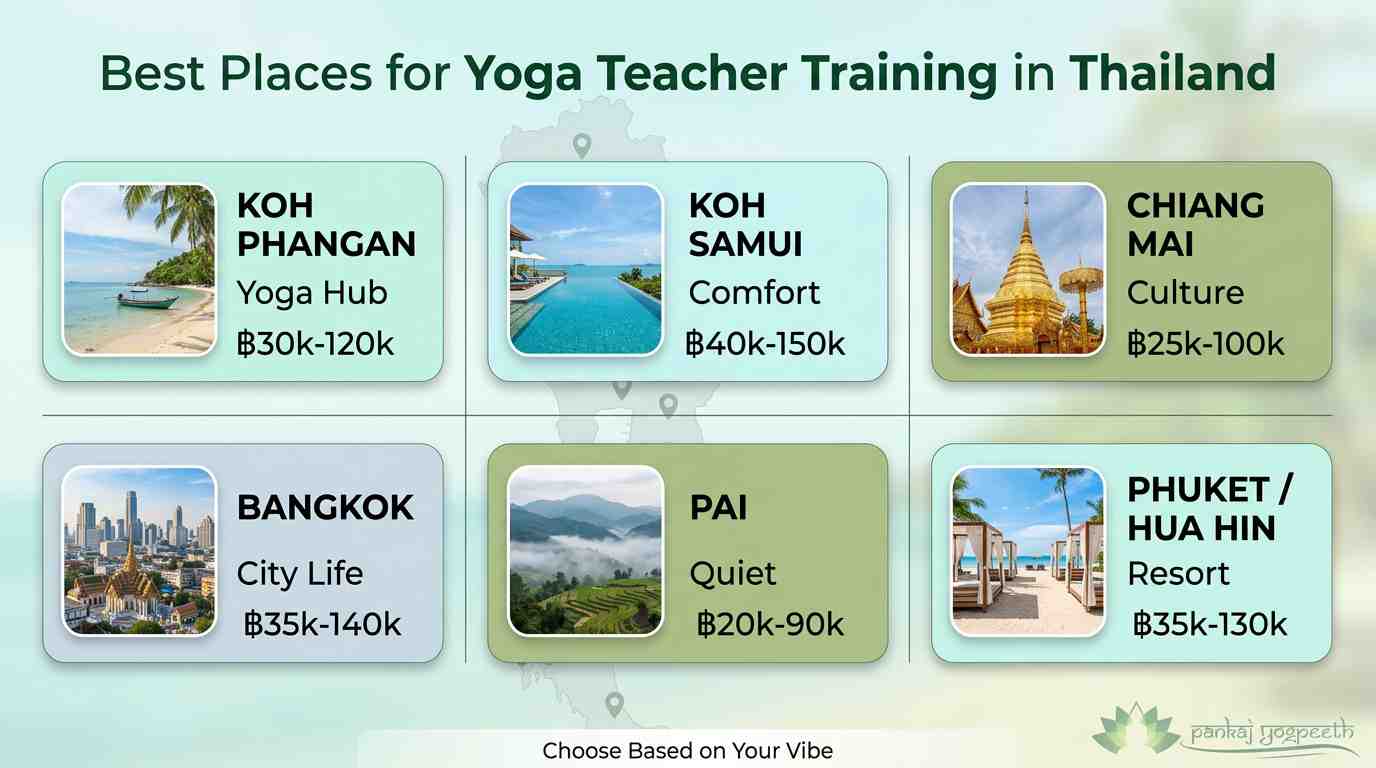
There isn't just one place to go in Thailand. There are five or six, and each one has a different atmosphere, pricing, and sort of student it works best for. One of the most common mistakes first-time training students make is choosing the wrong place. So let's make sure everything is clear.
| Location |
Vibe |
Cost Range |
Best For |
| Koh Phangan |
Tropical, yoga-centric, community feel |
฿28,000–฿72,000 |
First-timers, beach lovers |
| Koh Samui |
Resort-feel, quieter, more polished |
฿40,000–฿100,000 |
Comfort + quality seekers |
| Chiang Mai |
Cultural, cooler, mountain setting |
฿32,000–฿79,000 |
Culture seekers, avoiding heat |
| Bangkok |
Urban, accessible, year-round |
฿36,000–฿90,000 |
Time-pressured, city-based |
| Pai |
Remote, mountain town, deep immersion |
฿25,000–฿57,000 |
Solo seekers, quiet immersion |
| Phuket / Hua Hin |
Tourist resort, developing scene |
฿40,000–฿100,000 |
Comfort + solo travellers |
Koh Phangan Yoga Teacher Training - The Yoga Capital of Thailand
Koh Phangan is undoubtedly the most well-known name in yoga training in Thailand. And the reputation is well earned. Yoga teacher training in Koh Phangan, Thailand, has the highest concentration of Yoga Alliance-registered schools in the country, with established names. Classes with programmes starting monthly or bi-monthly throughout the year. English is widely spoken. The food scene is excellent. And the community of international students is unlike anywhere else in Southeast Asia. Additionally, it's one of the affordable yoga teacher training destinations in Thailand, with full residential programs included.
Koh Samui Yoga Teacher Training - Where Quality Meets Comfort
Want everything Koh Phangan has to offer, but with a more polished and peaceful vibe? You should check the yoga teacher training in Koh Samui, Thailand. There are fewer schools, but more little ones. Fewer students in each class. Better arrangements for individual rooms. And a direct flight from Bangkok, which makes it easier for people coming from other countries. It costs a little extra. But for many students, the extra comfort during a long residential training is worth every baht.
Chiang Mai Yoga Teacher Training - Culture, Mountains and Cooler Air
Not everyone likes to go to the beach. Some students learn better when it's cooler outside, and that's what yoga teacher training in Chiang Mai gives you. The weather is milder, especially from October to February. There is no other place like this for culture. Many schools here weave in Thai massage, meditation, and Ayurveda alongside asana. And the cost of living stretches further than almost anywhere else in Thailand. There are well-known 200-hour and 300-hour Yoga Alliance-certified courses here.
Bangkok Yoga Teacher Training - For the Time-Pressured Traveller
Do you have Limited time? Flying in and out of Suvarnabhumi? That's exactly what Yoga teacher training in Bangkok, Thailand, is about. Most programmes here are studio-based, not residential, with flexible start dates and a year-round schedule. You will have to find your own somewhere to stay, but the Yoga instructor courses in Bangkok are reasonable, and the city's public transportation is the best. It's not the best choice for immersion. But for some students, it's the best option.
Now you know where. The next question most students ask, and arguably the more important one, is which programme level is actually right for where you are in your practice right now.
What Style of Yoga Teacher Training Should You Choose in Thailand?
This is something that most students don't consider until it's too late. You chose where to go. You looked at the dates. You're nearly ready to make a reservation when you remember you don't know what kind of yoga this school really teaches.You might not think it matters, but it does.
The Most Popular Yoga Styles Taught in Thailand Teacher Training
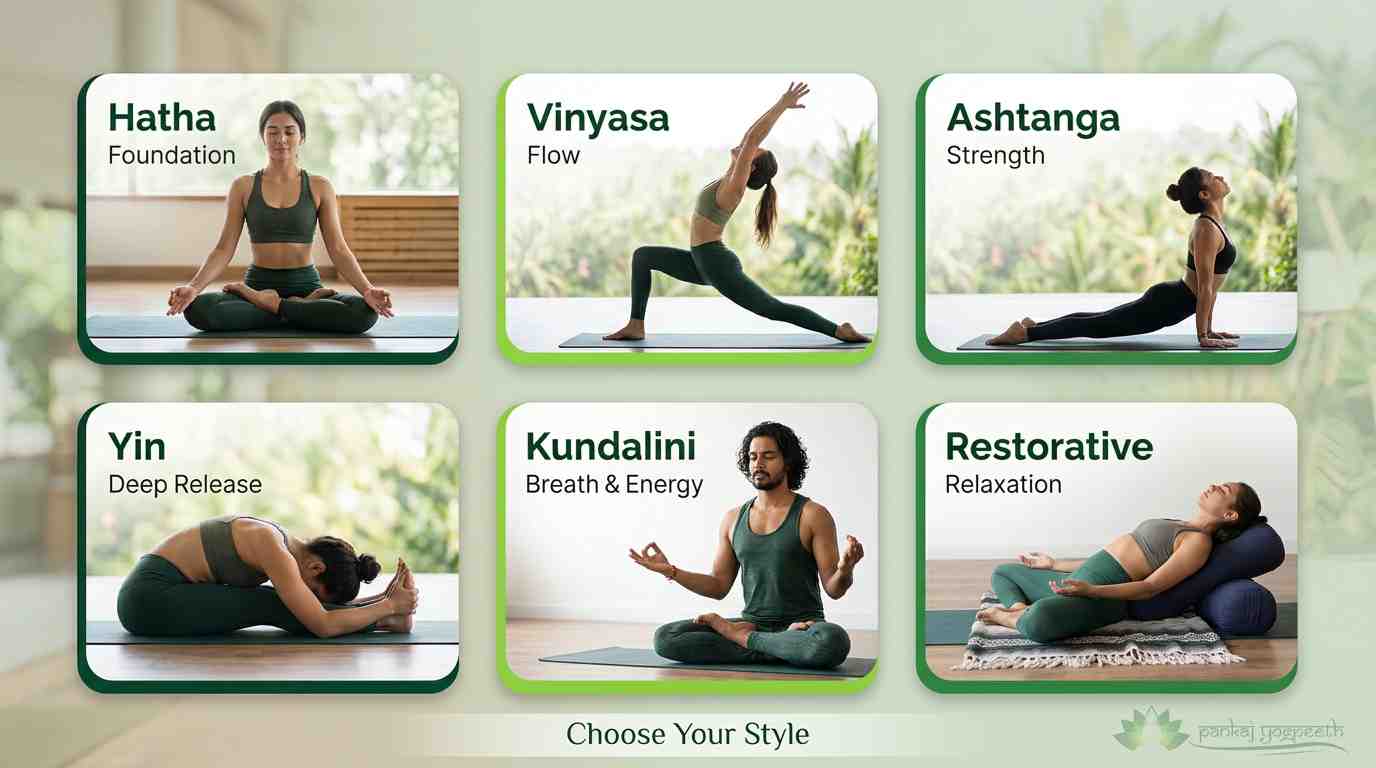
| Style |
What It Focuses On |
Best For |
Common in Thailand |
| Hatha Yoga |
Traditional postures, breathwork, alignment - slower pace |
Beginners, classical foundation seekers |
Very common - good base for all styles |
| Vinyasa / Flow |
Dynamic movement linked to breath, creative sequencing |
Energetic, creative teaching style |
Very common - widely taught and in demand |
| Ashtanga |
Fixed sequence, breath-focused, physically demanding |
Disciplined practitioners wanting rigour |
Available - especially Mysore-style in Chiang Mai |
| Yin Yoga |
Long-held passive postures targeting connective tissue |
Therapeutic teachers, complementary style |
Common as add-on or standalone module |
| Kundalini |
Breathwork, mantra, energy practices |
Spiritual seekers, meditation-focused students |
Available - Koh Phangan has several schools |
| Restorative Yoga |
Passive supported postures for deep relaxation |
Therapeutic teachers, wellness industry students |
Growing - often combined with Yin modules |
- Hatha yoga teacher training in Thailand is the most common, and there's a solid reason for that. It is the classical base on which all other styles are built. Hatha is the bedrock of most 200-hour programmes in Thailand, with additional forms added on top.
- Vinyasa yoga teacher training in Thailand is the second most popular style to teach right now, and some say it's the most in-demand worldwide. Vinyasa is worth putting at the top of your list if you want a creative, exciting teaching career.
- Ashtanga yoga teacher training in Thailand is stricter and more physically demanding. It's suitable for those who already practice regularly and seek structure over flexibility.
- Want something that will help you relax? You can now get Yin yoga teacher training in Thailand as a stand-alone module or as an add-on. It complements any primary style certification.
- And if your route is more spiritual than physical, Kundalini training in Koh Phangan has many schools that focus on breathwork, mantras, and energy work.
200 Hour vs 300 Hour Yoga Teacher Training in Thailand
This is where you start if you've never learned formally before. The 200-hour yoga teacher training in Thailand is the standard way to begin teaching worldwide. It covers everything from anatomy and asana alignment to teaching, yoga philosophy, pranayama, and providing students with exercises.
200 Hour Yoga Teacher Training in Thailand
Most 200-hour YTTC programs in Thailand are residential and last for 21 to 28 days. They are fully immersive and follow a set plan from early morning to late evening. You get more than just a badge at the end. A practice, a voice for teaching, and a group are all things you have. For 200 hours, you get:
- Asana technique and alignment fundamentals
- Human anatomy and physiology for yoga teachers
- Yoga philosophy - Patanjali's Sutras, the eight limbs, the history of yoga
- Pranayama and breathwork instruction
- Meditation and mindfulness techniques
- Hands-on teaching practice with real feedback
- The business of yoga: how to start teaching after you finish
When you're done, you can register with Yoga Alliance as an RYT-200, a credential that studios, retreats, and wellness jobs worldwide recognise. The best places in Thailand for a 200-hour YTTC are: Bangkok, Koh Phangan, Mai Khao, and Koh Samui. The average cost is between $800 and $2,500 USD (฿28,000 to ฿90,000 THB) for a room with food.
300 Hour Yoga Teacher Training in Thailand
Already have your 200hr? You already know that the basics aren't enough.The 300-hour yoga teacher training in Thailand is for graduates who want to go beyond the basics and learn more about advanced teaching methods, deeper theory, specialised styles, and the kind of complex understanding that makes great teachers great. Don't think this is a game for beginners. Your 200hr certification is a strict prerequisite, no exceptions at any credible school.What your 300 hours give you:
- Advanced asana - backbends, inversions, arm balances with full anatomical understanding
- Specialist style modules - Yin, Restorative, Prenatal, Trauma-informed yoga
- Advanced pranayama and subtle body theory
- In-depth yoga philosophy - Tantra, Samkhya, Advaita Vedanta
- Advanced teaching practicum - sequencing for specific populations and conditions
- Business development - building a sustainable teaching career
After finishing your 300-hour YTTC in Thailand and adding it to your current 200-hour, you will be able to register with Yoga Alliance as a RYT-500, which is the highest level of individual yoga teacher registration in the world. The best places in Thailand for a 300-hour YTTC are: Koh Phangan, Chiang Mai, and Pai: Prices range from $1,200 to $3,500 USD (฿43,000 to 126,000 THB), and most programs include food and lodging.
So, 200hr or 300hr? Here's the Simple Answer
If you haven't completed a formal teacher training before, start with the 200 hour. No exceptions.If you hold a valid 200hr certification and you're ready to teach at a higher level, work with specialist populations, or simply go deeper into the practice, the 300 hour YTTC in Thailand is the natural next step. And if you're planning? Some students complete their 200hr in Koh Phangan and return for their 300hr in Chiang Mai, two completely different environments and stages of growth.
Programme level sorted. Now, what does your day actually look like once training begins?The daily schedule surprises most students. It's more structured, and more rewarding, than they expected.
What Is the Daily Schedule Like in Thailand Yoga Teacher Training?
The days are very organised, which most students don't realise, and it's not a yoga vacation. The schedule shows that it's a professional training. But here's the thing: once you're in it, the beat is the most stable part of the whole thing. This is what a normal day looks like in a 200 hour yoga teacher training in Thailand.
A Typical Day YTTC Thailand Daily Schedule
| Time |
Activity |
Notes |
| 5:30–6:00 AM |
Morning meditation / pranayama |
Optional but strongly encouraged sets the tone for the entire day |
| 6:00–8:00 AM |
Morning asana practice (led by teacher) |
Typically 2 hours — Hatha or Vinyasa depending on curriculum |
| 8:00–9:00 AM |
Breakfast |
Included in most residential programmes |
| 9:30–11:30 AM |
Anatomy, philosophy or teaching methodology |
Core academic content, body anatomy, yoga philosophy texts |
| 12:00–1:00 PM |
Lunch + rest period |
Most schools provide plant-forward Thai meals |
| 2:00-4:00 PM |
Teaching practice / practicum session |
Students teach each other in small groups, supervised feedback |
| 4:00-5:00 PM |
Yoga philosophy or Sanskrit class |
Optional depth modules |
| 5:30-7:00 PM |
Evening practice - Yin, Restorative or Meditation |
Cooling down and integrating the day |
| 7:30 PM |
Dinner |
Final meal, dietary options available at most schools |
| 9:00-10:00 PM |
Study / journaling / self-practice |
Recommended - exams and teaching assessments require preparation |
Every day, six to eight hours of structured training. That's what it's like to undergo intensive yoga teacher training in Thailand. And yes, it's full on. But that's the point.The schedule for yoga classes in Thailand is set up such that when you leave, teaching yoga doesn't feel like a skill you've learnt. It feels like you've been there.
In the early dawn. Long sessions of practice. Teaching your peers before you feel ready. That's where you really grow. What do you really get out of doing that program for 21 to 28 days in a row? The certificate is important. But it also matters what it means worldwide.
What Certification Do You Receive and Is It Recognised Internationally?
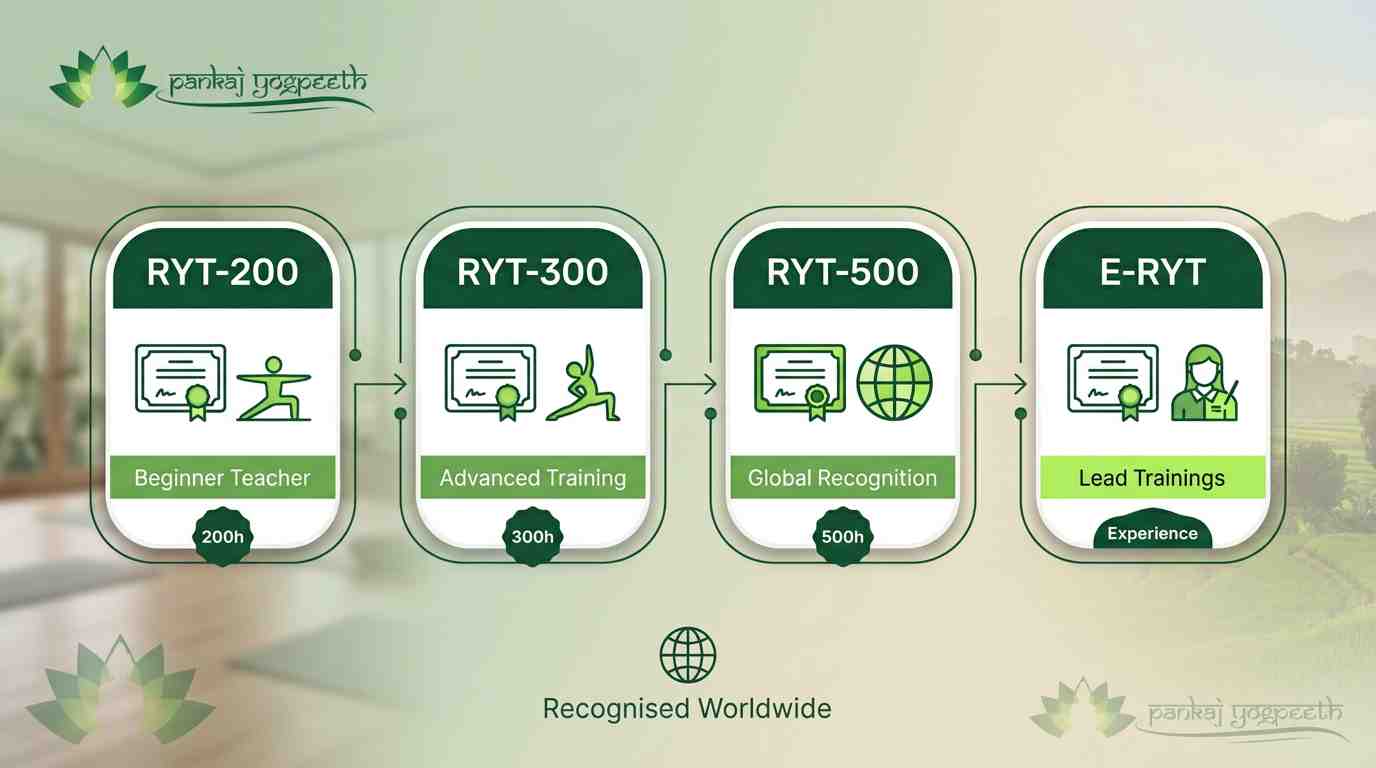
Before you book anything, you should ask this question.Because not all yoga certifications are the same, and not all yoga schools in Thailand give out certifications that studios and companies around the world can use. This is everything you need to know.
Yoga Alliance Certifications Available from Thailand Programmes
| Certification |
Hours Required |
Who It's For |
Teaching Rights |
Annual Fee |
| RYT-200 |
200 training hours |
First-time teachers - beginners to trained practitioners |
Teach yoga professionally worldwide |
$65 USD/year |
| RYT-300 |
300 additional hours (post-200hr) |
200hr graduates wanting advanced training |
Advanced specialisation + teaching credential |
$115 USD/year |
| RYT-500 |
200hr + 300hr combined |
Most qualified standard for professional teachers |
Full international recognition, required by many studios |
$115 USD/year |
| E-RYT |
2,000+ teaching hours post-certification |
Teachers with substantial real-world experience |
Can lead Yoga Alliance registered teacher trainings |
Higher registration level |
Is a Yoga Alliance Certification from Thailand Recognised Worldwide?
Yes is the short answer. Yoga Alliance is the global standard for certifying yoga teachers. It's based in the US, but it has students worldwide. For example, a RYT-200 from a recognised yoga school in Thailand is the same as one from the US, UK, or India.The certificate doesn't depend on where you are. The registration for the school does. That's why checking out the school directly on yogaalliance.org is the most important step before signing up for any yoga teacher training in Thailand. You are safe as long as the school is registered as a RYS-200 or RYS-300 school. Don't bother if it's not on the list.
Your Yoga Teaching Journey Starts Here
You did the research. You know where the places are, how much they cost, what the credentials are, and what the days are really like on the ground. Now all that's left is to take the step.Yoga teacher training in Thailand gives you something that most courses don't: a certificate that is recognised throughout the world, world-class teachers, a worldwide community, and a place that is truly designed for change, all for a fraction of the cost of other places.Whether it's Koh Phangan, Chiang Mai, or Bangkok, Thailand is ready when you are.
Looking for Something Even More Affordable? India and Nepal provide some of the best Yoga Alliance-certified teacher training programs in the world that won't break the bank. Pankaj Yogpeeth offers 200-hour and 300-hour yoga teacher training in Rishikesh, India, and Pokhara, Nepal. The course is based on real yogic heritage and is much cheaper than training in Thailand. Look into the Pankaj Yogpeeth programs.