Yoga Teacher Training: How to Choose the Right Course If You Live in Turkey
People who live in Turkey who want to teach yoga are lucky in one way: they can choose. You can learn close to home or get in your car and go somewhere far away. That's why you should give yoga teacher training in Turkey some thought before you decide to do anything.
We keep it basic and clear in this guide. You'll learn where the local courses are, from weekend yoga teacher training in Istanbul to beach getaways, how much they cost, the difference between 100, 200 and 300 hour levels, and the honest pros and cons of each. The goal is simple. To support you in picking the course that's right for your life, your budget and where you want teaching to take you.
What Are Your Yoga Teacher Training Options in Turkey?
Turkey has a lot more to offer than most people think. If you’re looking for yoga teacher training in Turkey for beginners or something a little more advanced, the courses fall into three categories. Which one works best for your life right now? That’s the true question, and it is based upon your time, your budget and how far you want to go. Here are the primary ways:
- City weekend courses: modular training over several weeks, common in Istanbul.
- Short retreats: intensive courses by the sea, usually in Bodrum or Antalya.
- International training: a residential course for complete immersion in another country.
City Courses and Coastal Retreats in Turkey
Wondering where to train as a yoga teacher in Turkey? Most people begin in the city. Weekend courses are the perfect fit if you want to learn but cannot take time off work, and yoga teacher training in Istanbul is the best option.
If you want a brief but full stay, you have to step away and focus fully, so the seaside around Bodrum or Antalya is for you. Here’s how the three routes compare.
| Route |
Format |
Best for |
| Istanbul weekend course |
8–9 weeks, part-time |
Keeping your job and routine |
| Coastal retreat |
3–4 weeks, intensive |
A focused local immersion |
| Overseas residential |
3–4 weeks abroad |
Deep tradition and value |
Read across, and it’s an easier choice: stay flexible in the city, go all-in on the seaside, or go for true depth.The next decider in general is cost once the routes are set.
How Much Does Yoga Teacher Training in Turkey Cost?
And this is where the cost of yoga teacher training in Turkey gets tricky. The lira changes so quickly that most schools don't use it to set prices. Instead, they use dollars or euros. Is the price written on the box the real price? Sometimes, in cities, a weekend course will only cover the training, leaving your room free for you. On retreats, you pay for both the room and the food at the same time. Carefully observe these three:
- City course fee: usually the only course fee; accommodation is done by yourself.
- Retreat fee: usually covers lodging and meals for the intensive.
- Extras to add: supplies, registration and travel where not included.
Why the Lira Price Is Not the Whole Story
To find out how much yoga teacher training costs in Turkey, you need to read the full price list in dollars or euros and then add any room costs that are not included in the course price. This is the amount you can expect.
| Course type |
Typical cost |
Room and meals |
| 200-hour city course |
USD $2,500–$3,200 (approx. ₺ live figure) |
Usually separate |
| 200-hour coastal retreat |
USD $3,000–$3,800 (approx. ₺ live figure) |
Usually included |
| 300-hour |
Higher, varies by school |
Varies |
The real cost of some choices for yoga teacher training in Turkey is much lower than what the headline says. This is because they include a bed and breakfast and other extras in the price.Taking cost into account, the level of the course affects what you learn.
Which Course Level Suits You: 100, 200 or 300 Hour?
You can tell who a course is made for by how many hours it has, so it's important to match those hours to where you are now. Are you not sure which one you need? Most people will say that the 200-hour answer is the most honest one. The shorter and longer answers are right there on either side of it. If you make the right choice, you won't pay extra or less for what you need.
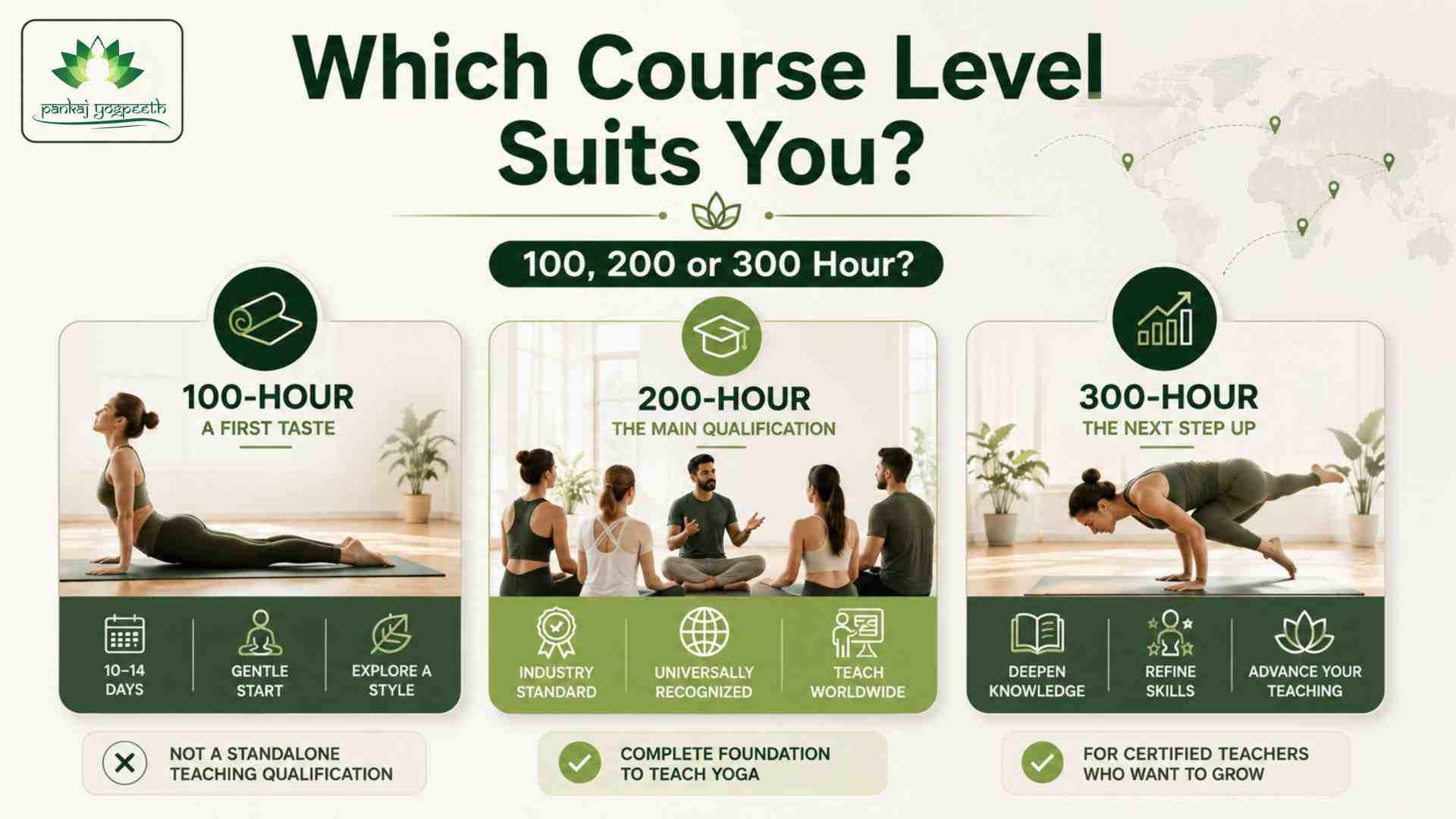
100-Hour: A First Taste
Most of the time, it takes 10 to 14 days to finish a 100-hour yoga teacher training. You can start with it slowly or use it to brush up on a single style. As a first step, don't see it as the end. It doesn't give you the right to teach on its own.
200-Hour: The Main Qualification
To teach yoga you need a 200 hour teacher training program. It is the first thing almost all new teachers do and for many it is the only training they ever need. This is the lesson you should take if you only take one.
300-Hour: The Next Step Up
The 300 hour yoga teacher training is a complement to the previous 200 hour training. It works for teachers who are already licensed and want to get better and learn more. You can think of it as the next level up you get after teaching for a while. Let’s quickly look at how these three levels compare.
| Course |
Typical length |
Best for |
| 100-hour |
10–14 days |
A first taste |
| 200-hour |
21 days to 9 weeks |
Becoming a certified teacher |
| 300-hour |
4–6 weeks |
Building on a 200-hour |
What you have to do is start with the 200-hour unless you already have it to decide between the 200-hour and 300-hour. When you are ready to go further, you can move up to the 300-hour.
If you want to learn in Turkey, it helps to be honest about the advantages and disadvantages.
What Are the Pros and Cons of Training in Turkey?
Like any other road, the path to becoming a yoga teacher in Turkey has its pros and cons. Should you go to Turkey to become a yoga teacher? It really depends on what is most important to you. You can save time and money by staying close to home, but you miss out on some of the depth that a school abroad can offer. It is much easier to make the call when you can see both sides clearly.
Weighing Local Study Against Training Abroad
You can train in Turkey to be close to home, to keep working, and to learn in a language you're already familiar with. Training abroad costs you some comforts in exchange for more tradition and full engagement and so the choice you make will depend on what is most important to you. Take a quick look at these two sides.
| Pros |
Cons |
| Close to home, no long travel |
Fewer deep-tradition options |
| Keep your job with weekend study |
Room often charged separately |
| Familiar language and setting |
Prices tied to US dollars or euros |
| Local teaching contacts |
Less full immersion |
Line up the columns, and it's easy to see which one to pick. Ease of use or depth. Only you can decide which is more important.The pros and cons are weighed up before the credits determine whether the course counts abroad.
Will a Turkish Yoga Teacher Training Be Recognized Internationally?
First things first, good news: a Yoga Alliance-certified yoga teacher training that you get in Turkey will work in most places. What makes it happen? Not the country, but the business that the school joins. But there is a twist that you should know about.
Some Turkish schools are on the list with Yoga Alliance International Europe, and others are on the list with Yoga Alliance. The two groups are not the same. This is important:
- Registration behind it: the weight lies with the registry, not the country.
- Which registry: check whether your school is listed with Yoga Alliance International Europe or Yoga Alliance.
- Check it out for yourself: look up the school in the official directory before you sign up.
Checking Which Registry Your School Belongs To
Many people skip this step, but it's important. Check with the school to see which registry they use, and make sure it works with your plans, depending on whether you want to do a RYT 200 or teach abroad. That quick check is what really decides if yoga teacher training in Turkey is recognized around the world.
Even though Turkey has been recognized, some goals still go beyond the country.
When Is Training Abroad the Better Choice for You?
It's not always in your heart to stay close to home. When is it a good idea to go right to the source? Most of the time, when you want to know more about the practice than just getting a certificate. This is why yoga teacher training in India is a good idea. India is where yoga was created, so the tradition is strong, and the cost is often less than a school back home. This is the path that most trainers take:
- Rishikesh: a lineage from the Himalayas and the oldest tradition.
- Varkala, Kerala: a calm coastal option in India.
- Pokhara, Nepal: a calmer Himalayan environment.
These are the three main choices next to each other.
| Location |
Setting |
Best for |
| Rishikesh |
Himalayan foothills |
Tradition and lineage |
| Varkala |
Kerala coast |
Calm, seaside study |
| Pokhara |
Nepal, lakeside |
Quiet Himalayan retreat |
There is something for almost everyone at each spot, from the history of the mountains to the peace of the lake.
Full Residential Training in India and Nepal with Pankaj Yogpeeth
Pankaj Yogpeeth's yoga teacher training in Rishikesh is at the heart of what they do, carrying on the Himalayan practice that first brought people to India. You could also stay in Varkala in Kerala for a calmer beach experience, or you could go to Pokhara in Nepal for a peaceful water stay.
A journey that includes food, lodging, and the course usually costs less than just the course fee in Turkey. The 200-hour yoga teacher training in Rishikesh is the real deal, and they'll take care of all the details for you.
Now that you have two options- training close to home in Turkey or going to the source- there is one more thing you should do before you make a decision. This is true no matter which option you choose: a few easy checks that will let you know if a school is real or not.
What Should You Check Before You Enroll Anywhere?
There is one skill that will save you time and money no matter where in the world you choose to train: how to pick a yoga school. What do most people forget to do? Instead of depending on a school's shiny certificate on the website, check the school out in the official directory.
That one habit rules out most of the weak choices before your money is even at risk. A logo doesn't prove anything on its own. It doesn't take long, but it saves a lot of trouble down the road. Before you pay, do these three easy things:
- Registry, not the website: check the official list to make sure the school is correct.
- What is included: fee, room, meals and certificate spelt out first.
- Independent reviews: read across more than one site.
Reading Reviews and Refund Terms the Right Way
If you want to become a yoga teacher, the best things to look at are the reviews and the return policy. These will tell you more than any paper. There are real reviews of yoga teacher training that are steady and detailed. They talk about teachers, days, and other details, and they appear on more than one site, not just the school's page.
When you see a wall of five-star lines with nothing behind them, you should be careful. You should then have a written refund policy to go with those reviews. That way, you'll know what to do if your plans change. Before you commit, these two checks cover the most important area.
Once you've checked off every school and each category, you're done with your research. Now you have to make a choice, and only you can honestly answer that question.
Choosing the Right Yoga Teacher Training for Your Life in Turkey
The question you need to ask yourself at the end of the day is: what do you want to get out of this course? If you want to get a qualification that you can easily fit into your work and daily life, yoga teacher training in Turkey is a smart and practical choice. It’s close to home and easy to fit into your daily routine.
But if you really want to experience the depth, tradition, and immersion of learning yoga where it all began, your road may take you somewhere else. India and Nepal quietly shine in this area, giving you more for your money and a better experience at the source.
No matter which way you lean, don't let the stunning picture guide you. Instead, focus on your goal. And if you want to learn at the source, Pankaj Yogpeeth has courses in Rishikesh, Varkala, and Pokhara ready for you. Pick with your heart, and then start.