
What Is the Right Time to Join a 300-Hour YTTC After Completing a 200-Hour YTT?

You've earned your 200-hour certificate. Maybe you’re taking a step into yoga teaching,or already leading your first few classes. And yet one question keeps coming back: what is the right time to join a 300-hour YTTC after completing a 200-hour YTT?
Deciding when to take that next move can be unexpectedly overwhelming. You are balancing your personal beginner's practice with your professional aspirations and wondering privately if you should jump into a 300-hour yoga teacher training now or hold off for a bit.
This guide will help you understand your personal preparation, consider the pros and cons of signing up now vs. waiting, grasp the official Yoga Alliance requirements, and choose the advanced course that’s right for you.Because the solution isn't a date on the calendar, it's a series of signals that the vast majority of teachers overlook.
What Is a 300-Hour YTTC, and Why Take It After a 200-Hour YTT?
The 200-hour course taught you the basics: the basic postures, basic anatomy, an introduction to philosophy and the essentials of teaching. So what does 300 YTTC add on top of that? In one word, depth. It’s the logical development in your base training, the same track, only a bit further down the line. It is the difference between learning how to teach and learning how to teach with actual authority. But what does “deeper” really mean in practice? Let's take it apart.
200-Hour vs 300-Hour YTT: What's the Difference?
Here’s the difference between a 200-hour and a 300-hour yoga teacher training: one creates the foundation, the other builds mastery. A 300-hour course takes you into advanced asana, hands-on adjustments, functional anatomy, deeper philosophy, subtle energy (chakras, nadis, bandhas), advanced sequencing and yogic psychology, the kind of advanced yoga study a 200-hour simply doesn’t have time for.
| Aspect |
200-Hour YTT |
300-Hour YTTC |
| Focus |
Foundations |
Depth and mastery |
| Anatomy |
Basic |
Functional, asana-based |
| Philosophy |
Introduction |
In-depth study |
| Asana level |
Core posture |
Advanced + adjustments |
| Teaching skills |
The essentials |
Refined, confident delivery |
| Credential |
RYT-200 |
Path to RYT-500 |
How Does 200 + 300 Hours Make You an RYT-500?
So what does all that extra training get you? Combine your 200 and 300 hours and voila, you’re a full 500-hour yoga teacher training, qualifying you for the RYT-500 credential with Yoga Alliance.
That certification suggests serious, advanced study. And in a saturated market, a 500-hour-qualified yoga teacher is a real advantage for studios and students choosing whom to study with. So clearly the next step is a 300-hour YTTC. The actual question is, when do you take it?
Can You Join a 300-Hour YTTC Immediately After a 200-Hour YTT?
Let's get the most common question out of the way first. Yes, in most cases you can go straight into a 300-hour YTTC after your 200-hour course. There is no waiting period required. But just because you can doesn't mean you should. So let’s see how fast it makes sense for you.
How Soon Can You Enrol After Your 200-Hour YTT?
Most schools have one basic rule to get a valid 200-hour certificate. That’s it. So, if you are asking how soon you can join a 300-hour YTTC after a 200-hour YTT, the honest answer is: next month, if you want to.
The true catch is not permission. It’s absorption. If you get into a complex subject before you’ve taught much, it means some of that depth washes over you instead of engaging with it.

Should You Join Right Away or Wait a While?
The truth is, both roads are just fine. For the truly devoted, those who know yoga is their career and want to retain the momentum, going right in is the way to do it. Six months to two years is a good time frame for individuals still discovering their voice as a teacher, saving up or not ready to commit again so quickly.
| Consideration |
Join Immediately |
Wait 6 months–2 years |
| Confidence |
High momentum, fresh skills |
Steadier, tested in real classes |
| Depth absorbed |
Some may wash over you |
Lands more deeply |
| Finances |
Need funds ready now |
Time to save |
| Teaching experience |
Minimal |
Real classes behind you |
| Risk of plateau |
Low, you keep growing |
Possible if you drift |
So what is the best time to do a 300-hour yoga teacher training? It's entirely up to you, and here's a short comparison to help: So you can settle in. But the larger question is, should you, and that comes down to preparation.
How Do You Know If You're Ready for a 300-Hour YTTC?
That is the real content of the decision. Forget the calendar; readiness isn't about how many months have passed since your last course. It's about whether a few key things in your life have quietly lined up. So, am I ready for a 300-hour yoga teacher training? Here's how to tell, honestly.
Signs You're Ready and Signs It's Worth Waiting
The best way to know is to read your own signs. A couple of green signs show you're ready to jump in:
- You're teaching regularly and starting to feel stable in front of a class.
- Your practice is regular and grounded.
- You may put time and money into it without taking over your life.
- And most telling of all, you really want a deeper knowledge, not just another diploma.
If most of these ring true, that's your green signal. But a few signs point to it being worth waiting a bit longer:
- You are still gaining your basic confidence as a teacher.
- You've been inconsistent in your practice, or you've simply started again.
- Money is scarce at the moment, and saving first would lessen the load.
- Or you're aiming for the badge harder than the growth behind it.
There is no perfect score to aim for. The more "ready" signs you receive, the smoother and richer your experience will be.
The Four Pillars: Experience, Practice, Time & Money
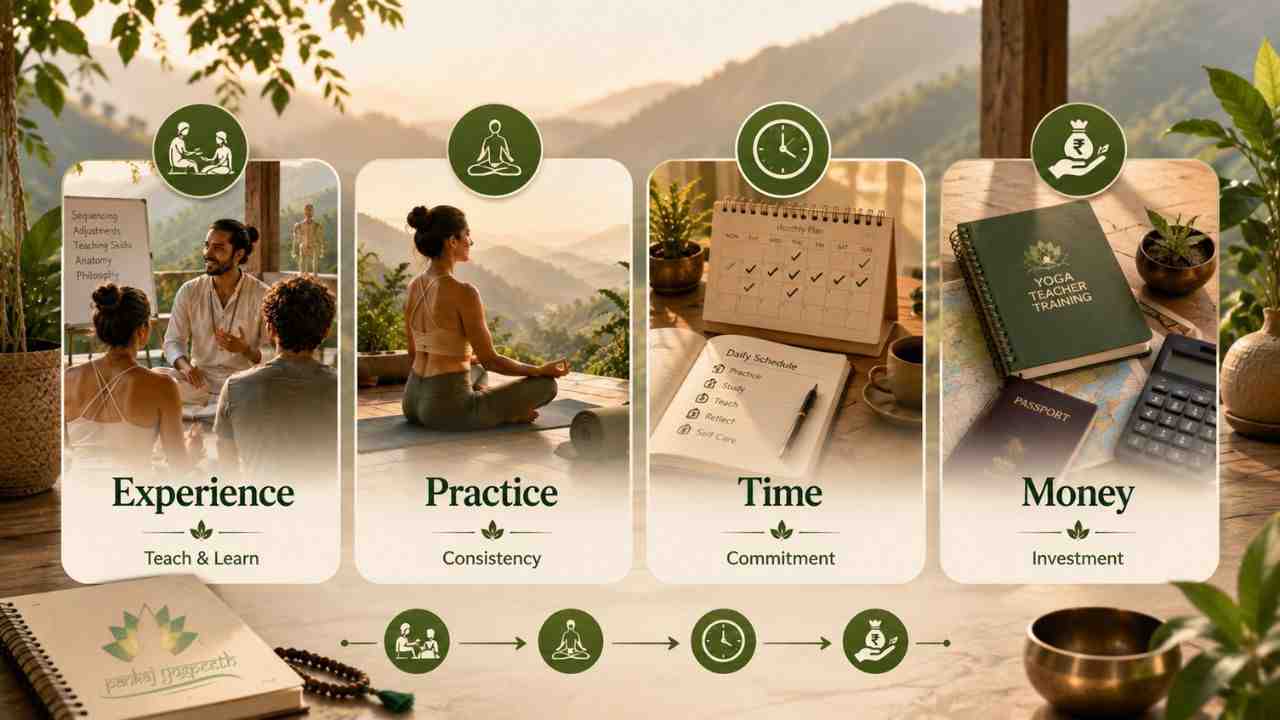
Those signs come down to four pillars, and each requires an honest evaluation.
- Teaching background: You don’t need it to join, but it makes all the difference to be in. Real classes make advanced stuff stick, not just float past. So, if you are wondering, should I have teaching experience before a 300-hour YTTC? For most individuals, even a little helps.
- Your own practice (and injuries): Good news: this isn’t about mastering advanced positions. It’s about teaching craft. With frequent practice and acceptable fitness, plenty can be accomplished, and injuries can be worked around nearly always.
- Time and life timing: Courses are available in intensive, month-long formats or in a spread-out format. Whatever it is, don’t throw it away in a busy season; give yourself the space to really enjoy it.
- Cash: Fee plus budget for travel, accommodation & visas if you go overseas. It is a one-time expenditure, and in many countries, this ongoing yoga instruction is a tax-deductible business expense (check your local guidelines).
Once you get these 4 pillars aligned, there is only one practical box left: the formal requirements.
What Are the Requirements for a 300-Hour YTTC?
The good news: the requirements for a 300-hour YTTC are quite simple. There’s simply one big box to tick, really, before you register.
Do You Need Yoga Alliance Certification First?
The short answer: You need to do 200 hours of training (an RYT-200 or similar) before you can take a 300-hour course. That is the only strict condition of that foundation. And no, you don’t have to stay with the same school. You can complete your 200 and 300-hour courses at different institutes.
Be sure your Yoga Alliance 300-hour teacher training program is from an accredited school so your credential is valid. One honest detail to know: a 300-hour course will open up the educational pathway to the RYT-500 title, but Yoga Alliance will generally additionally ask that you log a certain number of teaching hours (historically about 100 hours after you graduate from your 200-hour course) on their platform to claim RYT-500 officially.
| Requirement |
Detail |
| Prior training |
Completed 200-hour YTT (RYT-200 or equivalent) |
| Same school |
Not required, different schools are fine |
| School status |
Must be Yoga Alliance registered |
| Teaching hours |
100 post-200h hours to claim RYT-500 (verify) |
| Fitness/practice |
Regular practice and reasonable fitness |
The rules are subject to change, so always check the current criteria on the Yoga Alliance site. So the requirements are met, but is the investment actually worth it?
Is a 300-Hour YTTC Worth It After a 200-Hour YTT?
It's a good question. Real-time and money. Is it worth it to do a 300-hour yoga teacher training? Yes, for most serious teachers, but it helps to know what you are getting.
What Skills Does a 300-Hour YTTC Actually Improve?

This is where the true value exists. The primary benefits of a 300-hour yoga teacher training are really all about depth, in a few key areas:
- Advanced sequencing - planning intentional, purpose-driven classes.
- Hands-on tweaking - leading pupils securely and confidently.
- Functional anatomy - how the body functions in each stance.
- Deeper philosophy - the books and thinking behind the practice.
- Subtle energy - Chakras, nadis and pranayama.
- Yogic psychology - working with the mind, not only the body.
The result? You teach with more confidence, more safety and a voice that is uniquely yours.
What a 300-Hour YTTC Won't Do (Set Expectations)
Here is an honest word, because it avoids disappointments. 300-hour course sharpens your teaching, not your business. It won't teach you marketing, getting clients or running a studio. The RYT-500 badge is a nice plus, but the fundamental gift is a deeper teaching voice and safe corrections, not business admin. Learn those different abilities somewhere else.
Career Growth, Niches, and RYT-500
But the professional upside is there. An advanced yoga certification gives studios and students legitimacy. It also allows you to carve yourself a specialisation you enjoy, Yin, yoga therapy, prenatal care, so you can stand out, not blend in. That emphasis makes a big difference for long-term yoga teacher job development. The last thing to do is choose the right route if it's worth it to you.
How to Choose the Right 300-Hour YTTC
Once you have decided to proceed, the final stage is choosing the right course. They are not all equal. A little research here goes a long way toward improving the overall experience.
Style, Format (Residential vs Online), and Location
Begin with what you want to teach. If you have a passion for Vinyasa, Hatha, or Yin, find a course structured around that style and yoga teaching philosophy. Then think format. You can do a residential course and immerse yourself, or study online and fit it around your lifestyle.
And don't forget where you're training. The 200-hour to 300-hour yoga teacher training is the appropriate time to go deeper, and there is no better place to do so than in Rishikesh, the home of yoga. Away from the distractions of the ordinary, surrounded by real culture and quiet, you receive the unbroken mental space that advanced philosophy actually requires.

Checking Yoga Alliance Registration, Syllabus, and Reviews
Do your homework before you commit:
- Download the curriculum to see if it covers what you want to study.
- Read real reviews from past students, not testimonials.
- Look at the faculty and class size; smaller groups imply more attention to you.
- Check your Yoga Alliance registration to ensure your certificate is recognised.
- A school that is open and easy to deal with usually treats its students well in the future as well.
Now that we know the how, here are the fast answers teachers are still looking for.
So, When Is the Right Time for You?
We keep coming back to this truth: there is no one best time to start a 300-hour YTTC after a 200-hour YTT. There is only one right time, and that is when your life, funds, teaching experience, and steady practice all come together.For some, it's immediate. For some, it’s a year or two down the road. Both are valid, perfectly valid.So be honest with yourself and go through the four-pillar checklist. If the signals are mostly yes, then you are ready.
Because the following step is not just another certification, it’s where teaching becomes mastery and yoga turns inward again. Trust your training, and the time will come.
If the signals are yes, come and see what's possible. 300-hour yoga teacher training in India and Nepal, with personal mentorship and in-depth philosophy and anatomy, recognised by the Yoga Alliance through Pankaj Yogpeeth. Wherever your journey takes you, there is a place for you here.