Why Is Yoga Teacher Training Vietnam Becoming One of Top Destination for Yoga Education?
Vietnam has quietly become one of the most talked-about countries in Asia for yoga teacher training. From rural learning centres in rice fields to beachside shalas on the coast to peaceful schools up in the misty hills, the nation offers a setting for almost any kind of learner. The right yoga teacher training in Vietnam may give you a strong skill base, genuine teaching practice, and a certification recognised worldwide.
This is the guide to all that, in simple English. Why Vietnam is the place to be, where you can train, the styles you can learn, levels of courses, what it all truly costs, how to discover a good school, and the ideal time of year to go. It's from experienced yoga teachers to help you decide. By the end, you'll know if Vietnam meets your goals and how it stands up against India.
What's Fueling Vietnam's Rise as a Yoga Training Hub?
A few years ago, very few people had Vietnam on their list of destinations for yoga teacher training. That's a swift change. Word has spread among travelling yogis, tiny schools have started up along the coast and in the mountainous regions, and now Vietnam is holding its own alongside the big names. Here's what really explains that shift.
What Makes Vietnam a Standout Place to Train?
The biggest attraction is the feel of the schools themselves. Most yoga teacher training in Vietnam is in small groups, located mainly along the beaches of the south and the colder highlands inland. That means more personal attention and a slower pace than you'd get in a crowded course elsewhere.
It's easier on your budget too. A yoga retreat in Vietnam, or a full training, is generally noticeably more affordable than the same thing in Bali, and the country's fresh food and blossoming wellness culture make the whole experience soothing. Getting in is just as easy, with a short e-visa for most travellers. Honestly, this is a newer scene. School quality varies more than in well-known centers, so we review the essentials and explain how to do so further down.
How Does Vietnam Compare to India and Bali for YTT?
If you are wondering whether Vietnam is a good place for yoga teacher training, the best way to find out is to compare it with the two major cities, India and Bali.
| Factor |
Vietnam |
India |
Bali |
| Vibe |
Coast + highland calm |
Deepest tradition |
Wellness tourism |
| Cost (200 hr) |
$1,300–$2,800 (₫34M–₫74M) |
$650–$2,800 (₹61,000–₹2,64,000) |
$2,200–$3,500+ (Rp39M–Rp62M+) |
| Tradition depth |
Growing |
Deepest |
Mixed |
| Best for |
Quiet, affordable reset |
Maximum depth |
Comfort + community |
So Vietnam sounds like your kind of place. Every place has its own vibe. And the right one matters.
Where Should You Train? Vietnam's Best Yoga Regions
There is no comparison between a morning on the beach and a morning up on the hills. So where you train really changes your experience. Here are the three regions most people choose, and what each one is actually like.
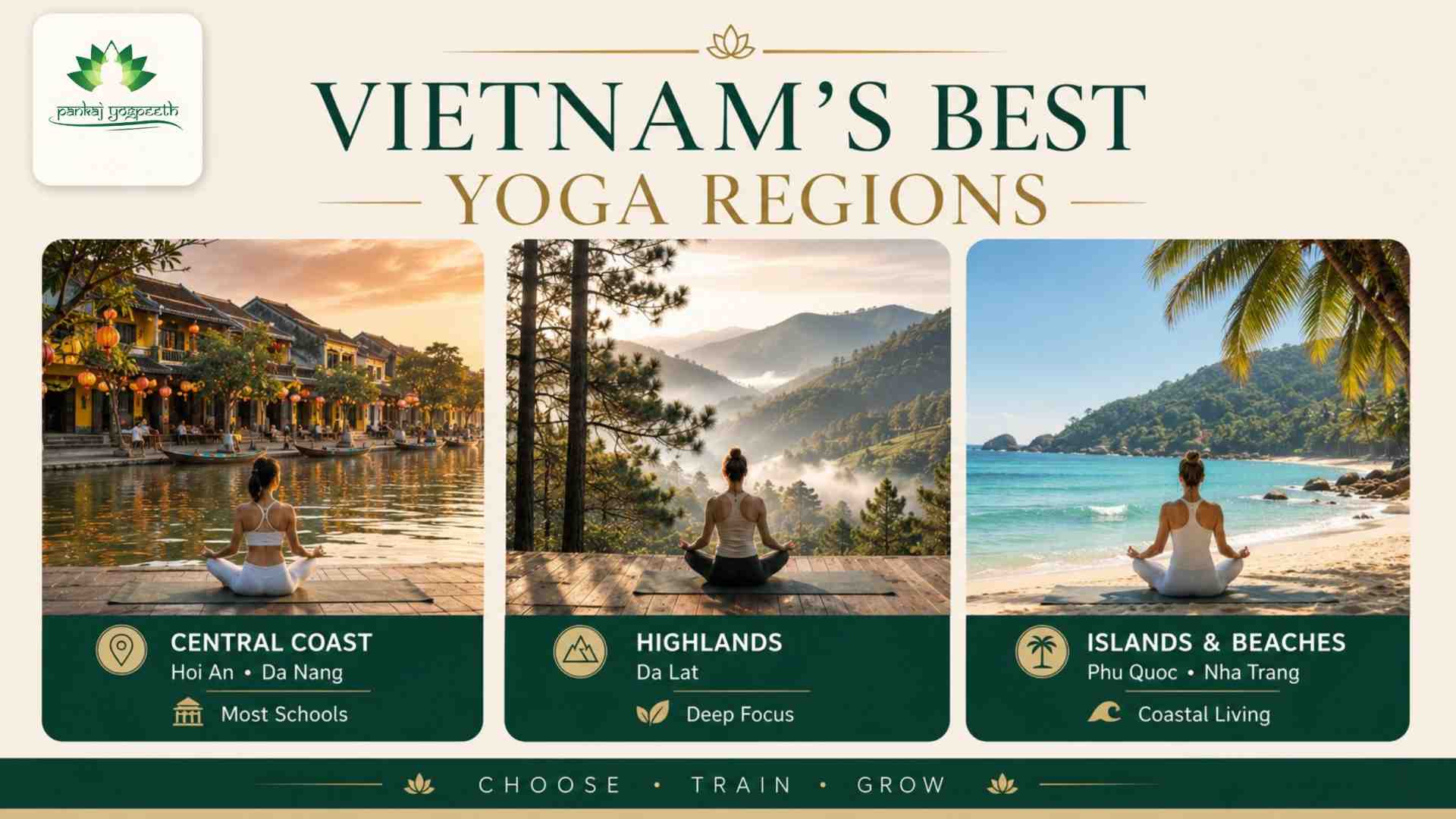
Central Coast - Hoi An and Da Nang
That’s the crux of it. Most of the schools are here. If you want the widest choice, start your search on the Central Coast. Yoga instructor training Hoi An programs place you in a lovely UNESCO World Heritage old town full of lantern-lit streets; yoga teacher training in Da Nang options are more seaside and modern. The nicest part is how accessible they are – both are approximately 40 minutes from Da Nang airport (DAD).
Highlands - Da Lat and the Cooler Interior
If beaches aren’t your thing, head inland. Da Lat is up in the hills, surrounded by pine forests and beautiful, crisp air. It’s tranquil, quiet, and easy to concentrate in, which is why Da Lat highlands yoga teacher training courses are popular among people who seek fewer interruptions. Another advantage: the moderate climate makes it a comfortable option year-round.
Islands and Beaches - Phu Quoc and Nha Trang
Looking for sun, sea and a slower pace, the islands and southern beaches are perfect for it. Phu Quoc and Nha Trang are laid-back and bright, ideal if you see your training as a proper coastal immersion with the sea just a few steps away.
| Region |
Best For |
Nearest Airport |
| Hoi An / Da Nang |
Beach + most schools |
Da Nang (DAD) |
| Da Lat (highlands) |
Cool, quiet deep focus |
Lien Khuong (DLI) |
| Phu Quoc |
Island beach immersion |
Phu Quoc (PQC) |
| Nha Trang |
Sunny coastal vibe |
Cam Ranh (CXR) |
Which Yoga Styles Can You Study in Vietnam?
The best part about training here is that you don't have to choose one style. Most courses offer you an example of a few.
Vinyasa and Hatha-The Everyday Choices
The majority of 200-hour courses in Vietnam are multi-style, combining several methods in a single curriculum. The two you'll practice the most are Vinyasa and Hatha. A Vinyasa yoga teacher training course in Vietnam is the flowing, moving type, where breath and movement are linked. Hatha is slower and more grounded, so you hold poses longer and actually feel them. A Hatha yoga teacher training in Vietnam offers new teachers a fantastic mix of challenging and calm and the flexibility to teach all kinds of students.
Yin, Nidra and Multi-Style Options
Most schools also offer a few relaxing options beyond the basics. Yin yoga teacher training sessions in Vietnam involve long, soft holds that stretch deep into the body. Yoga Nidra is a guided practice that you do lying down, and it's extremely calming. If you're more traditional, you can find Ashtanga at some schools, which is a structured sequence with a steady, classic beat. A multi-style yoga teacher training in Vietnam really lets you find what feels right with this much variation. The best part about training here is that you don't have to choose one style. Most courses offer you an example of a few.
100, 200, 300 or 500 Hours - Picking Your Level
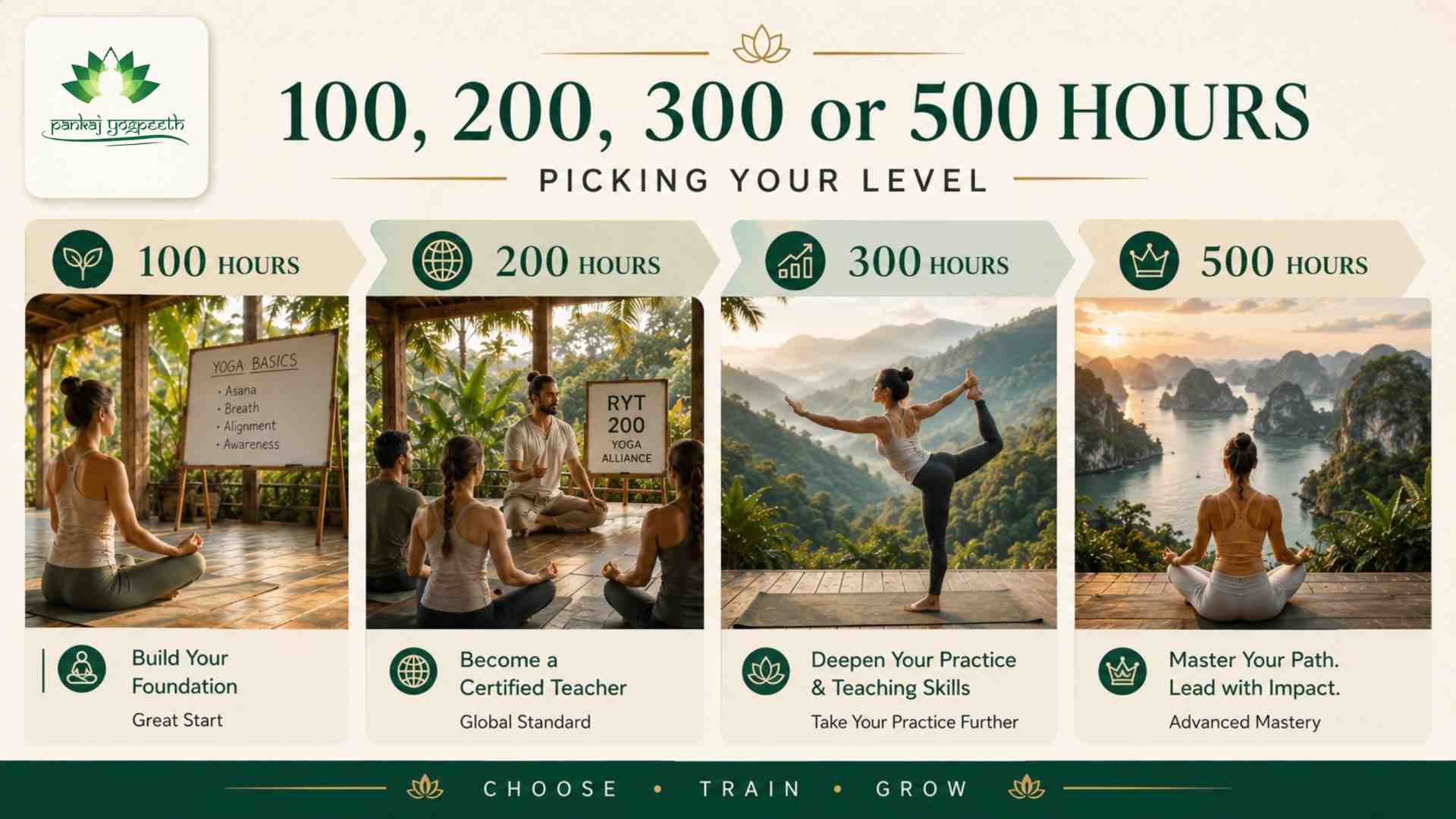
The length of yoga courses varies, and the number of hours you do will decide how deep you go. It’s basically a question of where you are now and what you want next to choose the proper one. Here’s a simple way to figure it out.
Is a 100-Hour Course Enough to Begin?
A 100-hour course is a terrific start, but generally speaking, it won’t be enough to qualify you to teach by itself. It helps develop your personal practice and provides you with a feel for the foundations, which is excellent if you’re not quite ready to commit to a full program yet.
Why the 200-Hour Is the Global Standard
This is the one that most people go for, and for good reason. A 200-hour yoga teacher training course in Vietnam is the starting step to becoming an international teacher. Complete it, and you can register as a RYT 200 Vietnam graduate and start teaching classes practically anywhere. If you are asking yourself which yoga teacher training course to take, the 200-hour is nearly always the answer.
When to Step Up to 300 or 500 Hours
Teach for a while, and you might want more. A 300-hour yoga teacher training course in Vietnam builds upon your 200-hour base, taking your talents to the next level. Add the two together, and you have the 500-hour level, the mark of a fully advanced teacher.
| Course |
Best For |
What You Get |
| 100-hour |
Deepening your own practice Foundation |
not full certification |
| 200-hour |
New teachers starting out |
RYT-200, teach worldwide |
| 300-hour |
Experienced teachers growing further |
Advanced training (builds on 200) |
| 500-hour |
Fully advanced teachers |
RYT-500 (200 + 300 combined) |
Price, after all, is only one factor of the formula. The school is the real deal too, which is just as vital, so here’s how to check before you book.
How to Tell a Genuine Yoga School from a Weak One
Not all the schools are the same; the Vietnam yoga scene is constantly changing. Do a bit of research up front to save yourself a lot of trouble later. This is how you can tell the real from the group.
Why You Must Verify Yoga Alliance Yourself
Many schools have a Yoga Alliance logo on their website, but a logo means nothing. Anyone can make one. The only way to be sure is to check the official Yoga Alliance directory yourself and see whether the school is listed by name. If you’re wondering if a yoga teacher training in Vietnam is Yoga Alliance certified, that directory provides the solution. A real, certified yoga teacher training school in Vietnam will always be there.
Red Flags That Should Make You Pause
A couple of things are worth a closer look. If a school only ever posts absolutely perfect five-star reviews, the whole picture may not be on display. Another reason to slow down is unclear teacher biographies that lack true history or certifications. And if there is no clear refund or cancellation policy elsewhere, it would be good to sort that out before you give over any money. Here are seven easy things worth checking out before signing up for a Yoga Alliance-certified yoga teacher training in Vietnam:
- Official Yoga Alliance Directory
- Lead teacher’s training hours
- Independent reviews (Google, BookYogaRetreats)
- A style that fits your purpose
- Small class sizes
- What is included in the pricing
- A clear rescheduling and refund policy
After you have selected a school you can trust, the next thing to work out is your budget. So what is training in Vietnam actually costing?
How Much Does Yoga Teacher Training in Vietnam Cost?
The good news: Vietnam is one of the affordable places to do your training. You get a great deal because one price covers almost everything you need.
What's Usually Included in the Price
Most courses pay for everything in one price, so it is very easy. Generally, the cost of your yoga teacher training in Vietnam includes your lodging (sharing or private room) and daily meals (typically vegetarian). As part of the agreement, you get your training, all the course materials and your certificate. Some schools even provide extras like a day trip or a spa treatment.
Hidden Costs to Budget For
A few things often fall beyond the primary charge, so it’s good to budget for them. Airport transfers often cost extra, and you will need to budget for flights, travel insurance and visa or e-visa fee. Save some for optional tours, extra nights and deposits (usually non-refundable). However, when you factor these in, an affordable yoga teacher training in Vietnam still comes out cheaper than most competing places.
| Course |
Typical Price (USD) |
In VND (est.) |
Room & Meals |
| 100 Hour |
$800–$1,400 |
~21–37M VND |
Usually included |
| 200 Hour |
$1,300–$2,800 |
~34–74M VND |
Usually included |
| 300 Hour |
$1,900–$3,400 |
~50–89M VND |
Usually included |
Once you’ve decided on your budget, the remaining things to plan are the easiest: when to travel and how to get there.
When to Go and Getting to Your School
A bit of time and trip planning can go a long way. Choose your season carefully, book your transit early, and the rest will fall into place. So here's the whole thing. 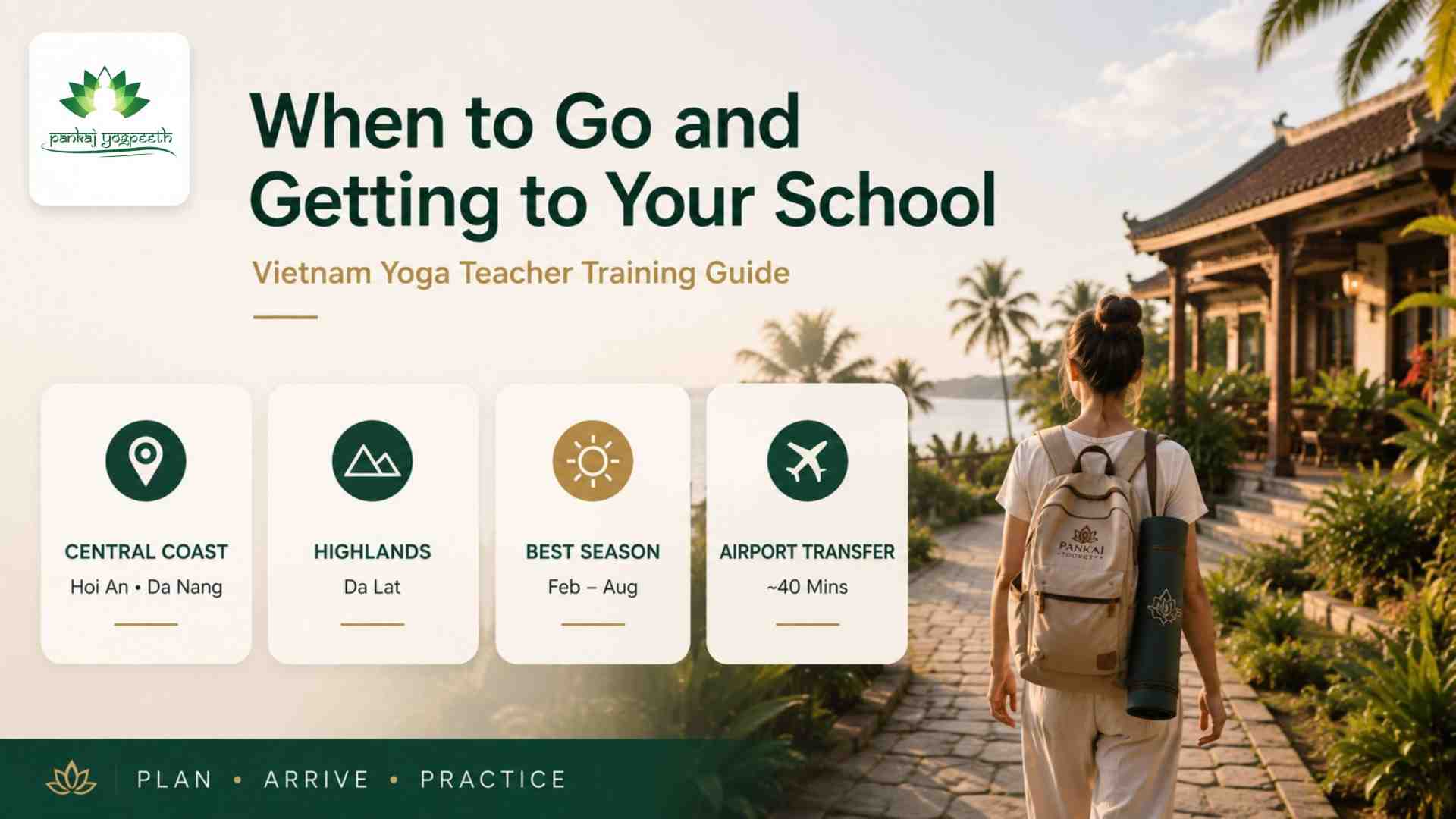
Best Months by Region
The most suitable time for yoga teacher training in Vietnam depends on your destination. The central coast near Hoi An and Da Nang is a good time to visit from February to August, as the weather is mild and dry. The highlands, if you choose them, are lucky for you; the cooler environment there is suitable year-round.
One tip: the best time to do yoga teacher training in Vietnam is also the busiest, so book three to six months in advance if you want a spot during peak months.
From the Airport to Your School
Getting there is easier than you think. Most travellers arrive by air into Da Nang (DAD), Ho Chi Minh City (SGN) or Hanoi (HAN), depending on their region. From there, the easiest option is a pickup arranged by your school, which most of them offer for a little cost. If you are asking how to get to Hoi An from Da Nang airport, it's about a 40-minute drive. The Da Nang airport to Hoi An transfer route is one that schools are familiar with.
A Few Things to Sort Out Before You Enroll
Two questions keep coming up before you book. Let’s get both of those sorted so you can sign up with confidence.
Can Complete Beginners Join a 200-Hour Course?
Yes, that shocks a lot of people. Most 200-hour courses are open to beginners; thus, a starting yoga teacher training in Vietnam is a perfectly reasonable place to start. You don’t have to touch your toes or do a headstand on the first day. What matters much more is your commitment to learning. A little practice at home ahead of time to get you settled, but it’s really not essential.
Visas and Safety for International Students
Most students come on an e-visa, but conditions are changing, so check the current visa requirements for yoga teacher training in Vietnam for your country before booking. Safety: Vietnam is a highly safe country and popular with single and female tourists, so take the usual precautions you would in any country. And one more thing: have both paper and digital copies of your bookings and visa documents.
Vietnam definitely feels like an actual competitor now. However, it's nice to know how it compares to where yoga first began so that you can make an informed decision.
Prefer to Train at the Source? Consider India or Nepal

Going to Vietnam to train is a great idea, and for many people, it's the perfect fit. Still, it's important to remember where yoga came from: the land where yoga began. Teacher training programs that put you right at the source, often with more tradition and, most of the time, at an affordable cost. Nepal, which is just across the border, offers a similar authentic and affordable experience. For students who want the same feel, a yoga teacher-training school in Nepal is a great second choice.
Training with Pankaj Yogpeeth in Rishikesh, Kerala or Pokhara
It totally depends on what kind of experience you want. If you are looking for the feel of a seaside or island getaway with modern comforts, Vietnam is a good option. If you want to explore the spiritual side at the heart of yoga history, check out programs like Pankaj Yogpeeth. They have real yoga teacher training options in Rishikesh and Kerala, India, as well. It is complete course for 100-200-300 hours yoga teacher training courses in Pokhara, Nepal, right across the border.
The most important thing is what you want to get out of your training, not where you end up. From there, the choice gets far easier once you know it. Find a school that fits your needs, your budget, and makes you feel good every time you talk to them.Vietnam is a great place to reset your budget on the beach, with sun, peace, and a slow pace. They are also great places to visit if you want to learn more about the roots of yoga. In either case, go with what feels right and have fun.