Yoga Teacher Training in Cambodia: A Complete Guide for Beginners
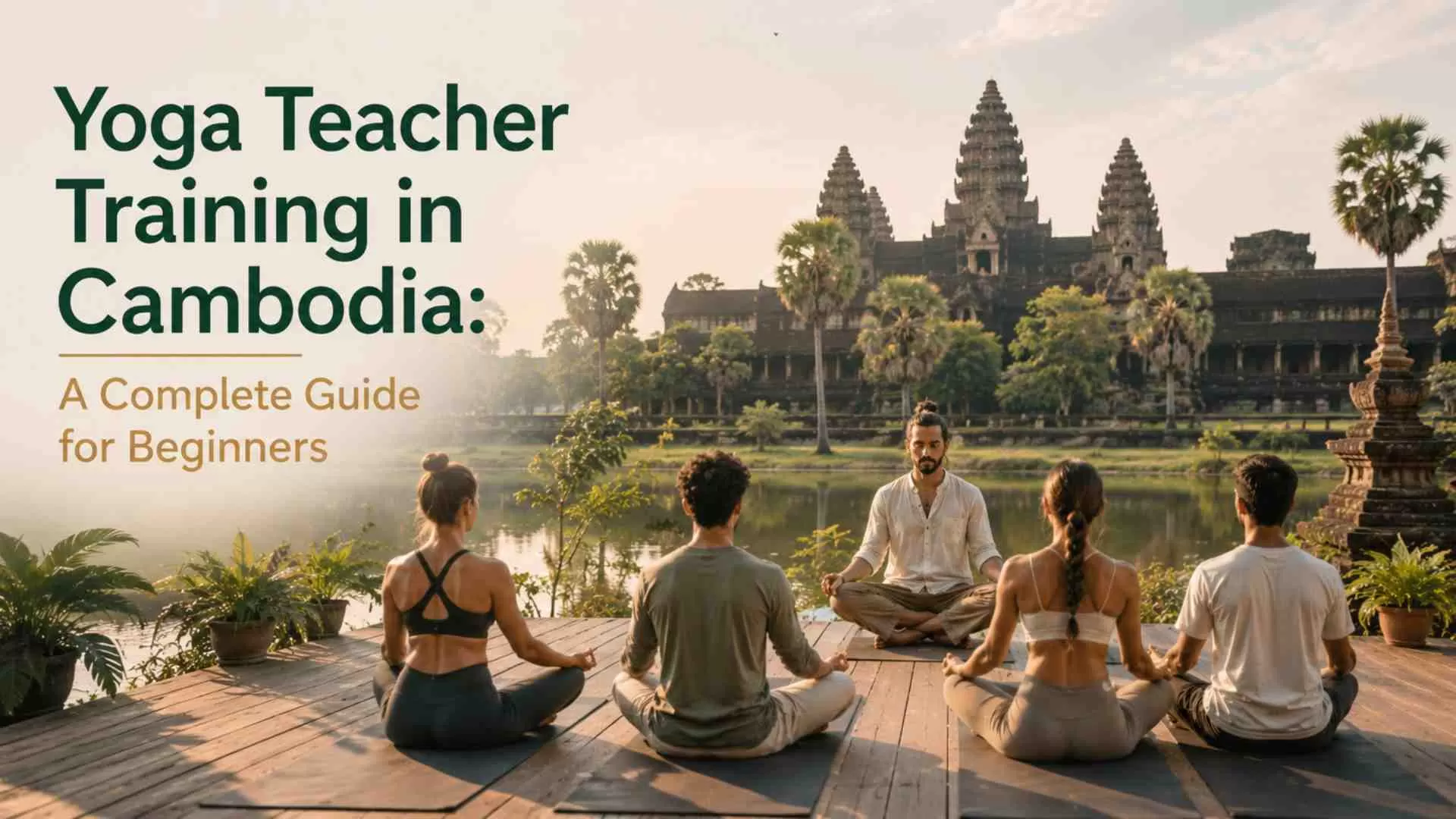
Cambodia has quietly become one of the most affordable destinations for yoga teacher training in Southeast Asia. You get temple-town surrounds near Angkor, riverfront studios and laid-back resort settings – usually for less than you'd pay in Bali or Thailand. This is what you need to know before you book. Where to train, what genres you can learn, how the 100 to 500 hour course levels compare, and what it all really costs.
We also talk about the ideal time of year to attend, the easy processes to get your visa and how to choose a good school from a bad one.It's written and fact-checked by a qualified RYT-500 teacher, so it's practical advice, not a sales pitch. At the end, you will know if Cambodia is what you desire – and how it compares to training in India.
Why Cambodia Is Becoming a Quiet Favorite for Yoga Training
Cambodia is slowly making its way onto the Southeast Asian yoga training map. A few years ago, a yoga resort in Cambodia was a rare find. Now tiny, targeted institutions are making a name for themselves, minus the crowds and noise.
What Draws New Teachers to Cambodia's Mat
The pull is fundamental. Siem Reap’s growing wellness sector offers small-group classes, the Angkor temples as a backdrop and a slower daily rhythm that gives you the chance to learn genuinely. The tourist visa is much easier to sort out and cheaper than those for Bali or Thailand. If you’ve ever wondered if Cambodia is a suitable place to learn as a yoga teacher, the honest answer is yes, with one exception. The scene is new and small; therefore, quality varies from school to school. Proper vetting is the most important stage, and we go over how to achieve it below.
How Cambodia Stacks Up Against Thailand and Bali
Here’s a brief comparison of yoga teacher training in Cambodia, Thailand, and Bali.
| Factor |
Cambodia |
Thailand |
Bali |
| Vibe |
Temple calm + coast |
Established island scene |
Wellness tourism |
| Cost (200 hr) |
$1,200–$2,600 USD (≈ ៛4.9M–10.5M riel) |
$1,800–$3,200 USD (≈ ฿59,000–105,000 baht) |
$2,200–$3,500+ USD (≈ Rp39.3M–62.5M rupiah) |
| Scene maturity |
Emerging |
Well developed |
Saturated |
| Best for |
Quiet, low-cost first training |
Variety + infrastructure |
Comfort + community |
Once you decide on Cambodia, the next question is quickly answered because the country makes it easy for you to decide.
The Best Places to Train Across Cambodia
Now, here is the time-saver part. If you're considering doing your yoga teacher training in Cambodia, there's essentially only one address: Siem Reap. Almost all the registered yoga schools in the country are based here, so your search becomes simple and fast. The other places on the map are worth your while, too, only for a rest, not study.
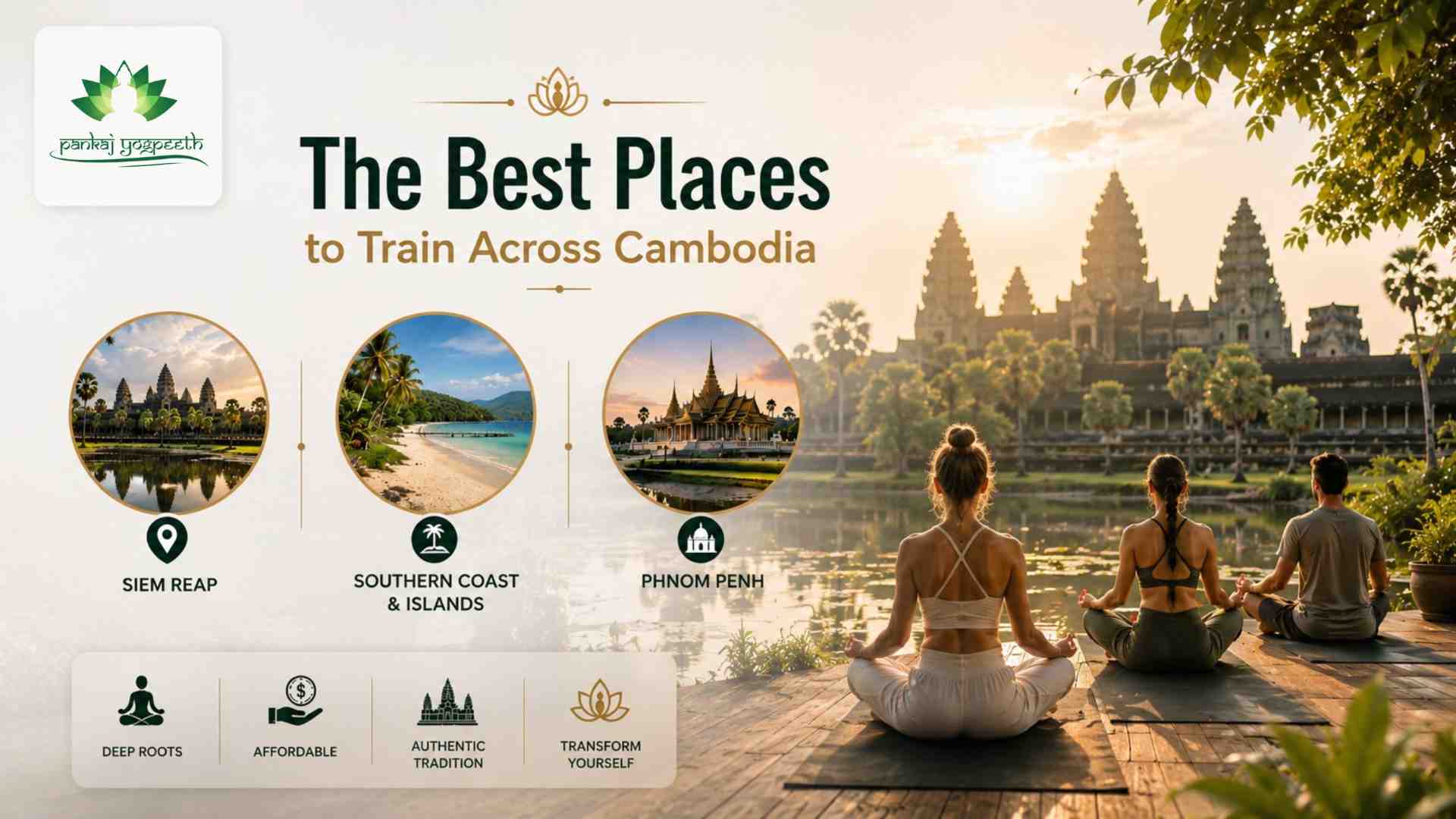
Siem Reap - Cambodia's Yoga Training Heart
Siem Reap is the obvious home for your training when you sign up for a 200-hour, 300-hour or complete 500-hour course. Almost every Yoga Alliance school in the country sits here. There are riverside cafes, peaceful resort courses, many vegetarian eating restaurants, and a sunrise practice near Angkor Wat, just five minutes away. Fly to Siem Reap - Angkor International Airport (SAI), 45km from town, or 60 to 75 minutes by driving.
The Southern Coast and Islands - Better as a Retreat Add-On
Riverside peace and famous pepper fields can be found in Kampot and Kep, and good beaches are offered by Koh Rong and Otres, as well. They are perfect for a pre- or post-course wind-down. Schools are not here. Treat them like a reward, not a training base.
Phnom Penh -Your Likely Arrival Point
The capital is largely how you get in. There are a few drop-in studios, but most students only pass through on their way to Siem Reap.
| Area |
Role for Your Training |
Nearest Airport |
| Siem Reap |
Main training hub - nearly all RYS schools |
Siem Reap–Angkor (SAI) |
| Phnom Penh |
Arrival gateway + a few drop-in studios |
Techo Intl (KTI) |
| Kampot / Kep |
Pre- or post-course riverside retreat |
Techo Intl (KTI) |
| Koh Rong / Otres |
Beach unwind after your course |
Sihanouk (KOS) |
So you have your base, now what you need to know is what you are actually going to practice when you get on the mat.
Yoga Styles You Can Learn on a Cambodian Course
If you are still finding your feet, the good news is that most courses in Cambodia are multi-style, whether you do a 200-hour, 300-hour, or a 500-hour program. In one course, you get a real skill spread, so you walk away well-rounded rather than boxed into a single approach.
Hatha and Vinyasa: Your Foundation
Hatha yoga teacher training in Cambodia offers the grounded, slow and purposeful postures that teach alignment and breath from the ground up. Then, the vinyasa yoga teacher training in Cambodia puts it all together, connecting those shapes into effortless, breath-led movement. And learning both offers you a true range, and that's exactly what systematic multi-style training is all about.
Softer and More Traditional Styles
Some schools also offer quieter or more traditional styles:
- Yin and restorative: gentle, supported holds to allow the body to open up while the mind calms down.
- Ashtanga: set positions done in the same order every time, with steady discipline for individuals who enjoy tradition.
Knowing the styles is half the picture; the other half is deciding how many hours you are willing to offer them.
Choosing Between 100, 200, 300 and 500-Hour Courses
Once you've got a style in mind, the next choice is how deep you want to go. The hours you put into a course tell you how far it will get you, and choosing the right one saves you money and second-guessing.
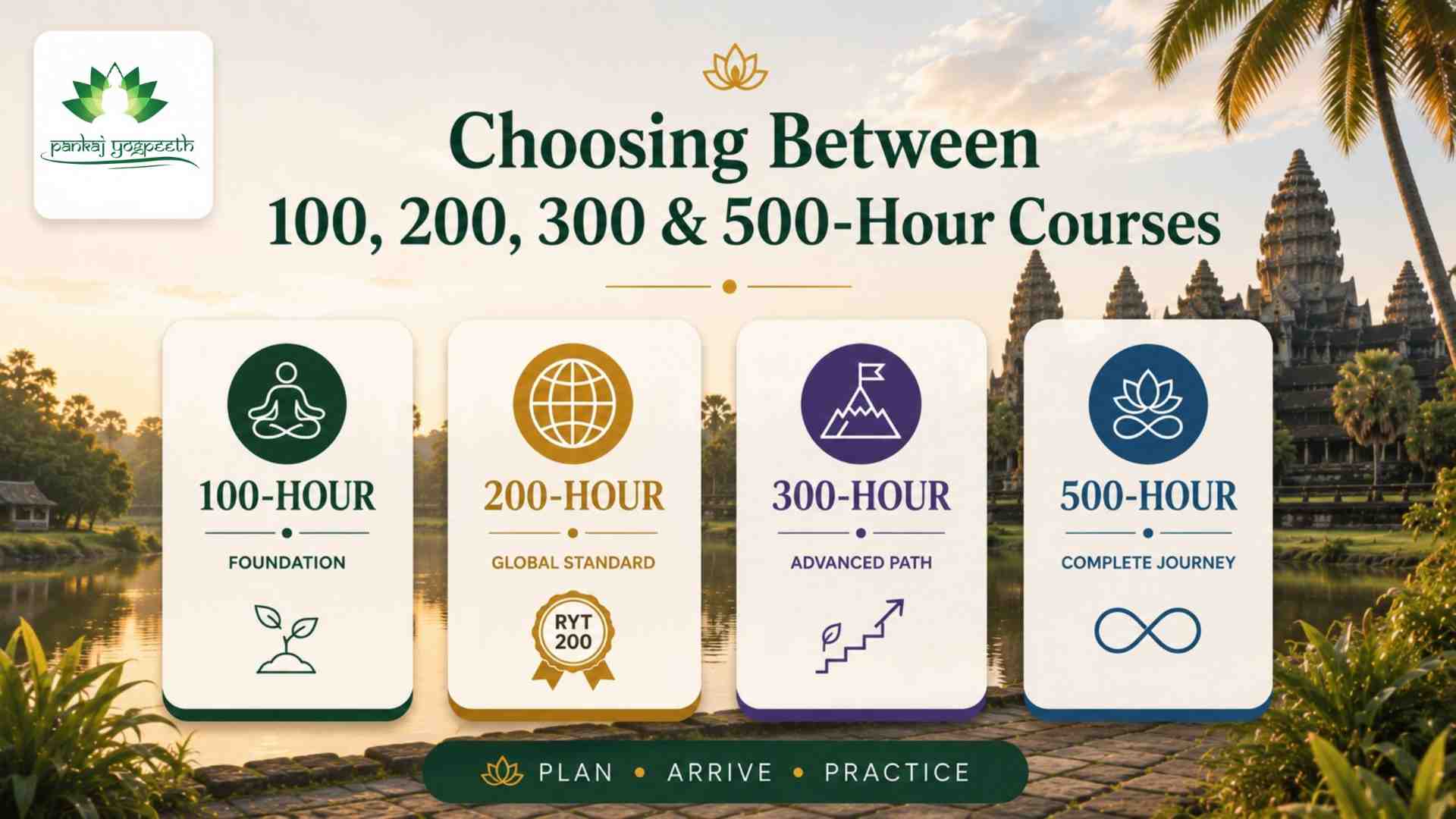
Is a 100-Hour Foundation Course Right to Start With
100 hours is a gentle introduction to the course. Ideal for total beginners who want to try before committing, or for working teachers adding a specialty such as Yin. It will strengthen your own practice, but it does not in itself make you a certified teacher, so see it as a stepping stone, not the finish line.
Why the 200-Hour Is the Worldwide Benchmark
If you want a definite answer, it's 200 hours. This is the global standard, and doing it gets you the RYT-200 certification that studios and schools accept everywhere. For nearly everyone who is questioning which yoga teacher training course to pursue, the 200-hour yoga teacher training in Cambodia is the perfect starting point.
When 300 and 500 Hours Start to Make Sense
A 300-hour yoga teacher training in Cambodia takes you into advanced terrain with your 200. Put the two together, and you get the entire 500-hour level, the deepest certification most teachers ever require.
| Course |
Length |
Best For |
| 100 Hour |
10–14 days |
Beginners / specialty |
| 200 Hour |
~21 days |
Becoming a certified teacher (RYT-200) |
| 300 Hour |
3–4 weeks |
Going advanced (after 200 hr) |
| 500 Hour |
Combined 200+300 |
Full advanced credential |
How to Spot a Trustworthy Yoga School in Cambodia
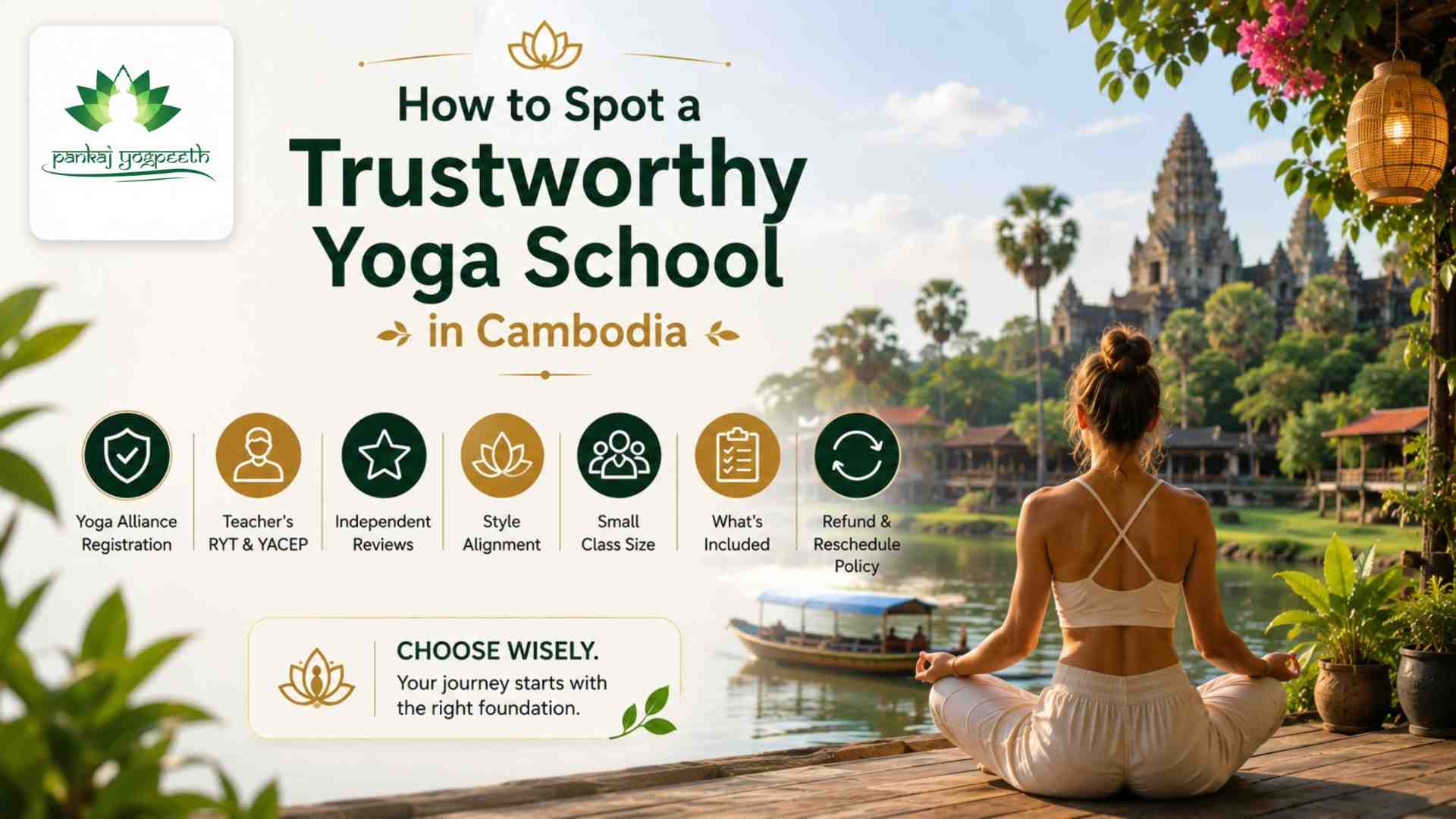
Here's where being careful earlier pays off. There are not many schools actually registered in Cambodia; therefore, it's worth doing a little research on your behalf. The good news is that the checks are quick once you know what to look for.
Why You Should Check Yoga Alliance Registration Yourself
A Yoga Alliance logo on the website isn't proof of anything. Badges can be added to a page by anyone. Cambodia has just a handful of legitimately registered schools, so just one step filters out most of the doubt. The only way to be sure is to look up the school in the official RYS database. Let this database be your guide to certified yoga teacher training in Cambodia, not the marketing.
Warning Signs Worth Slowing Down For
There are a couple of factors that should make you think twice about it. A wall of glowing 5-star reviews can be deceiving; overly general teacher biographies can hide inexperience; and a lack of transparency about refund policies should be taken seriously. Before you book, check these 7 things:
- The school is a Registered Yoga School with the Yoga Alliance.
- Lead teacher's RYT hours status YACEP
- Independent reviews on Google and BookYogaRetreats.com
- That the style you want is in the cards
- Small class size
- Exactly what's included in the fee
- A clear refund and reschedule policy
After choosing a school you can trust, the last thing you should think about is how much it will cost.
What Yoga Teacher Training in Cambodia Costs
A few requirements impact what you pay: how long the course runs, how well-known the school is, whether you take a private or shared accommodation, and the season you book in. Peak months and private rooms cost more, longer courses cost more, and that is most of the story.
| Course |
Typical Price (USD) |
In KHR (est.) |
In INR (est.) |
Room & Meals |
| 100 Hour |
$700–$1,300 |
~2.8M–5.2M ៛ |
~₹66k–₹1.23L |
Usually included |
| 200 Hour |
$1,200–$2,600 |
~4.8M–10.4M ៛ |
~₹1.14L–₹2.46L |
Usually included |
| 300 Hour |
$1,800–$3,200 |
~7.2M–12.8M ៛ |
~₹1.71L–₹3.03L |
Usually included |
What's Included and What's Extra
What the course fee normally covers: your lodging (private or shared), daily meals that are often vegetarian, all your training, course materials, and the diploma at the end, occasionally with an excursion or spa session thrown in.
Extra fees to plan for: your airport transfer (typically paid separately), flights and travel insurance, the visa fee, any optional excursions, extra nights you add on, and non-refundable deposits. It helps to compare all of this against an all-inclusive pricing comparison before you commit.
The money side is handled; it's only the practical lead-up to the trip itself.
Timing Your Trip and Reaching Your School
The school and budget are settled, the last two practical details are when to go and how to get to your door without any trouble. Once you know the rhythm of the seasons and the one form you need before you fly, both are easy.
The Best Months to Train by Region
Cambodia has two seasons, and either can work for you. The comfortable, easy window across the whole pleasant, comfortable window across the whole country with warm days and clear skies that make early practice a pleasure. May to October is the wet season, and it is greener, calmer and less expensive. The rain is generally in small showers rather than all day. If you’re dead set on a peak-season appointment, book three to six months ahead of time because the best schools fill up rapidly.
Getting From the Airport to Your Course
Most students will fly into Siem Reap (SAI), although it is possible to fly into Phnom Penh (KTI) or Sihanoukville (KOS). The good news is that most schools organise a paid pickup, so you will not be left wondering at the airport with your bags. Before you fly, one item to sort out is the free e-Arrival Card. This is compulsory for all plane arrivals, and you do it online within 7 days of arrival, then save the QR code for immigration.
With your trip dates and arrival planned out, the last things to set your mind at ease are the laws at the border and the questions every newcomer asks.
Visas, Safety and What Beginners Should Know
Before you arrange your journey, you normally have two worries: whether you are ready for this, and whether the paperwork and travel side will be a headache. They both have easy answers, so let's get those out of the way so you can prepare with a clear head.
Can a Complete Beginner Enroll in a 200-Hour Course
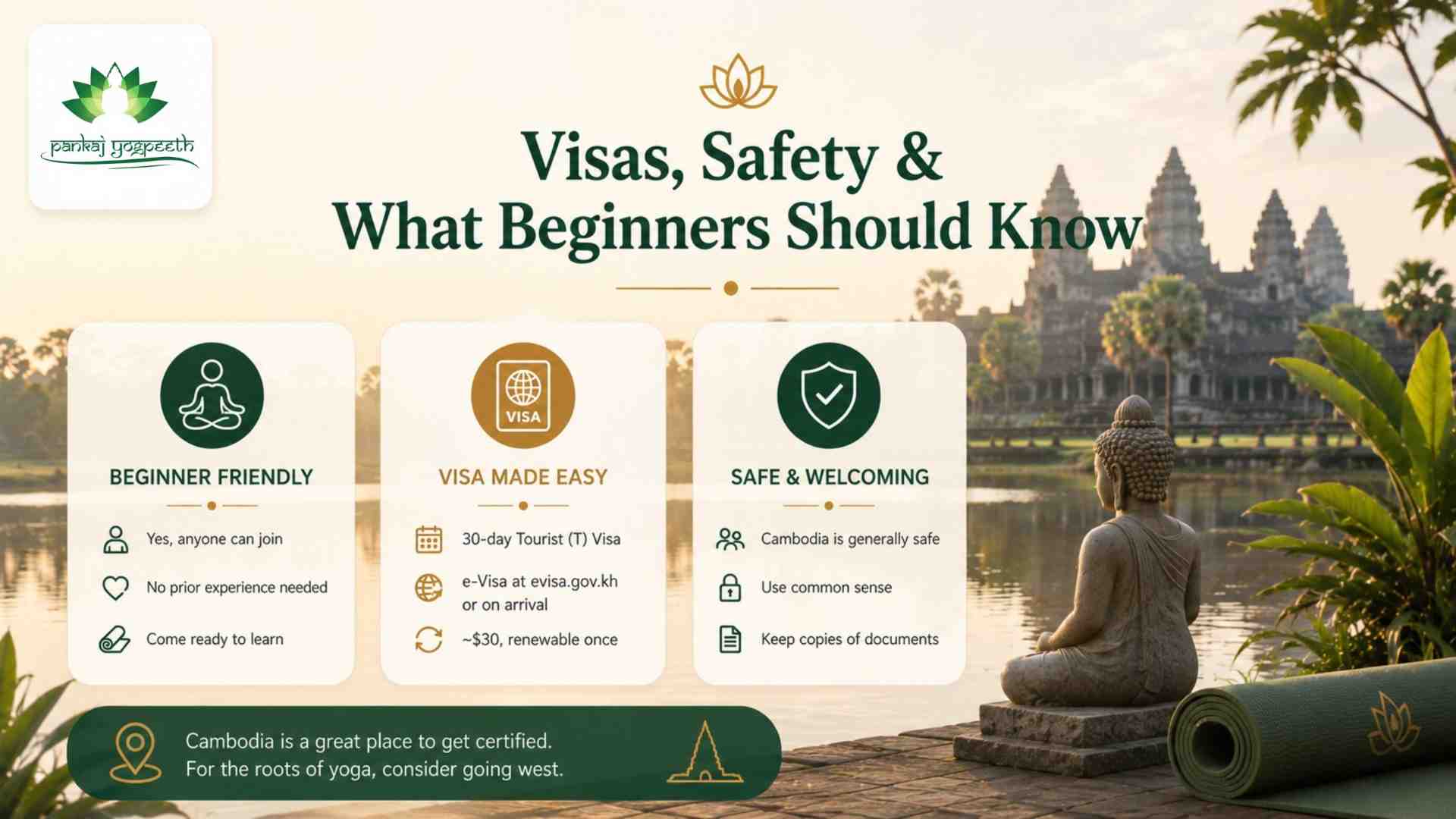
Yes, and here is where most nervous first-timers find assurance. Most 200-hour courses are meant to be accessible to beginners, so you don't have to touch your toes or hold a headstand on day one. More important is that you come willing to learn. Some home practice in the weeks before you fly will help you settle in faster, but it is pleasant rather than necessary.
Visa Rules and Staying Safe as an International Student
Most students arrive on a class T, tourist visa, for 30 days. You can get it online as an E-Visa at evisa.gov.kh, or on arrival, it is about $30, and you can renew it once for another 30 days. Cambodia is generally safe and a firm choice for solo and female travellers. Use the same common sense you would anywhere else, and save printed and digital copies of your bookings and passport papers.
Cambodia is a nice spot to get your certificate, but if you are drawn to the roots of the discipline itself, it is worth going a little further west.
Want to Train Where Yoga Began? Look to India and Nepal
Cambodia is a beautiful place to train, but it's worth remembering where it all started. India and its neighbour Nepal are the birthplaces of yoga, and that head start shows. You get more tradition, more heritage and very often a lower cost than South East Asia. That's why so many serious students still prefer to learn at the source, not near it.
Training With Pankaj Yogpeeth in Rishikesh, Kerala or Pokhara
It depends on what type of trip you like. If you are looking for a temple-town or island vacation with modern comforts, Cambodia is a good bet. If you want to dig deeper into the historical foundations of yoga, check out programs like Pankaj Yogpeeth in Rishikesh, Kerala, or Pokhara.
Strip away the details, and what you are left with underneath is: What you really want from your training. That's your response. Pick the school that suits your needs, that you can afford, and that feels real when you chat with them. Choose an easy option with a reset amongst temples and the sea in Cambodia, or dive deep into the roots this practice offers in India and Nepal. Either way, the mat is there. Jump, and you will know that the right place will meet you there.
FAQ (Frequently Asked Questions):
Helpful Resources
Course: Hatha Yoga Training in Kerala
Our Blog: The Power of Pingala Nadi
Our Blog: Benefits of Surya Namaskar