
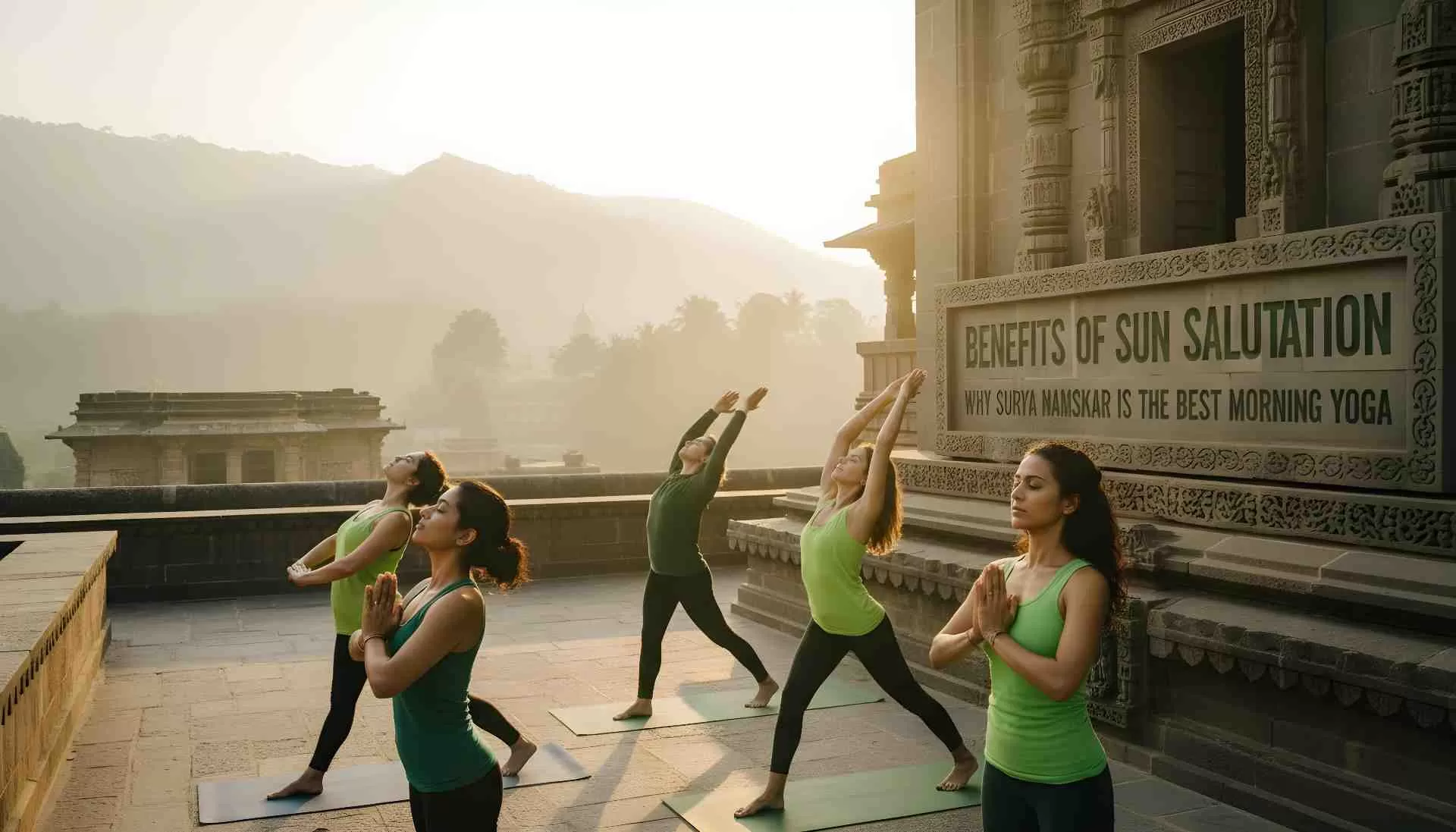
You wake up, your back is tight, your mind is already running away with thoughts of the day ahead, and somewhere in the background, there's a little voice telling you, "you should probably stretch." This is when Surya Namaskar comes in.
It's one of the oldest yoga sequences in the world, and quite likely the fastest method to move your complete body, breathe deeply and clear your thoughts, all in under 15 minutes. No fancy equipment or flexibility needed. Just a little free space and a few minutes. All you need to know about Sun Salutation, meaning, history, the 12 poses, benefits and how to do it.
What is Surya Namaskar (Sun Salutation)?
Surya Namaskar, or Sun Salutation, is a order of 12 yoga poses performed in a Rhythmic flow, generally around sunrise, to honour the Sun and refuel the body.The name comes from the Sanskrit origin:
- Surya = the Sun
- Namaskar = to bow with respect
Surya Namaskar means all together “a respectful greeting to the Sun”. Each round combines movement, breath and purpose, making it one of the most complete practices in yoga. It’s not simply exercise. It’s half stretch, part breath practice, part meditation, all in one continuous flow.
Why It’s Called the Complete Morning Yoga Practice
Many yoga gurus say that Surya Namaskar is the best morning yoga routine since it works on every region of the body in a short amount of time. The 12 strong Surya Namaskar positions stretch, strengthen, and tone all of the body’s major muscular groups. The breathing rhythm also helps get more oxygen to the brain and body.
A simple Surya Namaskar daily routine done every day can aid with digestion, flexibility, hormone balance, and even weight loss. Surya Namaskar is more than just a workout. It’s a movement meditation that lowers stress, improves focus, and gives you good energy for the day ahead. That’s why people often call it the best daily yoga routine for total health and well-being.
History and Significance of Surya Namaskar
Surya Namaskar has its origins in thousands of years of history, in the Vedic period of India, when sages and scholars would greet the rising sun as part of a daily ritual of appreciation. To them, the sun was not merely light, it was prana, the source of life itself. To honour it was to honour life. Over the centuries, this basic gesture of bowing to the sun developed into the 12-position sequence that we commonly practise today.
In its contemporary form, it was popularised in the early 1900s by the Raja of Aundh, who advocated its use as a daily health practice for the people of his state. The amazing thing is, even after thousands of years, Surya Namaskar still performs what it was supposed to do, integrate body, breath and awareness in one flowing practice.
The 12 Steps of Surya Namaskar Explained
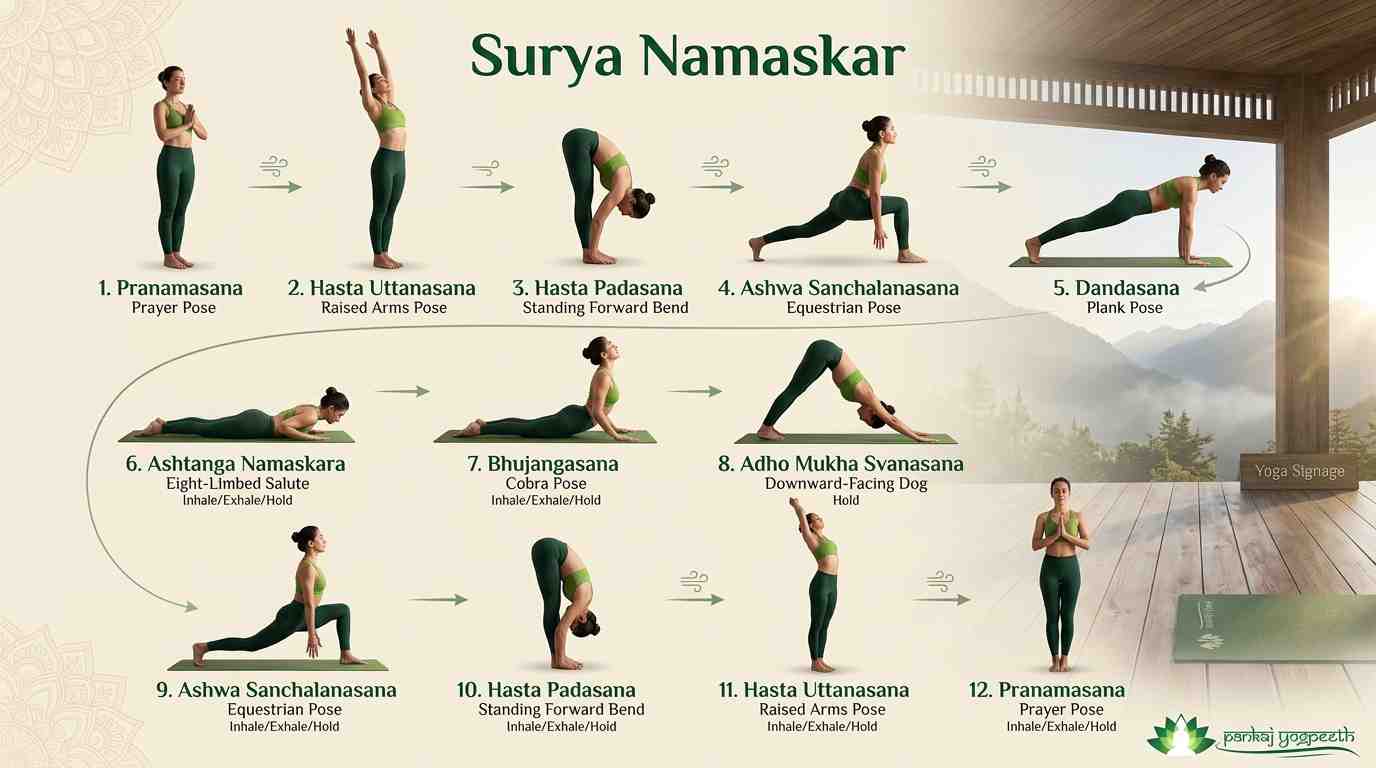
This is what most articles miss out on, but this is what you actually came here for. Here are the 12 poses of Sun Salutation in order, with the breath that corresponds with each.
- Pose 1 - Pranamasana (Prayer Position): Stand tall, feet together, hands at heart centre. Breath: Breathe out.
- Pose 2- Hasta Uttanasana (Hands Upwards Pose): Inhale and stretch both arms upward, bending back slightly. Breath. Breathe in.
- Pose 3 - Hasta Padasana (Standing Forward Bend): Fold forward, hands toward the floor alongside the feet, exhale. Breathe. Out.
- Pose 4 - Ashwa Sanchalanasana (The Horse Pose): Take the right leg back into a shallow lunge, facing front. Breath: Breathe in.
- Pose 5 - Dandasana (Staff Pose): Step back with the left leg to meet the right, and hold a hard plank. Breath: Exhale (short breath hold).
- Pose 6 - Ashtanga Namaskara (Eight-Limbed Salutation): Drop lower knees, chest and chin to the floor, lifting the hips. Eight points on the ground. Breath: Hold.
- Pose 7 - Bhujangasana (Cobra Pose): Slide forward and elevate the chest, arching the spine softly. Breath: In.
- Pose 8 - Adho Mukha Svanasana (Downward Dog Pose): Breathe out. Lift hips up and back into an inverted V.
- Pose 9 - Ashwa Sanchalanasana (Equestrian Pose): Bring the right leg forward into a lunge, in the same way as Pose 4. Breath: Breathe in.
- Pose 10 - Hasta Padasana (Forward Bend): Step the left leg forward and bend over both legs. Breath: Breathe in.
- Pose 11 - Hasta Uttanasana (Upward Facing Arms Pose): Breathe in, reach back up, arms above your head. Exhale. Breath.
- Pose 12 - Pranamasana (Prayer Pose): Stand up with your hands at your heart again. Breath: Breath out.
That is one half round of Surya Namaskar. Repeat this pattern to complete a full cycle, this time stepping back with the left leg first in Pose 4.
Top Benefits of Surya Namaskar
The benefits of Surya Namaskar are for the body, mind and soul. This is the honest breakdown.It makes you more fit overall and tones all of your major muscles.
Physical Benefits of Surya Namaskar: Strength, Flexibility, and Weight Loss
- Energises the whole body - All in one flow: arms, shoulders, legs, midsection and back
- Increases flexibility – particularly the spine, hips and hamstrings
- Improves posture – combats the slouch from being stuck at workstations all day
- Helps you lose weight – approx. 100-150 calories burned per 12 rounds
- Aids digestion - Forward bends massage internal organs
- Enhances blood flow - Delivers more oxygen to each cell
- Helps balance metabolism - long-term weight control
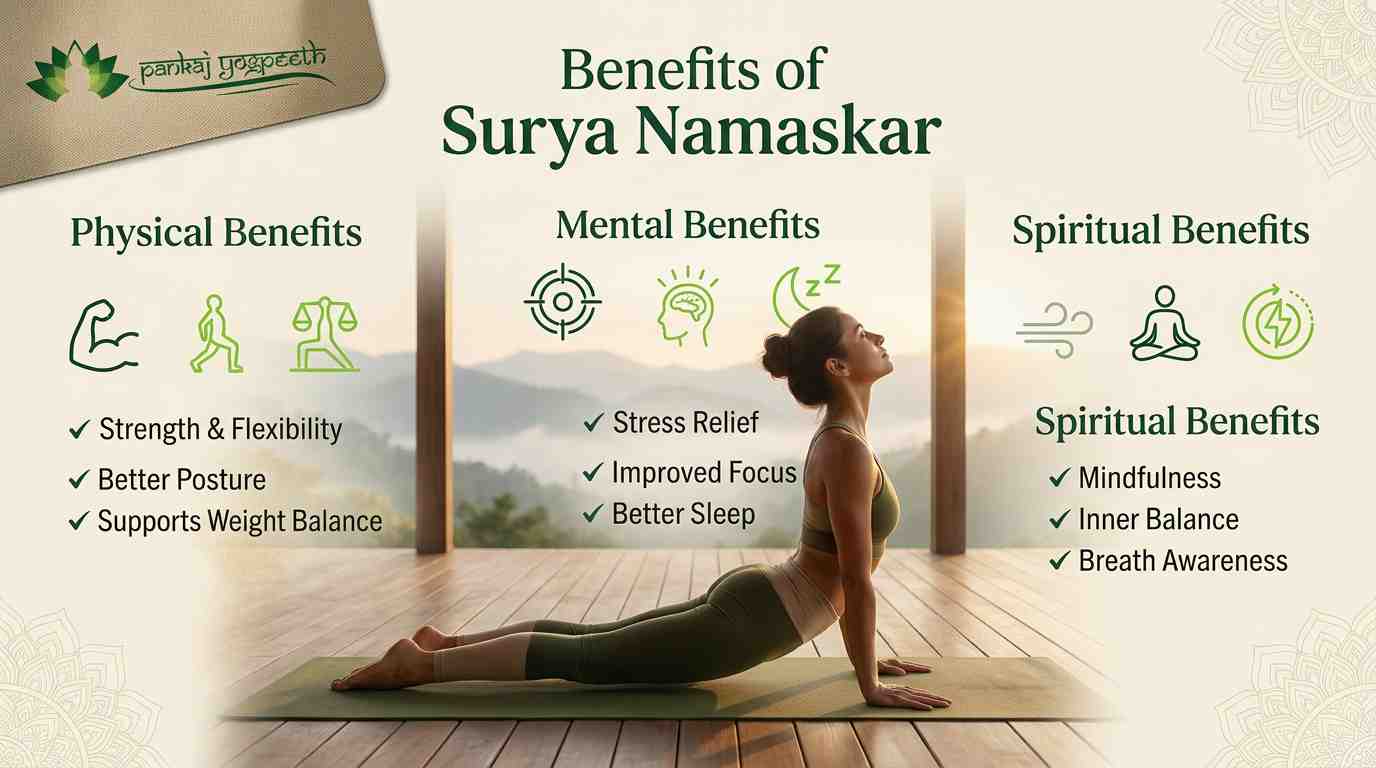
Mental Benefits of Surya Namaskar: Stress Relief and Emotional Balance
- Stimulates the parasympathetic nervous system to relieve stress and anxiety
- Improves focus and concentration for the next day
- Improves sleep quality when practised regularly
- Rhythmic breathing promotes emotional stability
- Develops mental discipline through daily practice
Spiritual Benefits of Surya Namaskar: Energy, Mindfulness, and Gratitude
- Encourages prana – the vital vitality of the body
- Develops thankfulness through the act of greeting the sun symbolically
- Balances the Manipura (solar plexus) chakra, the centre of willpower
- Slows mind chatter & deepens meditation
- Increases awareness of breath, body and the present moment
How Many Rounds of Surya Namaskar Should You Do?
The benefits of Surya Namaskar are for the body, mind and soul. This is the honest breakdown.That depends on your level. Here's a simple guide:
| Level |
Recommended Rounds |
Approx. Time |
| Beginner |
3–5 rounds |
10–15 minutes |
| Intermediate |
6–11 rounds |
15–25 minutes |
| Advanced |
12 rounds |
5–35 minutes |
| Fitness focus |
24 rounds |
45–60 minutes |
| Spiritual practice |
108 rounds |
90+ minutes |
Most yoga teachers promote 12 rounds a day as the sweet spot for complete body benefit. Begin small. Build gently. The consistency is what is important, not the count.In yoga and Hindu tradition, the number 108 is spiritually significant, representing wholeness and the universe. This is why devout yogis do 108 rounds on equinoxes and full moons.
Ideal Daily Practice for Beginners
It’s typical to ask yourself, “How many Surya Namaskar should I do every day?” when you first start. Traditionally, the best period to perform a Surya Namaskar is at sunrise, facing east, on an empty stomach. The body is at its freshest, the mind is calm, and the rising sun adds symbolic energy to the activity. Late afternoon (before sunset) is also good if you can’t do sunrise. Don’t practice straight after eating, wait at least 3–4 hours after you eat.
Surya Namaskar for Different Age Groups
| Age Group |
Recommended Rounds |
Focus Area |
Precautions |
| Kids (8–15 years) |
2–4 rounds |
Flexibility, posture awareness, breathing habits |
Keep it fun and gentle, no forced stretches |
| Adults (16–45 years) |
6–12 rounds |
Strength, stamina, metabolism, mental focus |
Avoid skipping breath; practice on an empty stomach |
| Seniors (45+ years) |
2–6 rounds (slow pace) |
Joint mobility, blood circulation, balance |
Do gentle or modified surya namaskar; skip deep backbends |
Surya Namaskar is beautiful because everyone can practice it, kids learning their first yoga sequence, working adults fitting in 15 minutes of self-care or seniors keeping their joints mobile.
Who Should Avoid Surya Namaskar?
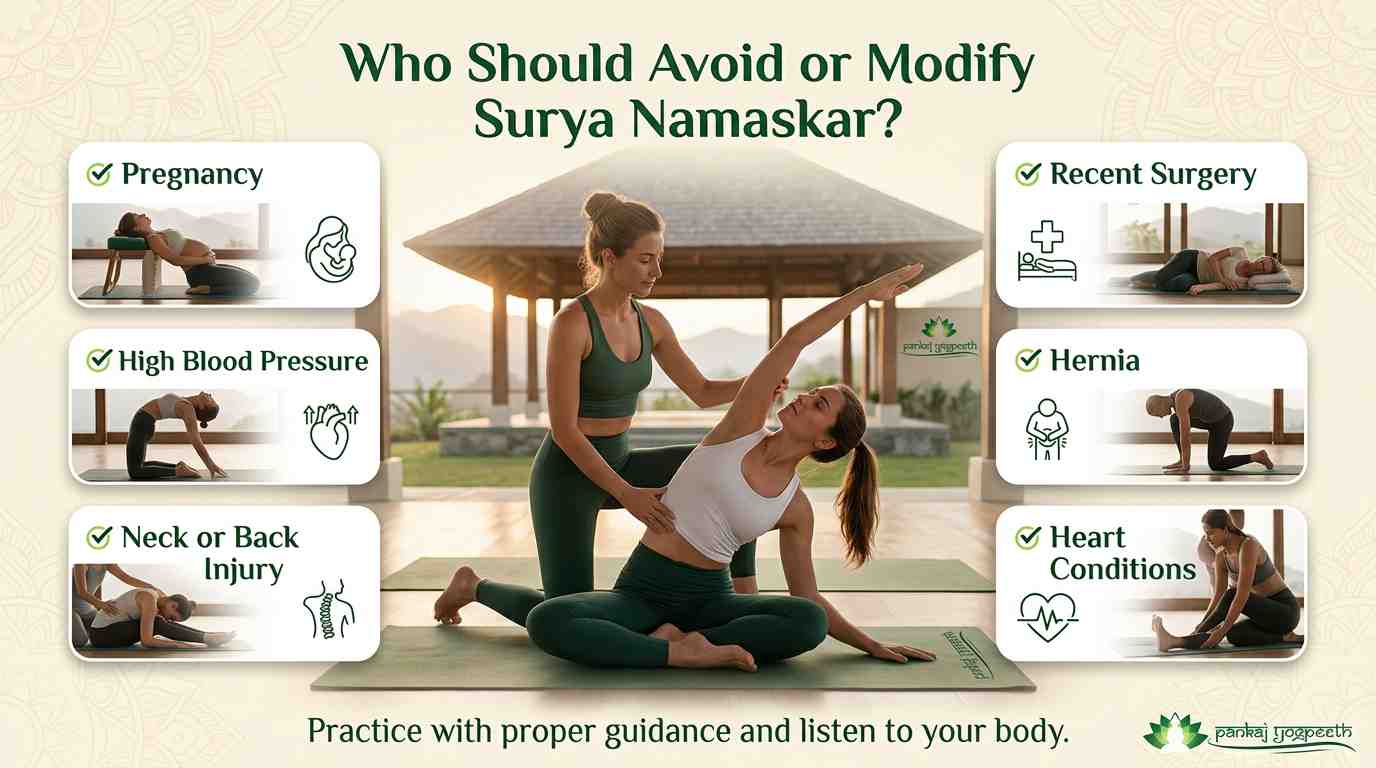
The key is to scale the intensity to your body, not the other way around. Surya Namaskar is typically safe, although certain conditions warrant caution or modification:
- Pregnancy (after first trimester) – avoid forward turns and cobra
- High blood pressure - don't do deep backbends
- Severe neck or back injury – see a doctor first
- Recent abdominal surgery - wait till totally healed
- Hernia - avoid sharp forward bends and inversions
- Heart problems - only exercise under skilled supervision
- Menstruation – many yoga traditions advise rest for the first 2-3 days
If you are unsure, work with a certified yoga teacher who can safely adapt the sequence for you.
Final Thoughts: Surya Namaskar as the Best Morning Yoga
Modern mornings are fast. Phones are lighting up before your coffee has even cooled.And that's why Surya Namaskar is still so important - twelve silent poses that operate on every part of your body simultaneously, in less time than it takes to scroll through your inbox.
The body opens. Breath finds a rhythm. And somewhere in those few rounds, something subtle changes. Your shoulders go down a bit. This doesn't feel like a sprint of a day. Go little. Three rounds tomorrow morning. Build gently. The actual advantage isn't in one session, but in showing up on the mat, morning after morning.
Treat it as exercise, meditation, or prayer, it gives back what you put into the practice. And that's why the world, after thousands of years, still bows to the sun.