Yoga Teacher Training Courses in Spain
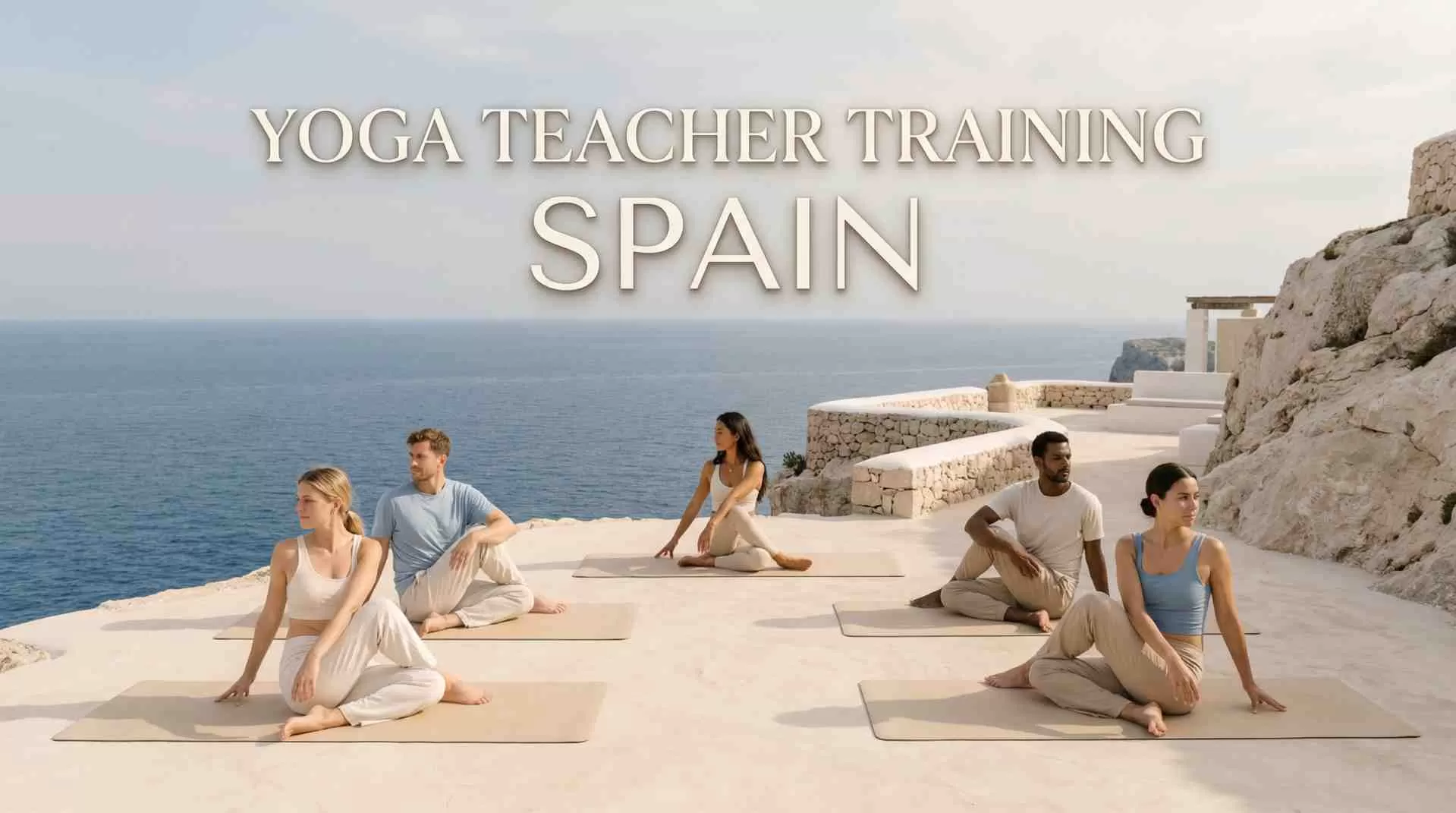
In the last ten years, Spain has been a popular place for yoga teacher training in Europe. Barcelona's beaches, Ibiza's spiritual mood, and Costa del Sol's weather are just a few of the reasons why thousands of students choose YTT Spain every year. The school offers a mix of Mediterranean beauty and high-quality training. Yoga teacher training Spain is comfortable for Westerners, taught in English, and is in beautiful places that aren't too far away. What's the catch? Programs usually cost between €2,500 and €4,500, but real training in India and Nepal, where yoga started, costs 40–60% less and is much more spiritual.
This guide has all the information you need regarding yoga certification in Spain, including 100-hour starting courses, 500-hour advanced programs, fees, locations, and what you get. Then we'll show you why thousands of people select Pankaj Yogpeeth's programs in Rishikesh, Pokhara, and Kerala instead. They offer authentic traditional teaching, better value, and actual change. Let's look at your choices and see what works best for you.
Why Choose Yoga Teacher Training in Spain?
Spain is now one of the best places in Europe for yoga teacher training, and it makes sense. You can learn from real teachers from India, the US, and Europe all in one spot. You without flying halfway across the world.
- Beautiful Places: You may do yoga on the Barcelona yoga training beach in the morning and then walk around Gaudí's buildings in the afternoon. Ibiza yoga certification gives you a true spiritual energy and a group of people who want to be healthy. Costa del Sol YTT offers year-round sunshine and affordable living by the sea.
- Global Community: You're working out with folks from all around the world, including Europe, America, and beyond. The friends and connections you develop here will frequently last longer than the certification.
- Spain's way of life already feels yogic: afternoon naps let you recuperate during intense training, Mediterranean food is basically sattvic eating, and weekend vacations to mountain villages or coastal cities keep you encouraged.
When you train to be a Best yoga teacher training here, you'll have access to great facilities, everyone will speak English, and you won't feel out of place. It feels more like an adventure than a task, and it's comfy and lovely. Spain just makes everything easy.
Types of Yoga Teacher Training Courses in Spain
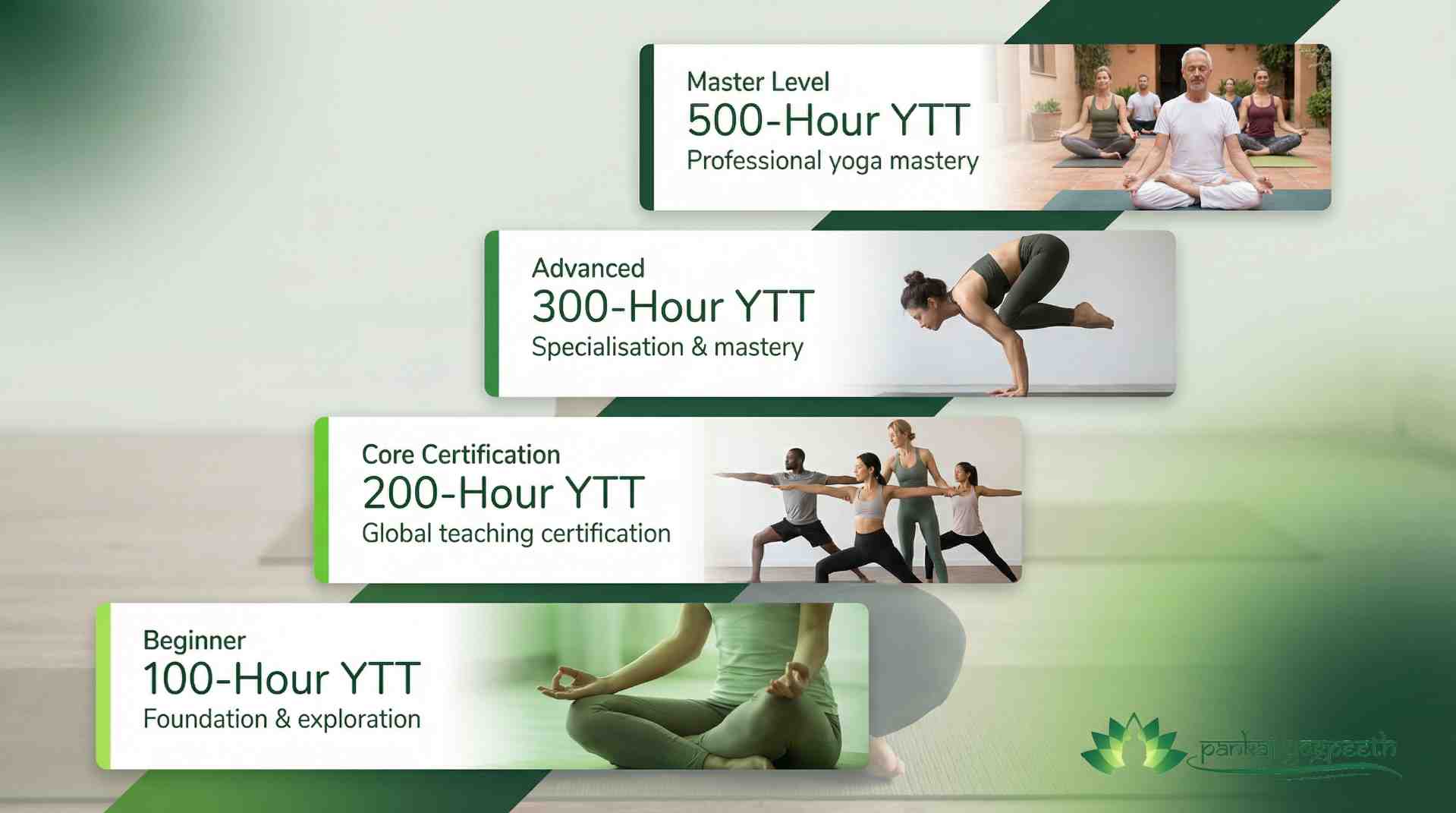
100-Hour Yoga Teacher Training in Spain
Not ready to leave work and life for a whole month? The 100-hour yoga course in Spain is the best place to start. It's like "yoga teacher training lite" a 10- to 14-day intensive that teaches you real things without making you commit to the whole thing.
- What You Really Learn: You'll learn 30 to 40 basic asanas with the proper alignment, 3 to 5 basic pranayama techniques, the beginnings of meditation and yoga philosophy, how to safely practice yoga by understanding how the body works, and how to teach yoga with feedback. It's short, but it's actual training.
- The Smart Part Is: Most beginner yoga certification programs in Spain focus on one style, like Hatha, Vinyasa, or Yin, so you don't have to learn everything at once. You get real depth instead of just surface-level things. And what if you adore it? Your YTT Spain certificate is the first step toward getting your 200-hour certification. You'll be a fully certified RYT 200 teacher. Just come back later and finish the last 100 hours.
- Cost: €800–€1,500 (a lot less than paying for the whole program up front)
Great for: People who are just starting, people who work full-time and can't take a month off, and anyone who is wondering, "Is yoga teaching really for me?" before going all in.You may think of it as a practice run that leads to something grander.
200-Hour Yoga Teacher Training in Spain
The 200 hour yoga teacher training Spain is the real certification everyone recognizes. It gives you the RYT 200 Spain certifications you need to teach yoga anywhere in the world.
- How It Works: If you live nearby, most intensive yoga training programs in Spain last 3 to 4 weeks straight or 6 to 8 weekends. You are getting full Yoga Alliance Spain-registered education that opens doors worldwide, no matter what.
- What You Really Learn: Spanish-certified yoga teacher training programs in Spain blend old knowledge with new ways of teaching. You do asanas for 2 to 3 hours every day, study philosophy that makes sense today, understand anatomy to keep people safe, and even teach real classes with feedback.
Quick Summary:
- Asana and Practice (100 hours): breathing, meditation, and postures
- Teaching Skills (25 hours): how to lead classes, make adjustments, and plan lessons
- Anatomy (20 hours): how the body works and how to avoid getting hurt
- Philosophy (30 hours): old books and teacher ethics
- Practice Teaching (10 hours): Teach, get feedback, and get better
Popular styles
- Hatha Yoga TTC: Traditional, slower, and easy to get to
- Vinyasa Teacher Training Spain: creative, dynamic flow 200-hour YTT in Barcelona (Ashtanga): strict and hard on the body
- Yin Yoga: Deep stretching and meditation.
Cost: €1,800–€3,500 for the course only or €2,500–€4,500 for everything.
Hatha certification in Spain is less expensive than luxury getaways. You get a whole Yoga Alliance-registered Spain certification, the confidence to teach, a change in yourself, and a global yoga community. This is what makes you a qualified teacher.
300-Hour Advanced Yoga Teacher Training in Spain
What You Really Learn Advanced YTT Spain lets you focus on one area, such as yoga therapy, prenatal yoga, dealing with certain groups of people, or learning how to sequence. You're diving deep into what matters to you, not just the surface.
A quick look: Difficult
- Asanas: Handstands, arm balances, and deep backbends that you couldn't do before
- Advanced Pranayama: holding your breath, using bandhas, and working with subtle energy
- Yoga Therapy: Helping individuals with pain, anxiety, and real problems
- Teaching Business: Marketing, pricing, and making a living that lasts, getting paid fairly
- Sequencing Mastery: Making experiences, not just exercises
- Deep Philosophy: Using the Bhagavad Gita and Upanishads in modern teaching
Path to RYT 500
You will reach RYT 500 Spain, the highest level of the Yoga Alliance, after finishing this 300-hour teacher training in Barcelona. This accreditation lets you teach at a higher level, lead retreats, and train other teachers. Putting money into something Intensive: 3–4 weeks or weekends: 2–3 months Price: €2,500 to €4,500
Graduates claim that the master teacher Spain training fundamentally changes how they teach. They are more confident, know more, and can guide anyone. You stop just showing people how to do poses and start making meaningful changes. This is when great teachers become amazing.
400-Hour & 500-Hour Yoga Teacher Training in Spain
The 500-hour yoga training in Spain is the highest level offered by the Yoga Alliance. It will make you a yoga master teacher in Spain with the most extensive education imaginable. This RYT 500 certification opens possibilities that a 200-hour one can't. The 500-hour teacher training Europe certificate gives you significantly deeper expertise and competence; most people do the 200-hour foundation and 300-hour advanced courses.
The Realistic Way
- Step 1: Finish the 200-hour foundation (3–4 weeks)
- Step 2: Teach for 6 to 12 months to obtain practical experience.
- Step 3: Finish the 300-hour advanced course (3–4 weeks)
- Step 4: Sign up to be a professional yoga instructor in Spain with RYT 500
- Step 5: Keep learning by taking workshops and focusing on specific areas.
When will it happen? 1–2 years overall, with teaching practice in between trainings.
What RYT 500 Really Means
- More Money: €40–80 each class instead of €25–40. You get your Money back in 6–12 months.
- Senior Positions: Lead teacher roles, workshop leadership, retreat facilitation
- Train Others: Eligible to lead teacher trainings yourself (after meeting requirements)
- Specialised Work: Yoga therapy, prenatal, trauma-informed, working with specific populations
- Career Credibility: Established studios won't hire lead teachers unless they have RYT 500.
- Online Options: Make courses, teach on platforms, and grow your brand
Total Cost Of 400-Hour & 500-Hour Yoga Teacher Training in Spain
The cost of complete yoga training in Spain is between €4,500 and €8,000 for both trainings. It sounds like a lot, but the increased teaching rates make up for the cost in 6 to 12 months. Graduates of the Yoga Master Program in Spain feel that the credential quickly pays for itself. What Changes Teachers report that attaining RYT 500 certification radically changes their careers. Not only do they have additional job choices, but they are also seen as master teachers. Studios trust you with more advanced students, workshops fill up faster, and retreat centres reach out to you. This makes teaching an actual job instead of just a side job.
Complete Yoga Teacher Training Curriculum in Spain
When you become a yoga teacher in Spain, you learn more than just how to teach poses. Your body will get stronger, your mind will calm down, and you'll be able to transition into teaching with confidence and ease.
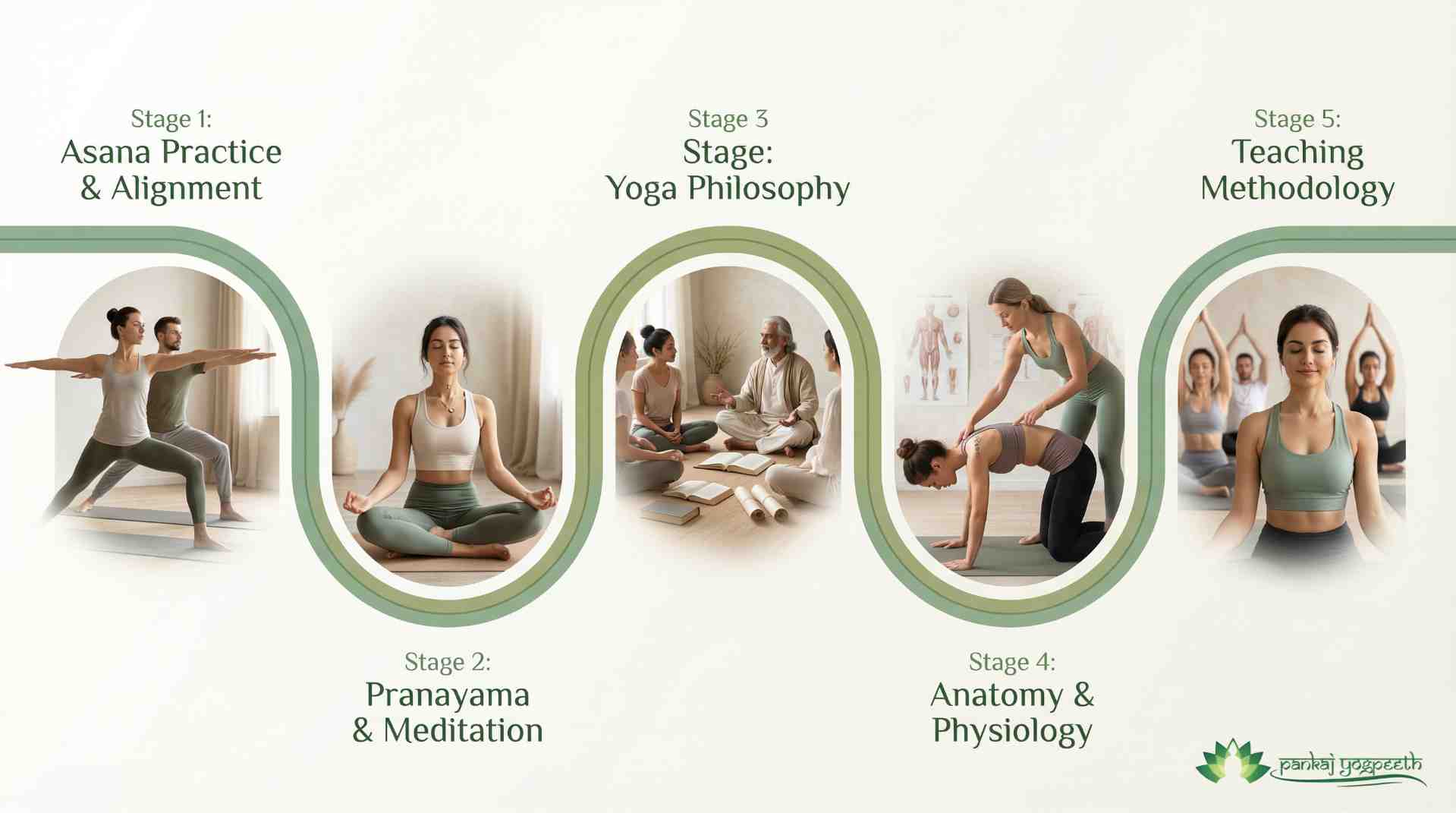
Asana Practice & Alignment
As the day starts, do yoga in a calm, deliberate way. You won't be pulling into shapes; instead, you'll learn how your body moves, where it needs help, and how to practice safely. Strength and flexibility grow naturally over time. Training takes place outside or in open areas a lot of the time, which gives the routine a calm and steady flow.
You create slowly:
- Being sure of yourself in both basic and advanced poses
- Knowing how to balance and move safely
- The skill of changing poses to fit different body types
- a natural link between breathing and moving
Pranayama & Meditation
Meditation and breathing exercises are slowly added to the training. You learn how simple meditation can help you focus and feel calm, as well as how breathing can change your mood and energy.
You don't have to "stop thinking." You learn to sit still and be aware, letting your mind settle on its own time.
| Practice |
How It Helps |
| Nadi Shodhana |
Brings balance and calm |
| Ujjayi |
Supports steady movement |
| Kapalabhati |
Builds energy and clarity |
| Bhramari |
Calms the nervous system |
| Yoga Nidra |
Deep rest and renewal |
Yoga Philosophy
Philosophy classes help you understand yoga beyond the mat. It is easy to connect ancient teachings to everyday life because they are presented in a way that is grounded and real. So this is where yoga stops being just a workout and starts to feel more like a way of life.
You look into things like
- The Eight Yoga Limbs
- As daily direction, the yamas and niyamas
- Different ways to do yoga and what they mean
- Using the lessons of yoga in modern life
Anatomy & Physiology
You can better understand what's going on inside your body when you do yoga if you take anatomy classes. When you move, you learn how muscles, joints, and the nervous system react. This helps you be careful when you practice and teach.
| Focus |
Why It Matters |
| Muscles & joints |
Reduces strain and injury |
| Spine & posture |
Supports healthy movement |
| Nervous system |
Explains yoga’s calming effect |
| Modifications |
Keeps practice safe for everyone |
Teaching Methodology
The attention stays on the practical, on safety, awareness, and avoiding getting hurt.The first lessons are given slowly. First, you watch, then you practice teaching short routines, and finally, you teach whole classes. Feedback is positive and helps confidence grow on its own. This part of the training helps you find your own clear, calm, and real way to teach.
You learn how to:
- Plan lessons that are well-rounded.
- Make your cues clear and easy.
- Control your time and energy.
- Trust yourself to hold room.
Cost Breakdown for Yoga Teacher Training in Spain
It's easier to plan your yoga teacher training course in Spain if you think about more than simply the cost of the course. Some expenditures are clear from the start, while others show up later. When you have a clear image, you can pick calmly and without surprises later. Spain is in the middle range for yoga training in Europe. It's cheaper than many Western European countries, but still more expensive than places like India or Nepal.
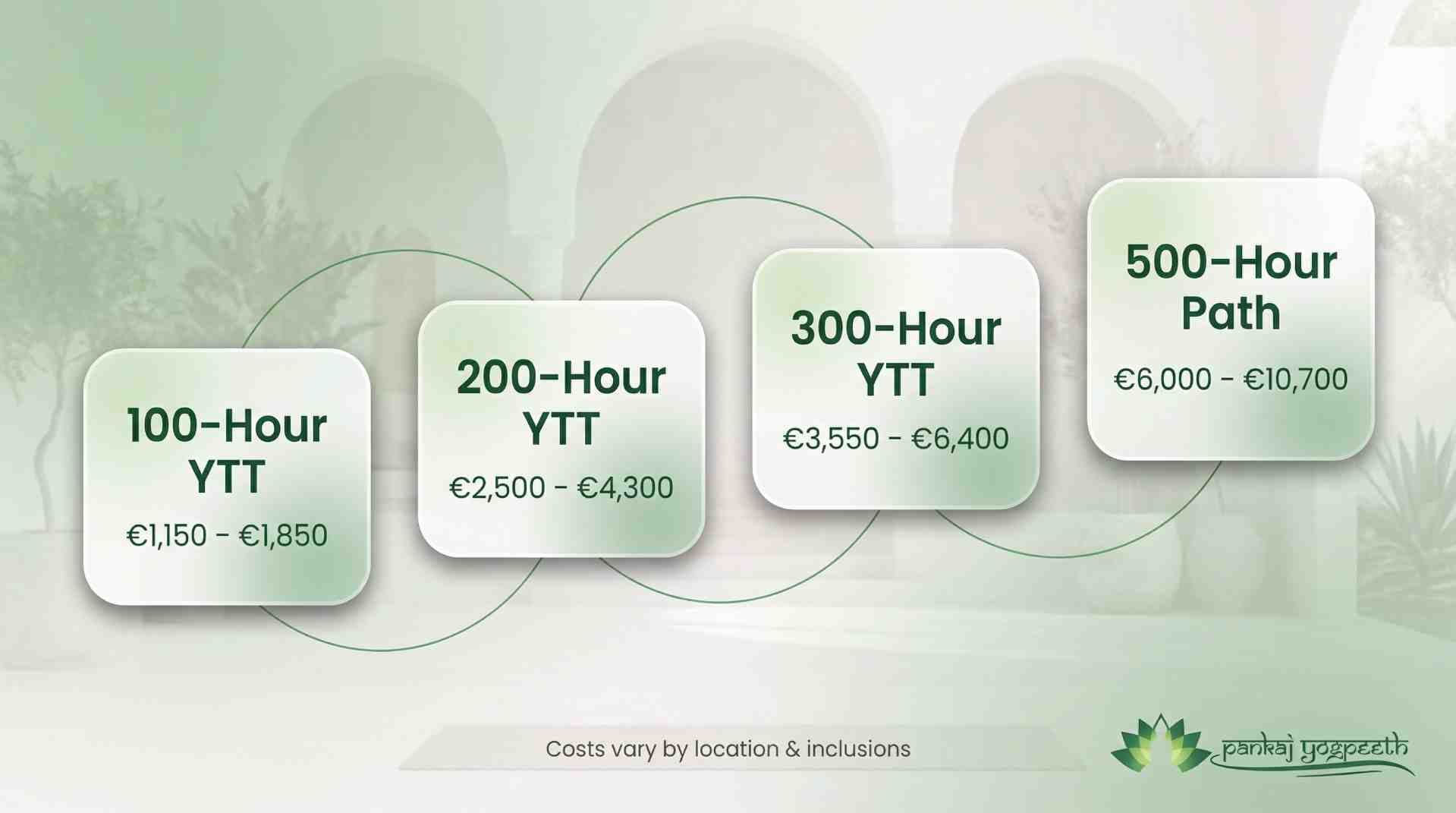
| Training Level |
Typical Total Cost |
| 100-Hour YTT |
€1,150 – €1,850 |
| 200-Hour YTT |
€2,500 – €4,300 |
| 300-Hour YTT |
€3,550 – €6,400 |
| 500-Hour Path |
€6,000 – €10,700 |
Prices are mostly based on where you are, what level of course you take, what kind of hotel you stay in, and what else is included.Training in cities like Barcelona tends to be more expensive. On the other hand, training in rural or southern areas tends to be less expensive. All-inclusive programs are easier to handle, but course-only options allow you more freedom.
Top Destinations for Yoga Teacher Training in Spain
It matters where you choose to complete your yoga teacher training. The site you choose in Spain doesn't just host your training; it also affects how you feel, how you practice, and how long the experience stays with you.
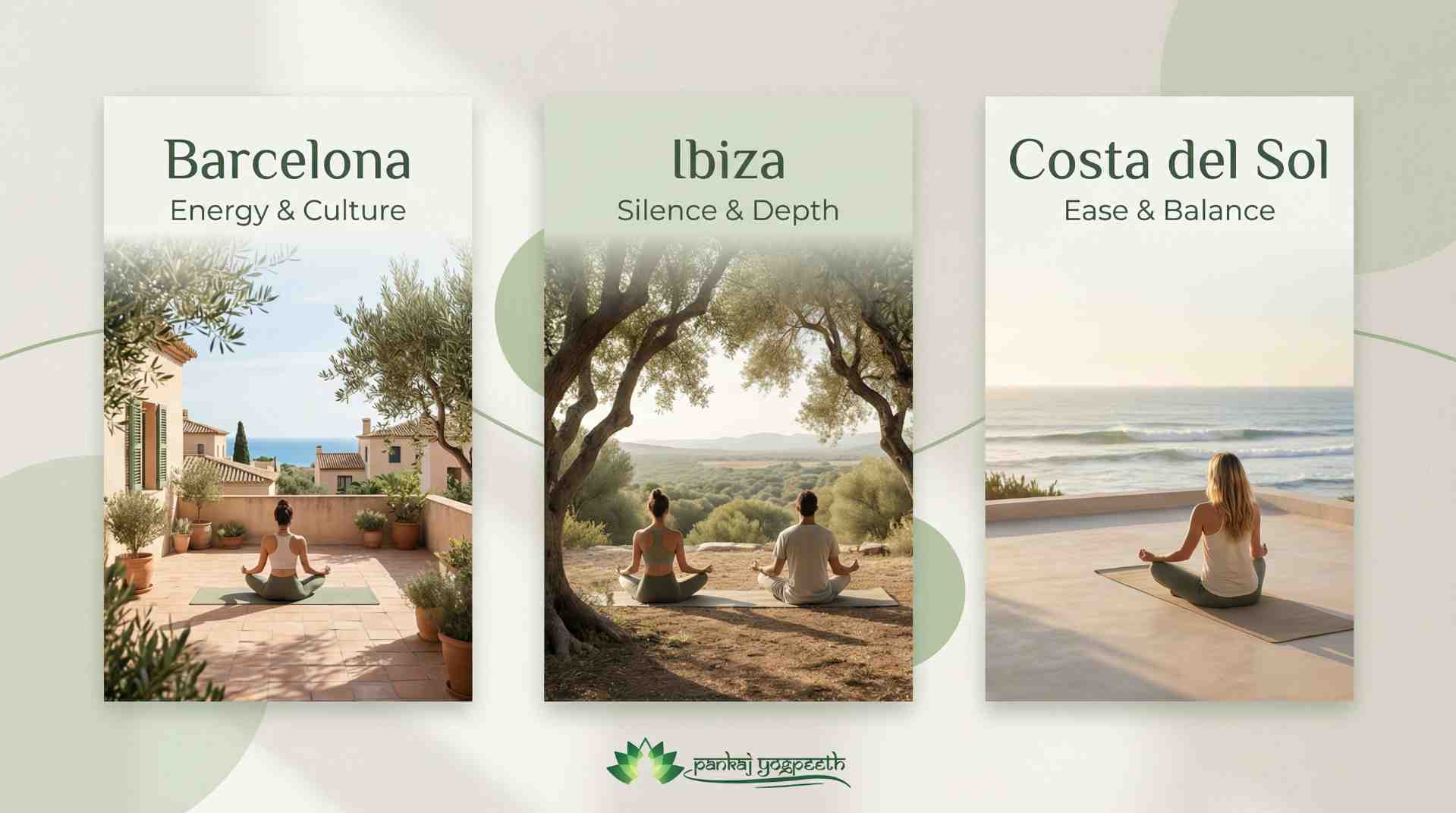
Barcelona - Energy, Culture, and Everyday Life
If you want yoga to be a part of your everyday life, Barcelona is the place to be. You practice in the mornings and do art, architecture, the sea, and movement in the afternoons. The city is full of life and creativity, and that energy naturally pours into your training. You meet individuals from all over the world, share ideas, and learn by being with others, not by being alone. Barcelona is a good place for people who want culture, structure, and inspiration all at once.
Ibiza - Quiet Space to Go Inward
There is a softer aspect to Ibiza that comes out slowly. Life is easy when you're not among people. You may practice, rest, enjoy nature, and be quiet. Yoga here feels more natural, less rushed, and more intimate. You can hear yourself better there, and you leave feeling lighter than when you got there. Ibiza is for people who want peace, profundity, and a retreat-like experience.
Costa del Sol - Ease, Warmth, and Balance
Costa del Sol is a tranquil and comfortable place. The days go by slowly, the sun is nearly always out, and training doesn't feel too hard. You may practice seriously without feeling like you have to. It's down-to-earth, cheap, and very human. If you prefer balance, simplicity, and a slow pace, Costa del Sol is the place for you.
Food & Nutrition During Yoga Teacher Training in Spain
During yoga teacher training in Spain, the food is simple, fresh, and helps with everyday practice. Most programs include vegetarian or vegan meals designed to keep the body light and the mind clear throughout long yoga days.

| Meal Time |
What It’s Usually Like |
| Breakfast |
Fresh fruits, yogurt, granola, whole grains |
| Lunch |
Balanced vegetarian meals with vegetables and legumes |
| Dinner |
Light, easy-to-digest dishes |
| Snacks |
Herbal teas, fruits, nuts |
Spanish food is a natural fit for a yogic way of living. Seasonal vegetables, fruits, legumes, whole grains, almonds, and olive oil are the main ingredients in meals. Some training sessions in coastal areas also offer light pescatarian options. The food feels healthy and grounding because the ingredients come from nearby. People get to know one another better over meals. The mornings are light, lunch is full and healthy, and the evenings are light, so the body can relax and heal before bed.
Pankaj Yogpeeth: A True Home for Yogis in India & Nepal
Spain is a fantastic destination to learn yoga for some people. But for a lot of people who are looking for something, the heart of yoga still pulls them closer to its roots. That's when Pankaj Yogpeeth stops being just an option and starts to feel like home.Pankaj Yogpeeth welcomes students from all across India and Nepal, not as tourists but as part of a common yogic journey. Life here is basic, purposeful, and very tied to everyday practice.
Yoga isn't something you do for a few hours; it changes the whole day.Pankaj Yogpeeth offers training that is based on tradition, led by competent teachers, and affordable so that yoga is available to everyone. You live near nature, have a balanced schedule, eat healthy foods, and learn yoga the way it has been taught for generations: through practice, discipline, and self-reflection.