
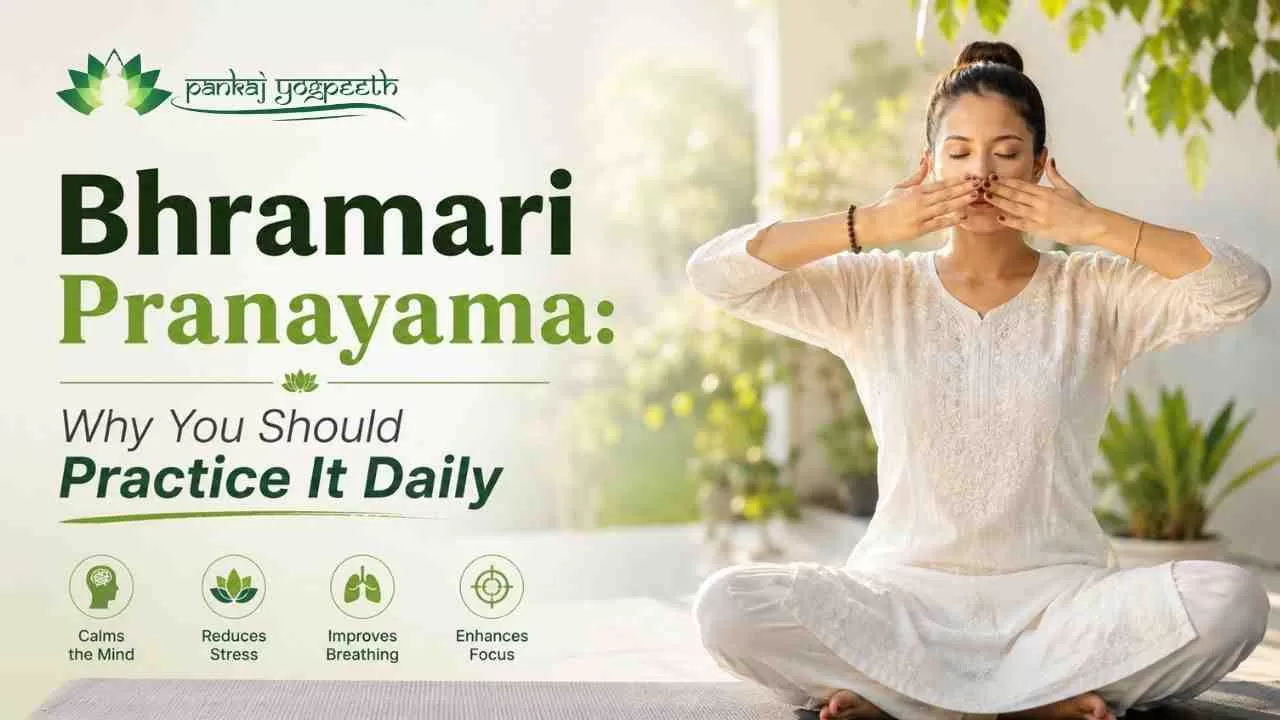
Close your lips, breathe in slowly, and let a low hum out on the exhale. Somewhere in the first round, the noise in your head goes down a little bit. That is bhramari pranayama, or bee breath, or humming bee breath as it’s commonly known, and it needs nothing more than your breath and five silent minutes.
This guide explains what it is, where your fingers and mouth go, which bhramari pranayama benefits hold up, how many rounds to complete, and who shouldn’t do it. One reason we publish it as a fertility platform.
Treatment cycles are long, uncertain and hard on sleep. And the humming isn’t decoration, it’s doing measurable work inside your sinuses and nervous system.
What Is Bhramari Pranayama (Humming Bee Breath)?
The name comes from bhramara, a Sanskrit word for the black Indian bee. That one word describes the method: the sound you create on the way out is designed to simulate a bee humming close by, low and uninterrupted. What you do is easy. Inhale gently through your nose, and then, with your lips closed, hum a long, steady hum for the whole length of the exhale. That's one circle.
It belongs to the pranayama family, breathing activities, not postures. Bhramari yoga is not a mudra in itself, but is often layered on top of Shanmukhi mudra, a hand gesture that seals the senses.
Why Is Bhramari Pranayama Also Called Bee Breath?
English translators never agreed on a name. The same practice appears as:
- Bee breathing or bee breath
- Humming bee breath or humming breathing
- Bumble bee breath yoga
- Hummingbird breath, sometimes
Both the Hatha Yoga Pradipika and the Gheranda Samhita mention it directly, thus none of this is new. It thrived because it asked for so little: no flexibility, no equipment, no floor space, no minimum fitness level. The active ingredient is the sound. So what does it truly do once you start to hum?
How Does Bhramari Pranayama Work on the Body and Brain?
Three things are happening at once, each accounting for a different element of how you feel. The first is your breath. Your exhale is significantly longer than your inhale, and that ratio pushes the nervous system toward its parasympathetic side, the branch that deals with relaxation rather than alertness.
Reduced resting heart rate. Heart rate variability, which shows how flexibly your body copes with stress, increases. And this alone accounts for most of the serenity you notice.
Bhramari Pranayama and Nitric Oxide
This gas is produced continually by your paranasal sinuses. When you hum, you move air back and forth quickly between your sinuses and nasal cavity, pushing much more into your airway than silent breathing does. There are two consequences:
- Blood vessels dilate, facilitating circulation through the nasal passages.
- Oxygen consumption is better assisted.
The third mechanism is the voice. The hum in your ears breaks the looped thoughts running through your head. This is why people who say they are too restless to meditate can frequently do bhramari. Those three methods explain a certain class of benefits, and quietly rule out a few claims you will see elsewhere.?
What are the Benefits of Bhramari Pranayama?
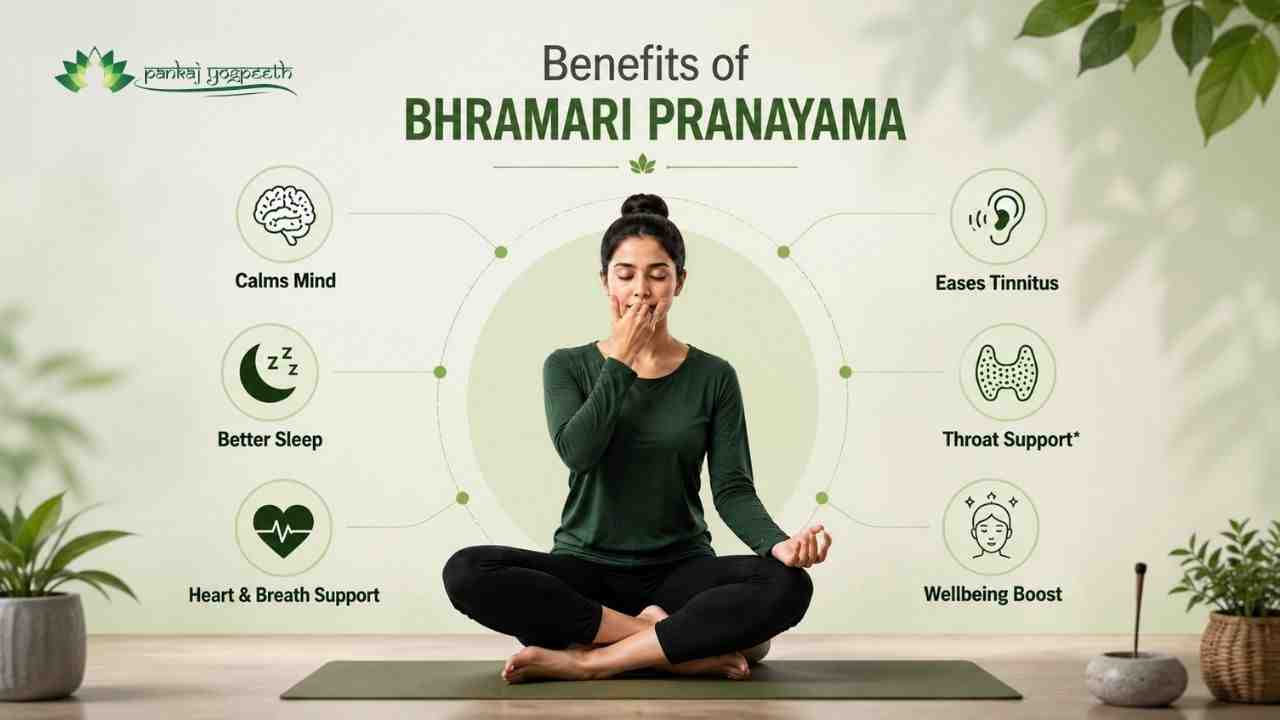
If you search for this practice, you will find fifteen benefits of bhramari pranayama described as if they are all equally proven. No, they aren’t. A few have been studied. Some are based on tradition, plausible but unproven. And one or two are repeated so often no one checks anymore. Here is the honest sort.
Bhramari Pranayama Benefits for the Brain and Mental Calm
This is where the humming bee breath benefits are most reliable and the studies least questionable. Agitation, anger and anxiety ease within a handful of breaths, faster than other calming techniques succeed, because the hum provides your attention something tangible to hold instead of asking you to empty your mind.
The minutes afterwards frequently sharpen concentration. The quiet advantage is that it is an entry point. If sitting still for meditation has always felt unattainable, bee breath offers your mind a job and gets you there sideways.
Bhramari Pranayama for Sleep and Insomnia
Is Bhramari Pranayama Good for Sleep and Insomnia? Yes, and bedtime might be its most powerful slot. There is empirical support for slow breathing with a lengthy out-breath as an adjunctive treatment for insomnia, and this practice fits closely with that pattern.
If you are doing it before sleep, keep the hum low-pitched and quiet. Instead of quieting, a loud, high hum awakens the system. That is what separates falling asleep from lying there trying to figure out why the strategy didn't work.
Bhramari Pranayama and Blood Pressure, Heart Rate and Breathing
These are true bee breathing advantages, but they are slow. Research shows that resting heart rate can be lowered, heart rate variability (a measure of how well the body copes with stress) can be increased, and breathing capacity can be enhanced in lung-function tests with as little as four to six weeks of daily practice.
Week one is hardly dramatic. Two honest boundaries. It supports treatment and does not replace medication given by a doctor. If you have high blood pressure or it is not well controlled, check with your doctor before you start.
Bhramari Pranayama for Tinnitus, Thyroid and Skin
Here, the claims outrun the facts, so read it carefully.
- Tinnitus – the hum is a self-generated masking sound that might reduce distress as you practice. It does not cure the tinnitus.
- Thyroid – tradition adds a chin lock to deliver vibration to the throat. There is no evidence of result.
- Skin – any effect is indirect through improved sleep and lower stress. It's not a skin treatment.
- Vertigo - Stay sitting or erect, keep your eyes open, and stop as soon as you feel unstable.
What you actually get relies significantly on how you hum, and that is exactly where most guides stop short.
Types of Bhramari Pranayama and Its Variations
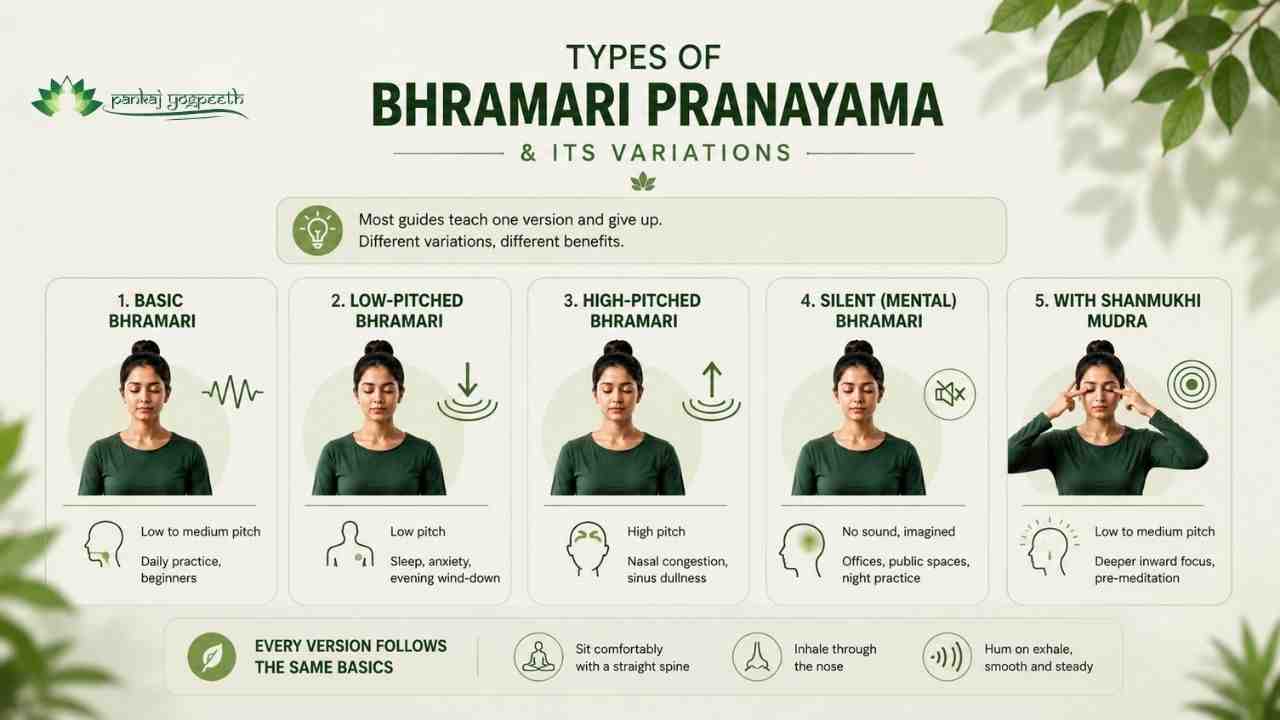
Most guides teach one version and give up. But the humming bee breath technique is readily bent, and what you get out of it is contingent upon the version you choose.
Everyone starts with basic bhramari. No hands, eyes closed, one long hum with every breath out. Learn this well before contributing anything. Pitch is the variable that nobody talks about. Hum low, and you will feel it settle in the chest, throat and jaw. Calming, the best choice at night. Hum higher and the vibration climbs into the skull and sinus cavities of the face.
Good for congestion and a heavy, blocked head. Same bee breath pranayama, different aim. Silent bhramari is to imagine humming on each out-breath without really humming.
There is still a little vibration about the face. This is the version for offices, shared rooms, late nites and clinic waiting rooms. Next comes the enhanced version with Shanmukhi mudra.
Which Bhramari Variation Should You Use?
| Variation | Pitch | Where you feel it | Best for |
|---|---|---|---|
| Basic bhramari | Low to medium | Throat, jaw, sinuses | Daily practice, beginners |
| Low-pitched bhramari | Low | Chest, lower throat | Sleep, anxiety, evening wind-down |
| High-pitched bhramari | High | Forehead, facial sinuses | Nasal congestion, sinus dullness |
| Silent (mental) bhramari | None, imagined | Faint facial vibration | Offices, public spaces, night practice |
| With Shanmukhi mudra | Low to medium | Whole head, amplified | Deeper inward focus, pre-meditation |
The same setup criteria apply to whatever version you choose, and two little positioning details define whether it works or not.
How to Do Bhramari Pranayama Step by Step
It takes only a minute to memorise the sequence. Getting it right involves two positioning details discussed just below.
- Sit up straight. Cross-legged on a cushion with hips higher than your knees or forward on a chair with both feet flat. Long spine, shoulders down.
- Close your eyes and let the jaw drop. Centre yourself with a breath or two before you begin.
- Inhale deeply from the nose, right down into the belly. No hurry.
- Exhale on a low, steady hum for the length of the out-breath, mouth closed.
- Repeat. That's one round.
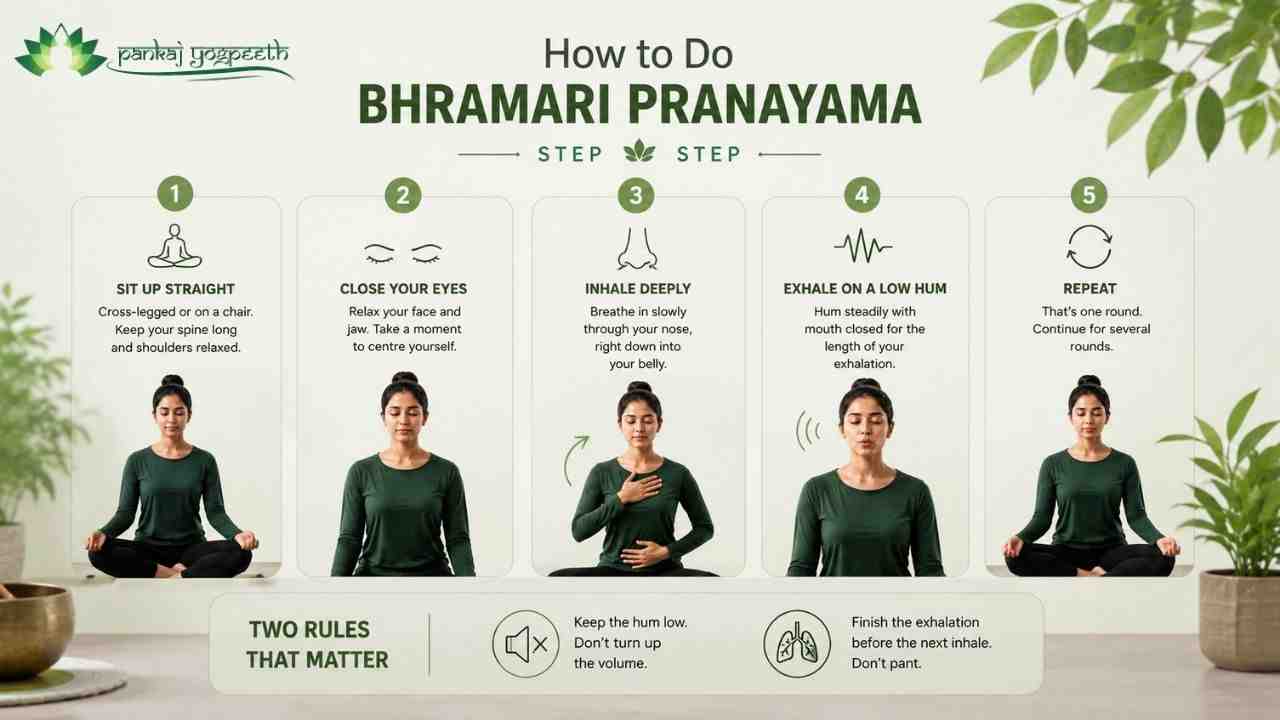
Two rules that really matter more than they sound. Don't turn the volume up, a strained hum is pointless. And finish the exhalation before you need to gulp for the next breath. If you're panting, you leaned in too far.
Bhramari Pranayama Hand and Finger Position
This is the mistake everyone makes at first. You press with your finger on the tragus, the little flap of cartilage on the cheek side of the front of the ear canal, not within the ear. Lightly press. You can either keep it still or press and release gently to the beat of the hum. In the extended version, the thumbs replace the tragus, and the remaining fingers go to the face.
Bhramari Pranayama Tongue Position and Mouth Setup
Lips closed, teeth slightly apart, the tip of the tongue behind the top front teeth. That little gap between the teeth is the part most people get wrong. That determines everything. The sound is stuck in your throat, your jaw locked. The main concept is that, with the teeth apart, the vibration travels up and vibrates into the cranium.
Am I doing Bhramari Pranayama right? Three fast checks.
- The hum is constant from end to end, no wobble or fade
- You feel a vibration in your face or head, not simply sounds
- The next breath comes easily, not desperately
If the basic set-up feels comfortable, one typical addition enhances the whole effect.
Bhramari Pranayama with Shanmukhi Mudra: The Six-Gate Variation
Its name means six gates, two eyes, two ears, a nose and a mouth. Turn your fingers around all six and the outside world disappears. This turning of attention inside is called pratyahara in the tradition. The hum now seems much louder. There is nowhere else for it to go.
Here, one rule is non-negotiable. Fingers should rest against the face, not press on the eyeballs. Pressure should be feather-light around your eyes.
And a clear warning: if you have anxiety or claustrophobia, the feeling of being locked in typically makes things worse rather than better. Skip it without guilt. Basic bhramari gives you most of the same advantages and none of the enclosure.
Shanmukhi Mudra Finger Placement
| Finger | Where it goes | Pressure |
|---|---|---|
| Thumbs | Tragus of each ear | Light — seals the canal |
| Index | Inner corners of eyes, or mid-forehead | Barely touching |
| Middle | Sides of the nose or bridge | Very light |
| Ring | Just above the upper lip | Resting only |
| Little | Just below the lower lip | Resting only |
With the technique settled, the next question is the one every beginner asks, how much, and when.
How Many Times and How Long Should You Do Bhramari Pranayama?
Begin with three to seven rounds. That really is sufficient for the first week, and stopping then is not laziness, it is how you avoid the light-headedness that causes people quit on day three. From there, add one round per week. Traditional guidance develops up to around seventeen rounds and then stops.
If you want the physiological effects, not just the calm, the lower resting heart rate, the better breathing capacity, the dose that studies actually utilized is 10 to 20 minutes daily, sustained across four to six weeks.
It’s something hardly any guide tells you straight, which is why so many people practise for a fortnight and decide it does nothing. Best to work early dawn and late nite. Mainly because ambient noise is reduced and you can hear the hum inside your own brain. Practice on an empty stomach or wait 2-3 hours after a meal.
Bhramari Pranayama Practice Plan
| Stage | Rounds | Session length | Best time |
|---|---|---|---|
| Week 1 (beginner) | 3–5 | 3–5 min | Morning, empty stomach |
| Weeks 2–4 | 7–10 | 8–10 min | Morning or bedtime |
| Week 5 onward | 12–17 | 15–20 min | Morning + short night session |
| For sleep only | 5–7, low-pitched | 5 min | 20 min before bed |
Volume is never better than consistency. Five rounds every morning will do you more good than twenty rounds twice a month. And if the room is too quiet to hum to, go silent. More isn't always better and for some people the honest answer is less, or nothing at all.
Bhramari Pranayama Precautions, Side Effects and Contraindications
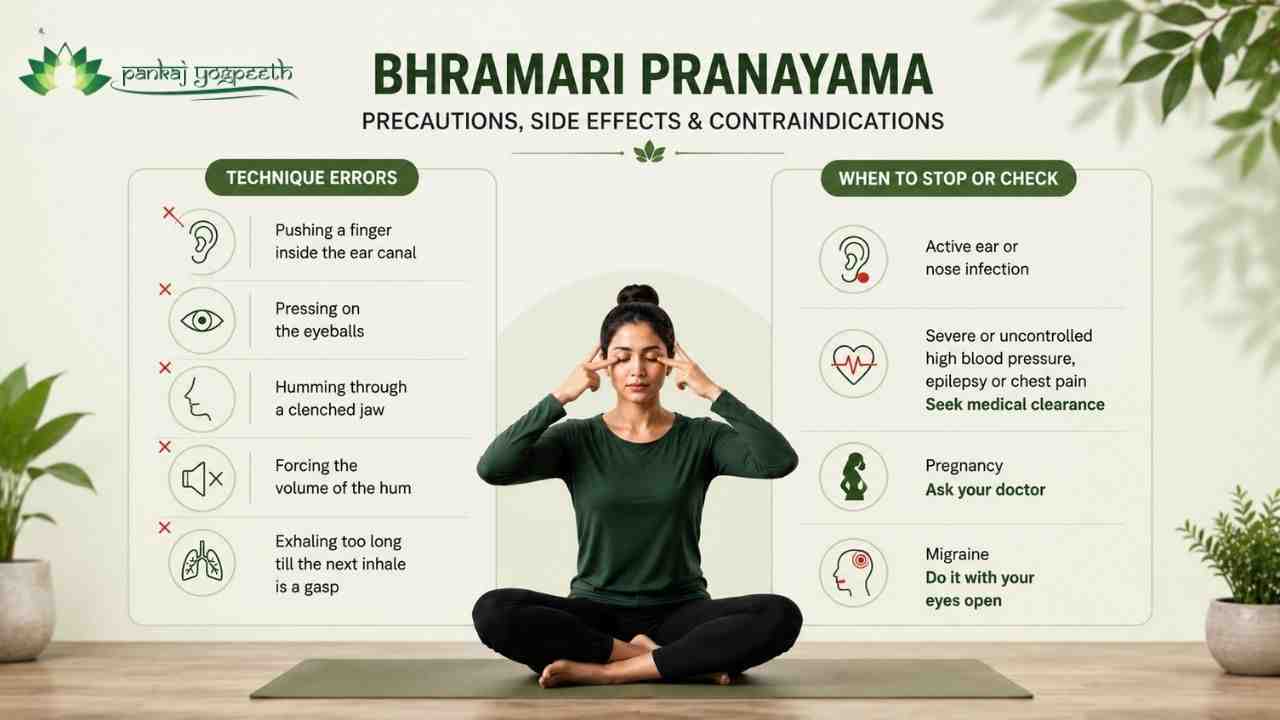
Two separate things get muddled here, so let us keep them apart. Things you may be doing wrong. Here are the common technique errors, and they can all be fixed in one session:
- Pushing a finger inside the ear canal instead of resting it on the cartilage in front
- Pressing on the eyeballs, not beside them
- Humming through a clenched jaw
- Forcing the volume of the hum
- Exhale as long as possible till the next inhale is a gasp
Reasons to stop or check with a doctor beforehand: an active ear or nose infection; wait until it clears up. If you have severe or uncontrolled high blood pressure, epilepsy or chest pain, seek clearance before you start. Pregnancy: Ask your doctor, as caution here is conventional, not tested. Migraine: don’t bother with the mudra; do it with your eyes open.
The honest answer about periods is that the warning is conventional and the evidence behind it is poor. If it feels right, then it is right. Be gentle, and decide for yourself.
One guideline, no exceptions: never lie flat in practice. When side effects occur, they are modest and temporary, such as mild dizziness and some ear irritation, and are virtually always due to technique, not the exercise itself.
Who Should Modify or Avoid Bhramari Pranayama
| Situation | Guidance | Why |
|---|---|---|
| Active ear or nose infection | Avoid until it clears | Pressure and vibration aggravate it |
| Migraine | Eyes open, skip the mudra | Covering the eyes can trigger dizziness |
| Pregnancy | Ask your doctor first | Traditional caution, limited data |
| Menstruation | Optional, keep it gentle | Traditional caution only |
| Severe hypertension, epilepsy, chest pain | Medical clearance first | Retention and facial pressure not advised |
| Lying down | Sit up instead | Resonance and safety both need upright posture |
For one group of readers in particular, the stress-and-sleep side of this practice is the whole point.
Where Bhramari Pranayama Fits in a Daily Yoga Practice
It’s not as big a deal as people think it is. Bhramari follows asana and before meditation, the body already warm and comfortable, the mind not yet asked to be quiet. That is where it is meant to be.
Asana relieves bodily restlessness. Bhramari looks after the mental side of things, so meditation starts from a quieter space rather than a conflict. Teachers teach it early on for the same reasons.
If you’re new to this and can’t even hold a posture yet, you can hum for five minutes and feel something move, which builds confidence fast. It does serious preparation work too. Pratyahara is the phase between breath control and meditation in the eight limbs a process of closing the senses inward, and bhramari is the most approachable entrance into it that exists.
Conclusion
Bhramari pranayama is a leisurely inhale, a long hum, and two minor things that make or break it, finger on the tragus, not in the ear; teeth apart, not clenched. The honest benefit is narrower than most pages means, but the parts that stand up are the aspects that matter most: calmer mind, steadier breath, better sleep.
Begin with five rounds tomorrow morning. Add one per week. That mental noise reduction you felt in the first round is not something you do. Now you can make it anywhere, in five minutes, on demand.
Want to go deeper than one technique? Most easily can open breath practices while a teacher is watching. At Pankaj Yogpeeth, we offer residential yoga teacher training in Rishikesh and Pokhara, with pranayama, meditation and asana from total beginner to certified instructor.