
Some nights, the body is tired, but the mind will not rest. Even when you close your eyes and lie down, your mind keeps going. You go to sleep late and wake up in the morning without having had much rest. This is where yoga nidra can help. As you lie still and listen to a soft voice, you can practice this ancient form of conscious rest. Your mind stays slightly awake while your body falls into deep stillness.
So is yoga nidra just another way of sleeping? Not quite. In sleep, you lose awareness, but in sleep yoga nidra, you remain aware while the body rests as deeply as it does at night. That is what makes it such a powerful practice for deep relaxation.
But the truth is simple. Before you can practise it, you must first understand what yoga nidra really is, and where it comes from.
What Is Yoga Nidra?
So, what is yoga nidra? In simple words, it is the practice of conscious sleep. You lie down completely still, you follow the voice of a teacher, and the body slowly falls into the depth of sleep while your awareness stays gently awake. Nothing is forced here. There is no posture to hold, no breath to control. You only listen, and let go.
Is yoga nidra meditation, or is it something else entirely? It sits somewhere between the two. Seated meditation asks you to hold your attention, but yoga nidra meditation asks you only to receive, which is why so many people find it easier to begin with.
What Does Yoga Nidra Mean in Yogic Tradition?
The word itself carries the answer. Nidra means sleep, and yoga means union. So when a seeker asks what yoga nidra is, the old teachers would say it is the sleep of the yogi, a state where rest and awareness live together. It is a practice as old as the Tantras, carried down through generations of teachers here in the Himalayas.
And once you understand this, a natural question follows.
Is Yoga Nidra the Same as Sleep or Meditation?
Many seekers come to us with this doubt. They have tried sitting for meditation and found the mind too restless. They have tried sleeping longer and still woken up tired. Yoga nidra sleep is neither of these, though it borrows something from both. It gives you the depth of sleep and the clarity of meditation, held together in one quiet practice. The table below makes the difference easy to see.
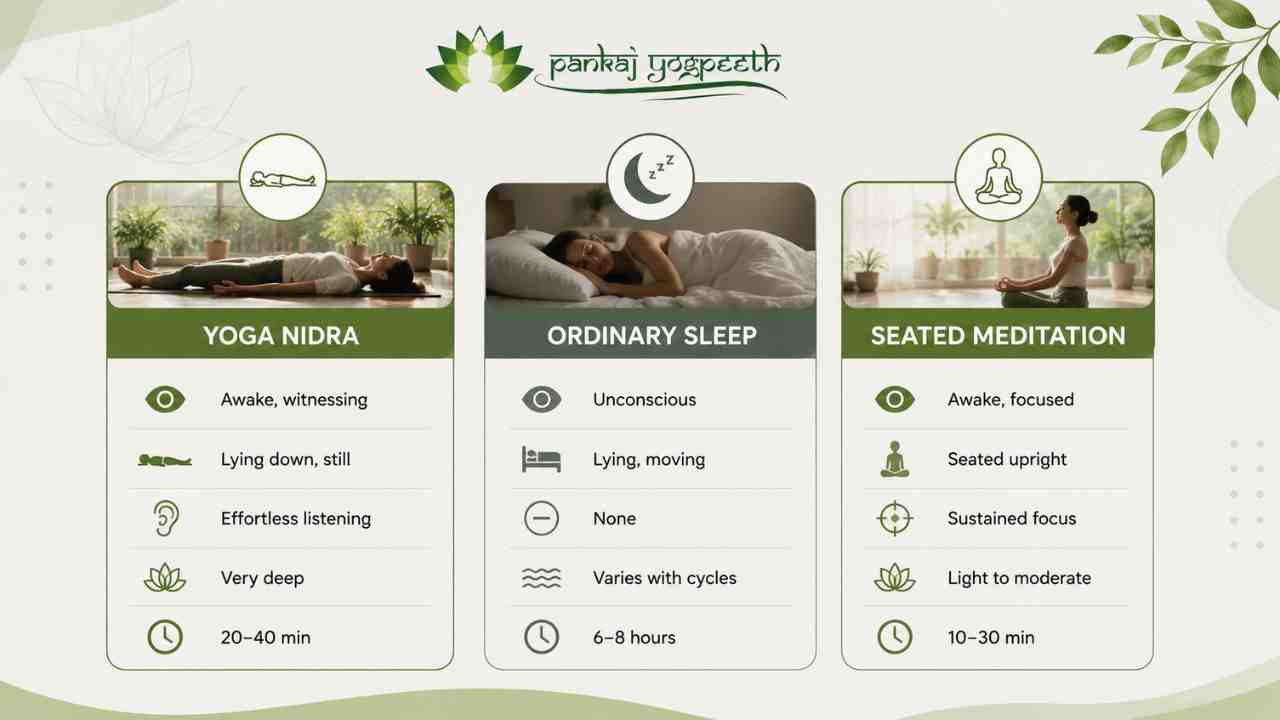
| Yoga Nidra | Ordinary Sleep | Seated Meditation | |
|---|---|---|---|
| Awareness | Awake, witnessing | Unconscious | Awake, focused |
| Body position | Lying down, still | Lying, moving | Seated upright |
| Effort | Effortless listening | None | Sustained focus |
| Depth of rest | Very deep | Varies with cycles | Light to moderate |
| Typical length | 20–40 minutes | 6–8 hours | 10–30 minutes |
Look closely, and you will notice the real difference lies in awareness. Sleep takes it away from you. Seated meditation asks you to hold it. Yoga nidra meditation simply lets it rest, open and quiet, while everything else settles.
But can yoga nidra replace sleep altogether? No, and it was never meant to. It supports your sleep and deepens its quality, but the body still needs its full night of rest.
So what is actually happening inside you during those quiet minutes?
What Does Yoga Nidra Do to the Body and Mind?
Something quiet begins to shift the moment you lie down and stop trying. What does yoga nidra do in those first few minutes? It signals to the body that there is nothing left to guard against. And once that signal is received, everything downstream begins to soften on its own.
Does Yoga Nidra Calm the Nervous System?
Yes, and this is where the whole practice takes root. Most of us live with the nervous system slightly switched on, always ready, always alert. When you lie still and follow the rotation of awareness through the body, that alertness is no longer needed. The system shifts toward rest, the breath slows without being told to, and the muscles let go of tension they've held for years. This is why yoga nidra for deep relaxation works so well even for those who have never practised yoga before.
What Happens in the Brain During Yoga Nidra?
The mind moves with the body. Over time, the brain slows down until it reaches a state of rest that you would normally only reach in deep sleep. Thoughts don't go away, but they get weaker around you.
| Layer of Being | What Happens in Yoga Nidra | What You Feel |
|---|---|---|
| Nervous system | Shifts toward rest-and-digest | Breath slows, tension eases |
| Brain activity | Moves toward slower, restful states | Thoughts settle |
| Muscles | Deep release through rotation of awareness | Heaviness, warmth |
| Breath | Softens without control | Steady, quiet rhythm |
| Emotions | Held gently, without reaction | Lightness after practice |
This is how the body works. What it gives you back in the long run is a different story.
What are the Benefits of Yoga Nidra
What the practice gives you back comes slowly, and you often notice it in everyday situations. A day that used to make you nervous goes by without leaving a trace. The benefits of yoga nidra that people talk about the most are usually not very big. They are small changes in the way you live your life.
What is yoga nidra and its benefits if you have never practised yoga before? It asks nothing of you that you cannot already do, because lying still and listening needs no flexibility, no experience, and no strength.
Is Yoga Nidra Good for Stress and Anxiety?
Yes, and this is where most people who are looking for change feel it first. Stress stays in the body long after the event is over. It shows up in the jaw, shoulders, and shortness of breath. The long-held stress has a place to go in yoga nidra. When you do it often, your body learns a new default: rest is available, not something you have to work for at the end of a long day.
What Are the Physical Benefits of Yoga Nidra?
The body responds in its own steady way. Over weeks of practice, the benefits of yoga nidra begin to show themselves in small, ordinary signs:
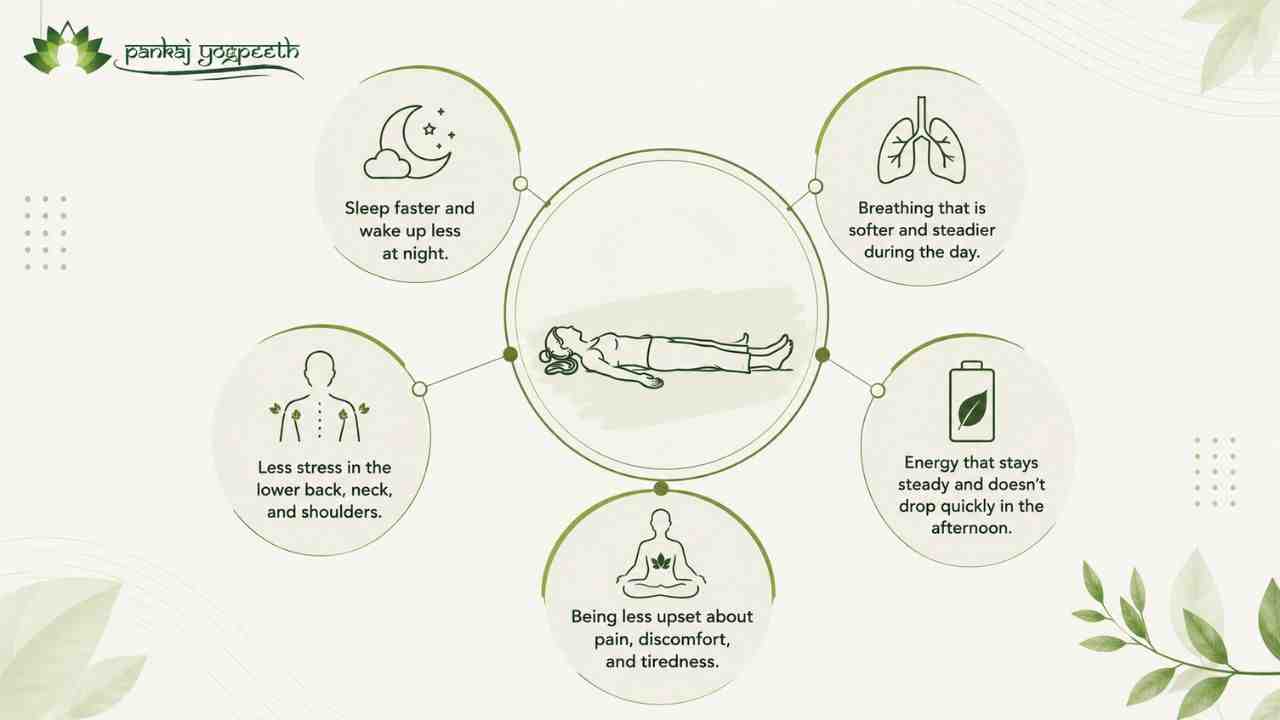
- Going to sleep faster and waking up less at night.
- Breathing that is softer and steadier during the day.
- Less stress in the lower back, neck, and shoulders.
- Energy that stays steady and doesn't drop quickly in the afternoon.
- Being less upset about pain, discomfort, and tiredness.
None of this happens overnight. But of all these gifts, the one seekers ask about most is sleep.
How Does Yoga Nidra Help with Sleep?
Sleep doesn't come from trying harder. It comes when the body finally believes it is safe to let go, and that is exactly what this practice offers. Yoga nidra for sleep works by taking the mind out of its searching and giving it something soft to rest upon instead.
Is yoga nidra good for sleep if you already sleep well? Yes, because it improves the quality of your rest, not just the hours, and even good sleepers wake feeling clearer after regular practice.
Is Yoga Nidra Good for Deep Sleep?
This is where the practice does its best work. Many people sleep for a long time but still feel tired when they wake up because they only got light, broken rest all night. In yoga nidra for deep sleep, the body learns to slow down even more, to the point where real healing can happen. Yoga Nidra deep sleep is less something you try to find and more something your body knows how to do over time.
Does Yoga Nidra Help with Insomnia?
For many, yes, and often more gently than anything else they have tried. Yoga Nidra for insomnia doesn't fight sleeplessness. It removes the struggle around it, so the night stops feeling like a battle you are losing.
| Sleep Difficulty | How Yoga Nidra Supports You | Best Time to Practise |
|---|---|---|
| Trouble falling asleep | Quietens mental chatter before bed | 30 minutes before sleeping |
| Waking through the night | Trains the body to return to rest | On waking, lying in bed |
| Light, unrefreshing sleep | Deepens the quality of rest | Early evening |
| Racing thoughts at bedtime | Anchors attention to breath and body | Just before lying down |
| Daytime tiredness | Restores energy without long naps | Early afternoon |
If this is what you are seeking, the next step is knowing how the practice actually unfolds.
How to Do Yoga Nidra Step by Step
The traditional practice moves through eight stages, and each one carries you a little further inward. Understanding how to do yoga nidra is less about memorising these stages and more about learning to follow without resisting.
What Do You Need Before You Begin?
Very little, and that is part of its beauty. You lie down in shavasana, the body straight, the palms open, the eyes closed. A blanket over you, because the body cools as it settles.
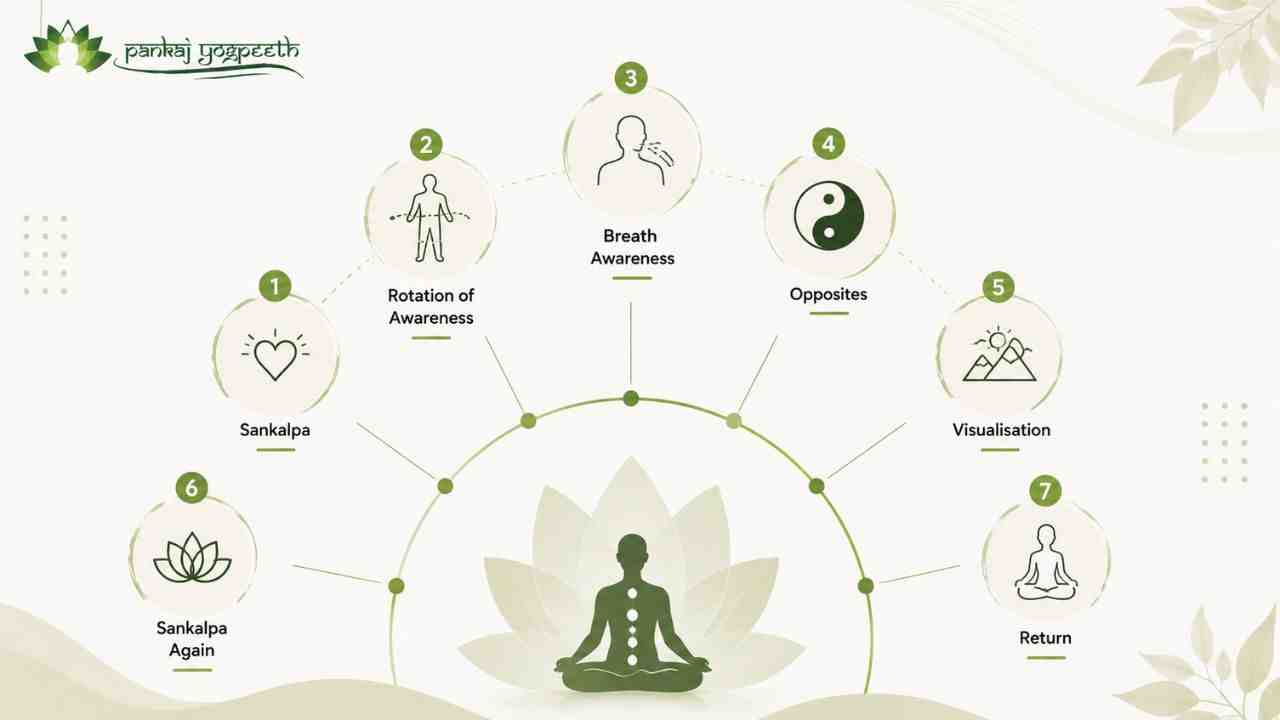
From there, the teacher's voice carries you through eight stages that always follow the same order:
- Preparation: Getting the body stable and making the easy decision to stay awake.
- Sankalpa: Your goal, said three times in silence.
- Rotation of awareness: Going through the body piece by piece.
- Breath awareness: As you count backwards, let the breath get softer.
- Opposites: Heavy and light, warm and cold, were held one after the other.
- Visualisation: Soft pictures are shown to a mind that is at ease.
- Sankalpa again: The same goal, but buried deeper.
- Return: Slowly brought back to the day and the room.
How to practise yoga nidra when your mind keeps wandering? You simply return, and you keep returning, because the wandering is not a failure but the very thing the practice works with.
What Is a Sankalpa in Yoga Nidra?
It is your heartfelt intention, always in the present tense. Not a wish, but a truth you plant in the deepest soil of the mind. Once you know the stages, you can begin the practice wherever you are.
How to Do Yoga Nidra at Home
You do not need a hall, a teacher beside you, or a special hour of the day. Learning to do yoga nidra at home only requires a corner where you will not be disturbed and a willingness to lie down and listen.
What Do You Need to Do Yoga Nidra at Home?
Less than you think. The table below covers everything you need to arrange before you begin.
| Element | Simple Guidance | Why It Helps |
|---|---|---|
| Space | Quiet room, dim light | Reduces sensory pull |
| Support | Mat, blanket, small pillow | Keeps the body at ease |
| Position | Lying flat, arms open | Allows full release |
| Sound | Guided voice or soft silence | Gives the mind an anchor |
| Duration | Start with 20 minutes | Builds the habit gently |
Set these up once, and the practice becomes much easier to return to.
How Do You Follow a Guided Recording?
At the start, a voice helps more than silence does. A yoga nidra guided meditation holds the sequence for you, so your mind doesn't wander about what comes next. Choose one and stay with it for a few weeks. If you are practising before bed, a yoga nidra sleep meditation works beautifully, and sleep yoga nidra of this kind will often carry you under before the recording ends. Which brings us to the question of timing.
When Should Yoga Nidra Be Done?
There is no single right hour. When you should do yoga nidra depends less on the clock and more on what you are carrying that day, and when you can lie down without rushing back to something.
When should you do yoga nidra for the deepest rest? The evening hours tend to give the most, because the body is already inclined toward stillness and asks for less persuasion.
Should You Do Yoga Nidra in the Morning or at Night?
Both have their gifts, and you may find yourself moving between them as your practice settles. Morning practice clears the mind before the day crowds in. Night practice releases what the day has left behind. If you are seeking sleep, the evening will serve you better, since sleep yoga nidra practised close to bedtime often carries you straight into the night.
| Time of Day | What It Offers | Suits You If |
|---|---|---|
| Early morning | Clear, settled start | You wake tense or anxious |
| Midday | Short reset without heaviness | Your afternoons feel foggy |
| Early evening | Releases the day's tension | You carry work home |
| Before bed | Softens into natural sleep | You struggle to fall asleep |
Choose the hour you can keep. A practice done at an imperfect time is still yoga nidra for deep relaxation, and it will do far more for you than a perfect hour you never reach.
Where Can You Learn Yoga Nidra Properly?
A recording will take you far. But there comes a point where you want to understand why the practice works, not only that it does. That understanding comes from a teacher, and from time spent in the tradition itself.
Yoga nidra was never meant to stand alone. It sits inside a wider path, beside pranayama, beside meditation, beside the asana that prepares the body to be still. Learn one and the others begin to open.
At Pankaj Yogpeeth, we teach yoga nidra meditation as part of our 200-hour yoga teacher training in Rishikesh, where the Ganga runs past the Himalayas and the day begins early. The same curriculum and gurus carry our courses to Pokhara, Nepal, for those drawn to the mountains there.
If you wish to one day teach this practice, or simply to understand it fully, you will find a place here whenever you are ready.