
You have been going to class for a while now. You know your way through a sun salutation. Then someone mentions, almost in passing, that postures are one part of eight, and that the 8 limbs of yoga were never mainly about the body. That is Patanjali's 8 limbs of yoga, and it is where yoga philosophy actually begins.
This guide walks through all eight in plain English, with the Sanskrit names and what they mean, whether the order matters, and what a beginner can do this week. Most guides list the eight and stop.
The better question is one Patanjali answers with a single word: are these steps you climb, or limbs you grow?Start with the list itself. The reasoning behind it comes right after.
What Are the 8 Limbs of Yoga in Order?
In order, the eight limbs of yoga are Yama, Niyama, Asana, Pranayama, Pratyahara, Dharana, Dhyana and Samadhi. The Sanskrit names look powerful at first, yet behind each one is a simple principle. So here they are, clear and simple, with what each is really asking you to do.
The 8 Limbs of Yoga in Order
| No. | Sanskrit | Meaning | What it asks of you |
|---|---|---|---|
| 1 | Yama | Ethical restraints | How you treat others |
| 2 | Niyama | Personal disciplines | How you treat yourself |
| 3 | Asana | Posture | A steady, comfortable seat |
| 4 | Pranayama | Breath control | Working with the breath |
| 5 | Pratyahara | Sense withdrawal | Turning attention inward |
| 6 | Dharana | Concentration | Holding one point of focus |
| 7 | Dhyana | Meditation | Focus becoming effortless |
| 8 | Samadhi | Absorption | Seeing without distortion |
Read down that list, and a pattern emerges. The eight limbs crawl steadily inward. The first two are about the way you live. Yama is how you relate to other individuals. Niyama is about your connection with yourself. Neither of them occurs on a mat.
The next three bring you into the body. Asana stabilises the posture. Pranayama works with the breath. Pratyahara begins to withdraw your attention from all things outside you.
The last three are only in the head. Dharana is single-pointed. Once it ceases feeling like work, that becomes Dhyana. When even the effort of watching has ceased, what remains is Samadhi. Note that just one of the eight concerns poses. That order resembles a staircase. Is this actually how it works? It’s a question to cling to, but first: where did this list originate?
Where Do the 8 Limbs of Yoga Come From? Patanjali's Yoga Sutras Explained
It is not a modern list; it was not invented by a studio. It comes from a teacher named Patanjali, who collected the yoga teachings of his time into 196 short verses called the Yoga Sutras. No one knows exactly when.
At least one scholar has dated the book somewhere between 200 B.C.E. and 400 C.E., and they still differ. What is certain, though, is that it became the foundational text of yoga philosophy, the framework that explains what all this practice is really about.
The eight limbs are mentioned in verse 2.29. Patanjali calls them ashtanga. Ashta is eight, and anga is limb. We'd been told, two chapters before, what the purpose was. 1.2 Yoga is defined as the end of the movements of the mind. And everything following that verse, all eight limbs, is just how you get there.
Quick clarification: Ashtanga yoga vs Ashtanga Vinyasa. These are two separate things that have the same name.
Ashtanga is the eight-limbed path of Patanjali, the philosophy discussed on this page. Ashtanga Vinyasa is the rapid, physical posture technique invented by K. Pattabhi Jois in the 20th century. The style borrowed the name. It is not the system. The source is settled, leaving eight individuals, starting with the two that almost everyone skips.
The First Two Limbs of Yoga: Yama and Niyama Explained
Patanjali did not start with the body. He started with behaviour. There is a reason for that, and it is not comfortable. What’s the use of a flexible physique if you’re still short with others, still stretching the truth, still restless the moment you walk off the mat? These two are the limbs everyone almost skips, and they are the ones the whole system is built on.
The 5 Yamas - How You Treat the World Around You
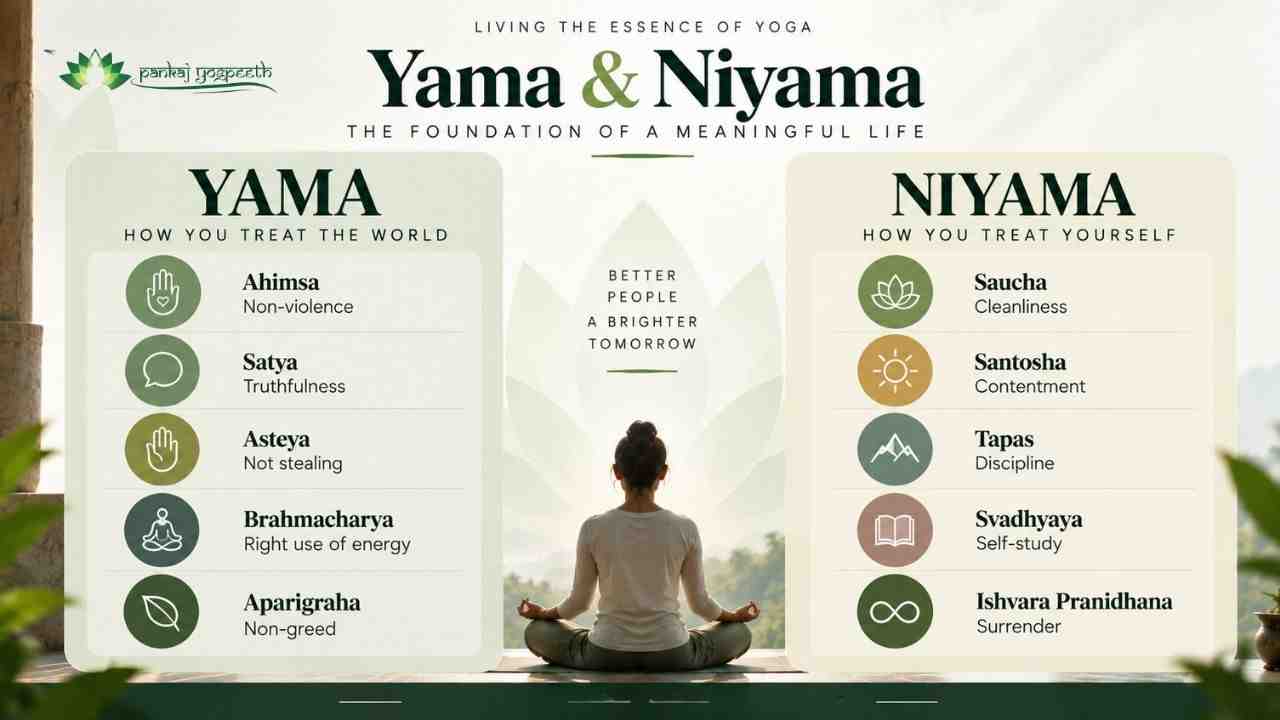
The Yamas deal with other people. Think of them as the limits you set on how you interact with the environment.
- Ahimsa - non-violence. Not only not harming others but eliminating the silent hurt you commit to yourself
- Satya - truthfulness. In what you believe, what you say, and what you do
- Asteya - not stealing. Including non-object stuff: somebody’s time, credit, attention
- Brahmacharya - proper use of energy. Moderation, not spreading yourself in all directions
- Aparigraha – non-greed. Not holding onto, not hoarding, not wanting more to find peace
The 5 Niyamas - How You Treat Yourself
The Niyamas direct the same inward focus. These are private habits. They are done in private, when no one is observing.
- Saucha – cleanliness. Your body, your space, and what you allow into your head
- Santosha – satisfaction. Releasing comparison, on and off the mat
- Discipline - Tapas. The inner fire that gets you practising on the days you don’t want to
- Svadhyaya – self-study, observing your own patterns and reading what wiser people said about theirs
- Ishvara Pranidhana – surrender. believing in something bigger than your effort
Yama vs Niyama - What's the Difference?
| Basis | Yama | Niyama |
|---|---|---|
| Direction | Outward | Inward |
| Concerns | Others, the world | Yourself |
| Nature | Restraints - what to avoid | Observances - what to cultivate |
| Example | Ahimsa: don't harm | Santosha: cultivate contentment |
| Practised | In every interaction | In private, daily |
Having established the ethical foundation, Patanjali moves on to the body and to the limb that most people these days confuse for all of yoga.
The 8 Limbs of Yoga Explained: Asana, Pranayama and Pratyahara
There are eight, and these three are the bridge in the centre. Behaviour behind you, the mind ahead, and the body and breath in between.
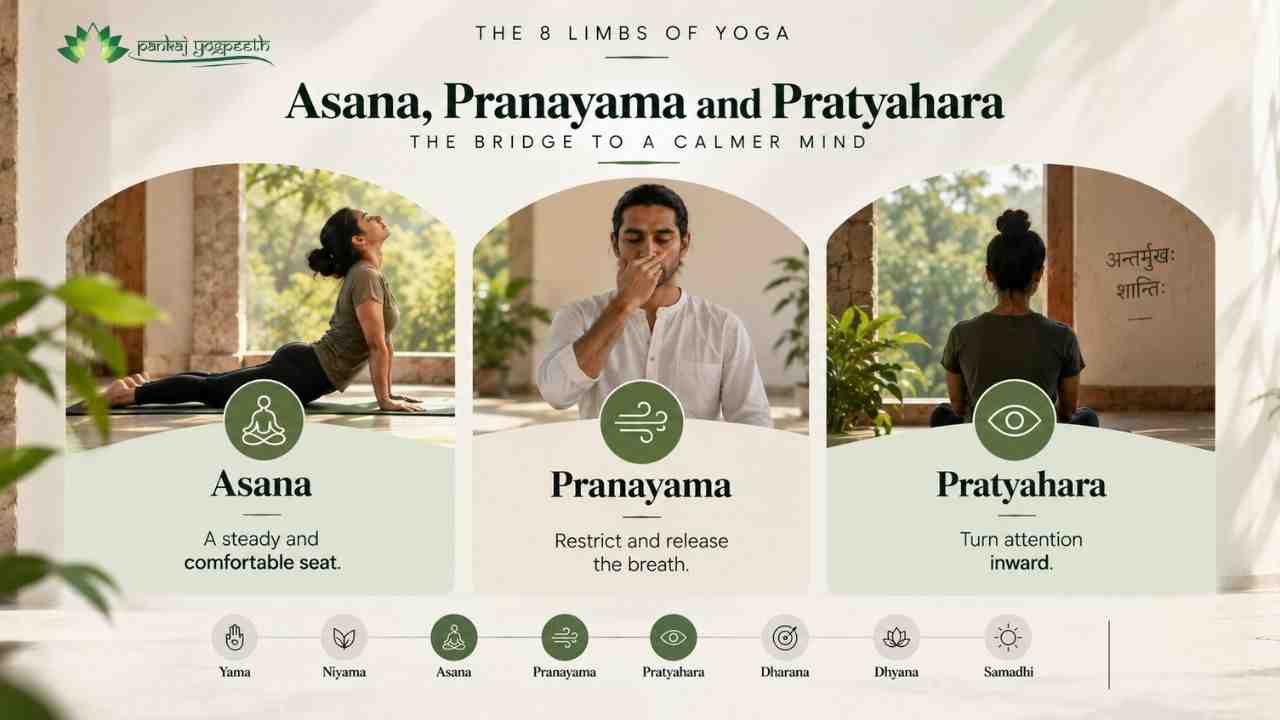
Asana: Why "Posture" Doesn't Mean What You Think
This is the bit that surprises most people. Asana does not mean a position. It means seat. In the 196 verses, Patanjali gives us only one piece of advice on how to hold a posture: sthira sukham asanam, steady and pleasant.
That is the entire alignment cue. Not deep or impressive. Stable and comfy. Asana was designed so that one could sit for long periods of meditation. Much later came all the contemporary studio stuff constructed on top of it.
Pranayama: Breath Control or Breath Freedom?
Pranayama connects two words. Prana is the life energy. Ayama is an extension or a control. Read it as prana-yama, and it signifies breath control, constraint. Read it as prana-ayama, breath expansion, freedom. Both are correct, yet they point in opposite directions.
That double meaning is no translation error. It reflects something true about breathing practice: you are restraining and releasing at the same time. This is also the branch of medicine that modern medicine takes seriously, because measurably slowing the breath down relaxes the nervous system.
Pratyahara: Turning the Senses Inward
Pratyahara is sometimes interpreted as withdrawal of the senses, which suggests turning the senses off. You can't turn them off. What happens is absorption. You grow so engaged in what is inside that what is outside no longer pulls at you.
You’ve done this before, lying in savasana, or midway through a book you couldn’t put down. The noise continued. It didn't matter anymore. Pratyahara is the inward turning of attention. What happens after it stays there are the remaining three limbs.
Dharana, Dhyana and Samadhi: The Inner Journey
Tradition has it that these three are one continuous act. Dharana is like a drop-by-drop stream of water. Dhyana is like oil spilt in a steady stream. That flow flowing into the water is samadhi.
Dharana in Yoga: Focused Concentration
Dharana is the concentration upon one spot. A candle flame, a mantra, the breath, it does not matter which. The useful thing to know: this is the state most individuals are in when they say they are meditating. That's not a failure. It's the job.
Dhyana: When Meditation Happens by Itself
Is meditation a part of the 8 limbs of yoga? Yes, the seventh is Dhyana. But Dhyana is not something you do. It comes when you no longer need effort to concentrate. The tell is simple: if you think I'm meditating, you're still in Dharana.
Samadhi: What Enlightenment Actually Means
Break the term down. Sama implies equal, or the same. Dhi means see. Samadhi means seeing equally. Not falling asleep. Not happiness. To see life as it is, without your likes and dislikes and habits colouring what is in front of you. Eight limbs in order, as Patanjali listed them, which leads us back to the question we started with.
Do You Have to Practise the 8 Limbs of Yoga in Order?
No. And the solution lies in the name. Patanjali termed them limbs, not steps. That was a decision. You go up a staircase one stair at a time. One after the other. You can not get to the fourth without the third. Limbs don't work like that. An arm doesn't grow first and a leg later. The whole thing grows together.
Traditionally, teachers use a chair to explain this. A chair has four legs. You lift one, and the whole chair comes with it. The eight limbs are the same: work on one and the others get stronger quietly with it.
You may observe this in only one class. An hour of asana includes breathing with intention, bringing your mind inward, and moments when your focus holds without wandering.
That's limbs three to six happening simultaneously with or without someone calling them. Most individuals nowadays enter through the third limb and find the rest catching up on their own.
So the 8 limbs of yoga aren't a ladder to climb. It's a bunch of stuff that all works together. Which leaves the only thing that matters for a newbie: what do you actually do with this on Monday morning?
How to Practise the 8 Limbs of Yoga in Daily Life
Start with one limb. Not eight. Choose the one that already bothers you and be honest, because most people know immediately which one it is. The one who can't sit still knows. The one who continues comparing knows.
This is what that really looks like. Say you choose Satya, truthfulness. For one week, your only job is to notice the small untruths. The "I'm fine" when you are not. The reason you gave for being late was not quite the reason.
You aren't fixing anything yet. "Just looking." And while you do that, something else happens that you didn't set up. Svadhyaya, the fourth Niyama, involves observing your own patterns. A tiny decision, two limbs acting at the same time.
One Small Practice for Each Limb
| When | Limb | Try this today |
|---|---|---|
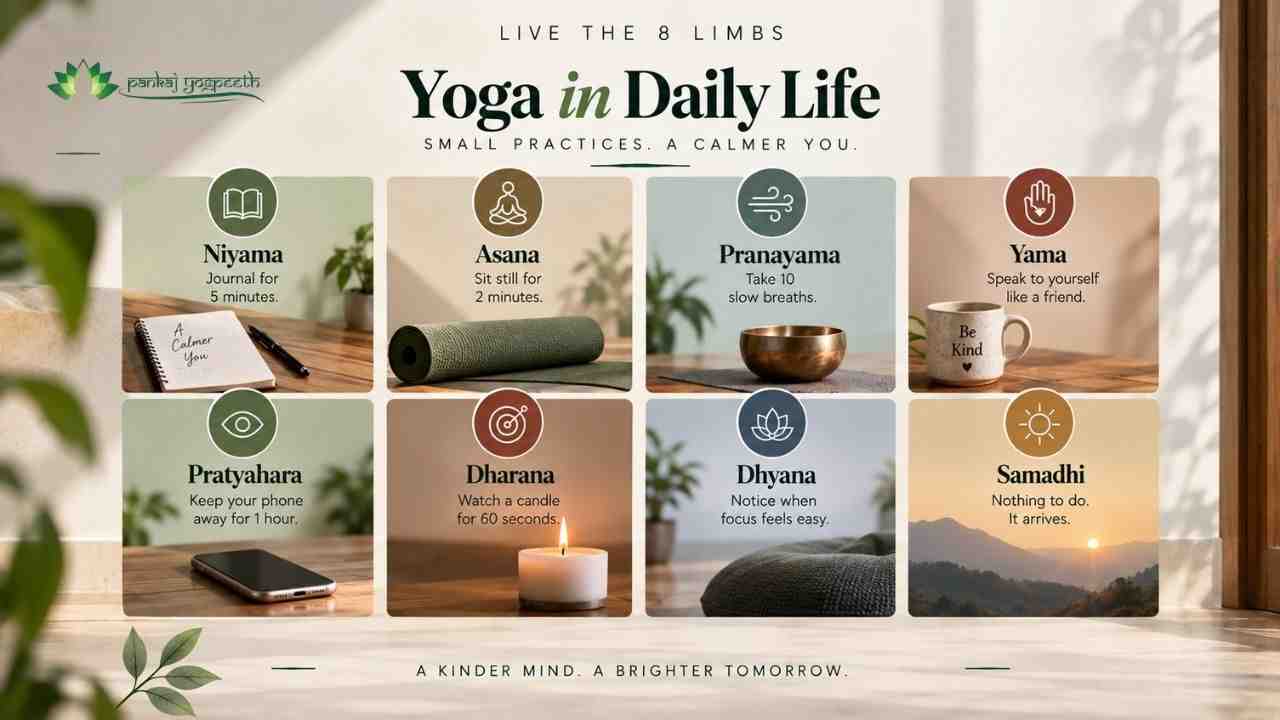
| Morning | Niyama | Five minutes of journaling |
| Morning | Asana | Sit still two minutes without adjusting |
| Morning | Pranayama | Ten slow breaths before you check your phone |
| Workday | Yama | Speak to yourself as you would to a friend |
| Workday | Pratyahara | Phone in another room for one hour |
| Evening | Dharana | Watch one candle flame for 60 seconds |
| Evening | Dhyana | Notice when focus stops feeling like effort |
| Anytime | Samadhi | Nothing to do, this one arrives |
None of this is a checklist to be ticked off. It's more like carrying a lens than achieving a task. Living the 8 limbs of yoga is closer. Progress is noticing more, not doing more. They seem tiny, but they change something bigger over time.
Why the 8 Limbs of Yoga Matter in Modern Practice
The promise is in verse 2.28. It states that steady practice of the limbs causes impurities to fade away until wisdom comes through. Without the poetry, the importance of the 8 limbs of yoga comes down to one thing: the aim is clarity, not achievement.
There is no certificate in the end. The real benefits of the 8 limbs of yoga are less and more mundane than that verse claims. People dispute less after a year of using this model. They find themselves hurrying earlier. They sleep better.
And the mat slowly stops being the only place yoga happens, which is what yogic philosophy was intended for in the first place. Along the journey, a few prevalent notions about yoga slowly uncoil.
6 Common Misconceptions About the 8 Limbs of Yoga
| Common belief | What Patanjali actually says |
|---|---|
| Yoga means postures | Asana is one limb of eight |
| Asana means difficult poses | Sthira sukham, steady and comfortable |
| You climb the limbs in order | They are limbs, not steps |
| Ashtanga yoga is a vinyasa style | Ashtanga means the eight-limb system |
| Meditation is something you do | Dhyana arrives; Dharana is the doing |
| Samadhi means blissing out | Sama-dhi, seeing equally |
Understanding the eight is another. That's what a training's for: to live inside of them.
Conclusion
Not eight steps, but eight limbs. Such is all there is to the distinction. The postures are one limb of the 8 limbs of yoga, and the two that come first, how you treat others, how you treat yourself, are the two almost everyone walks past. So choose one this week.
Let it be the one that has been annoying you since you read its name. That moment you realized yoga was bigger than the mat is not a hole in your practice. It's the beginning of one.
Study the concept, not the postures. The Yoga Sutras are a lifetime’s study and require a teacher to unlock them. Pankaj Yogpeeth’s Yoga Teacher Training in Rishikesh is taught as a lived system, teaching Patanjali’s eight limbs through the day, philosophy in the morning, asana, pranayama and meditation.