

Yoga asanas for diabetes are not a cure, and it is better to say that at the very start. But they are something you can do. Something that belongs to you, in your own room, on your own mat, every morning.
Perhaps a report came back with a number you did not expect. Perhaps a doctor spoke a few careful words and handed you a slip. And somewhere in that quiet drive home, a thought arrived. Surely there is more I can do than swallow a tablet.
There is. Yoga has held this answer for a long time, patiently waiting for anyone who wishes to sit down and begin. In the pages that follow, we will walk through the poses, the breath, and the small daily habits that support blood sugar in a gentle and steady way.
How Does Yoga Support Diabetes Management?
When sugar sits high in the blood, it is not that the sugar is missing. It is there. It simply is not reaching the muscles that need it. So yoga's work is quiet. It brings the muscles back into use, and a working muscle draws sugar in without waiting to be asked.
Does yoga work on diabetes the same way a walk or a gym session does? Not quite. A walk moves the body, and that alone is good. Yoga moves the body while slowing the breath, and a slowed breath softens the stress that keeps blood sugar raised through the day.
Then there is the belly. Many asanas fold, twist and press gently through the abdominal region, giving a soft internal massage to the organs sitting beneath.
Why Does Stress Raise Blood Sugar?
Because the body does not know the difference between real danger and a long, difficult week. Under pressure, it releases cortisol, and cortisol has one instruction. Release stored sugar, so the muscles are ready to run.
But you are not running. The sugar arrives and stays. Yoga breaks that loop, and this is where the real question begins.
Can Yoga Help Manage Blood Sugar Levels?
Yes, but it helps to be clear about what that yes means.
Yoga for blood sugar is supportive. It is not a treatment, and it does not replace the medicine your doctor has given you. It works alongside that medicine, quietly, so the body is better positioned to use what it receives.
Studies have shown that people who do yoga regularly for a few weeks often see improvements in their glycemic markers. These are the numbers that doctors use to see how sugar has changed over time. Not right away. But gradually, in the way that things change slowly.
How Long Does It Take to See a Change in Blood Sugar?
Longer than you would like, and sooner than you fear. A single session may shift a reading a little, but that shift doesn't last. What stays is built over weeks. Most people who practise on most days begin to notice something by the second month. So do not measure yourself by tomorrow morning's reading.
Measure yourself by whether you returned to the mat this week. Keep taking what you have been prescribed, speak to your doctor before you begin, and let yoga sit beside your care rather than in front of it. Now, to the poses themselves.
Which Are the Best Yoga Asanas for Diabetes?
Eight asanas carry most of the work here. Some twist, some fold, some lift, and each one reaches the body in its own way. You don't need all eight on the first day. You need to know them so you can choose from them :

Ardha Matsyendrasana, the Half Spinal Twist, wrings the middle of the body like a cloth. The spine turns, the belly presses, and the region around the pancreas and liver receives a slow squeeze that releases as you unwind.
Paschimottanasana, the Seated Forward Bend, is the opposite kind of work. Nothing is wrung. The body folds over the legs and stays there, and in that long stillness the belly is compressed, and the mind settles with it.
Mandukasana, the Frog Pose, is the most direct of them all. The fists rest against the abdomen, and the body folds down over them, so the pressure goes exactly where it is needed.
Dhanurasana, the Bow Pose, asks more of you. The body arches, the front opens, and the abdominal organs are stimulated while the back grows stronger beneath.
Bhujangasana, the Cobra Pose, offers a gentler version of the same shape. The chest lifts, the belly draws long, and almost anybody can hold it.
Setu Bandhasana, the Bridge Pose, works from below. The hips rise, and the thighs and glutes engage, and these are the large muscles that take up sugar most willingly.
Halasana, the Plough Pose, takes the legs overhead and stretches the thyroid along with the abdominal region. It is the most demanding pose here.
Vajrasana, the Thunderbolt Pose, asks almost nothing. You sit. You can even sit after a meal, and digestion is supported without a single strain.
Knowing how each one works is the first half. Knowing how to practise it is the second.
| Asana | Difficulty | Hold time | Best practised |
|---|---|---|---|
| Vajrasana (Thunderbolt Pose) | Easy | 5 to 10 minutes | After meals |
| Bhujangasana (Cobra Pose) | Easy | 15 to 30 seconds | Empty stomach |
| Setu Bandhasana (Bridge Pose) | Easy | 30 to 60 seconds | Empty stomach |
| Ardha Matsyendrasana (Half Spinal Twist) | Moderate | 30 seconds each side | Empty stomach |
| Paschimottanasana (Seated Forward Bend) | Moderate | 30 to 60 seconds | Empty stomach |
| Mandukasana (Frog Pose) | Moderate | 30 seconds | Empty stomach |
| Dhanurasana (Bow Pose) | Advanced | 15 to 20 seconds | Empty stomach |
| Halasana (Plough Pose) | Advanced | 15 to 30 seconds | Empty stomach |
The table is sorted from easiest to hardest, so it also works as an order. Begin at the top and stay there for a while. But before you step onto the mat, it helps to understand what these poses are actually doing inside you.
Yoga Asanas for Diabetes Control: How Do These Poses Work?
Two things happen in every practice, and they are not the same. The first is muscular. When the thighs hold a lift, those large muscles begin pulling sugar out of the blood to fuel themselves, without insulin having to do all the persuading. This is why movement matters so much for yoga asanas for diabetes control.
The second is quieter. A twist narrows the abdominal cavity on one side and opens it on the other. Blood is pushed out, and when you unwind, fresh blood rushes back in. The digestive and pancreatic region receives this again and again.
Neither is dramatic alone. Repeated most mornings, they change the conditions your body works in.
How Do Forward Bends Work on the Abdominal Organs?
By pressing and then letting go. A fold brings the upper body down over the legs, and the belly is compressed between them. Hold it, and the pressure stays steady on the organs beneath. Release it, and the region floods with blood again. It is a massage you give yourself from the inside. And it works best when the practice itself is shaped well, which is where we turn next.
How Should Yoga Be Practised for Type 2 Diabetes?
The poses stay the same. The way you practise them does not.
Type 2 diabetes usually arrives alongside other things. A body that has sat more than it has moved. Some extra weight in the middle. Muscles grown less willing to accept sugar, which is what insulin resistance means in ordinary language. So yoga for type 2 diabetes is shaped for that body.
Speed changes are the main ones. A faster practice looks better but does less. A slower one gives the muscles time to work, which makes them more sensitive to insulin.
Second, your breath leads, not your effort. Stress hormones are released when you push yourself so hard that your breathing gets short and irregular. Go as fast as your breath will let you.
| What to adjust | Standard practice | Adapted for type 2 |
|---|---|---|
| Pace of movement | Flowing from one pose to the next | Slower, with a settled breath between each pose |
| Length of hold | Short holds of a few breaths | Longer holds so the muscles stay engaged |
| Effort level | Pushing towards the fuller expression | Working within comfort, never to strain |
| Warm-up | Brief joint loosening | Longer warm-up, especially for stiff or heavy bodies |
| Breath | Follows the movement | Leads the movement, kept slow and even |
| Rest between poses | Minimal | A short pause whenever the breath rises |
None of this makes the practice weaker. It makes it suit you.
Can People With Type 2 Diabetes Practise Yoga Daily?
Yes, and daily is better than long sessions. Twenty minutes most days will do more for your readings than one long session on a Sunday. The body responds to the rhythm of return. Keep one day lighter. Breathing, quiet sitting, a short walk. That day is part of the practice too, not a gap in it. If daily is the answer, the next question is where a beginner should start.
Which of These Poses Should a Beginner Start With?
Three. That is all you need for the first month.
Begin with Vajrasana, because it asks nothing of you. Sit, breathe, and let the body settle. You can even hold it after a meal, so it fits into a day without needing a slot of its own.
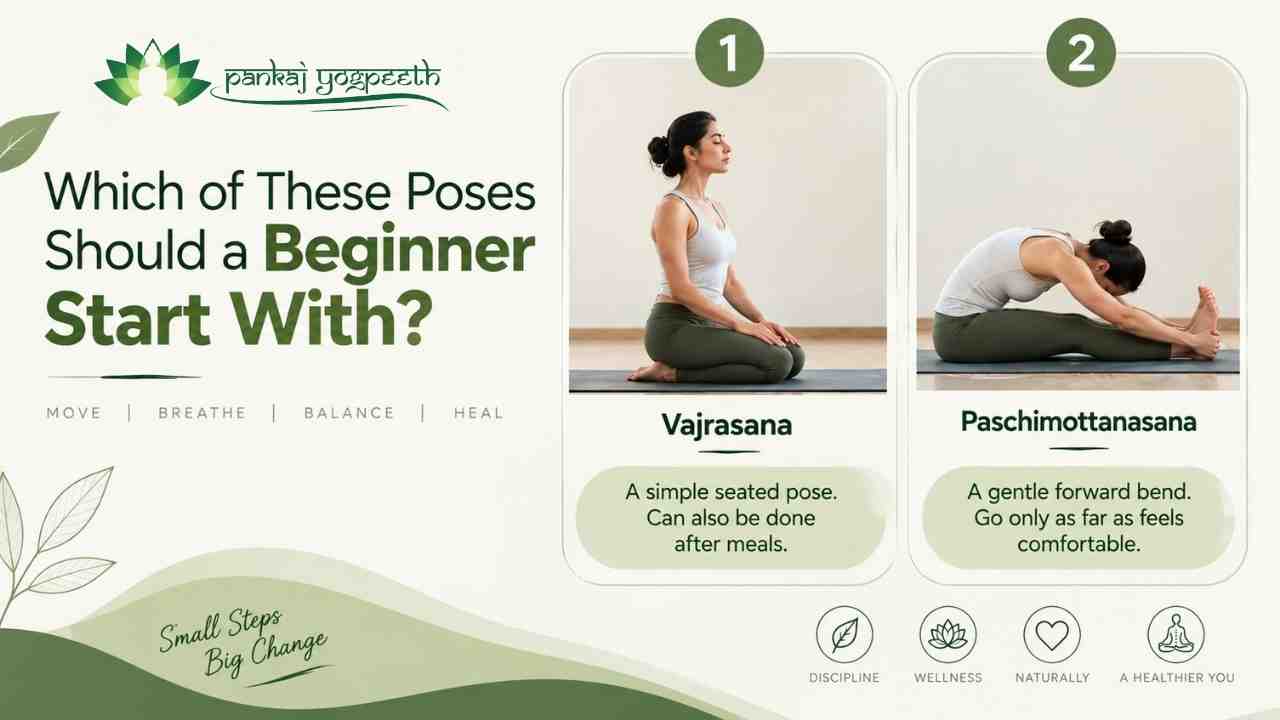
Add Bhujangasana next. The chest lifts only as far as it wishes to, and the belly draws long beneath. There is no version of this pose you can fail at.
Then Paschimottanasana. Fold forward over the legs and stop wherever the body stops. The knees may bend. The hands may not reach the feet. None of that matters.
Do you need to be flexible before you begin? No, and this misunderstanding keeps most people off the mat. Flexibility is what practice gives you, not what it asks of you.
What Should You Do If You Cannot Sit on the Floor?
Use a chair. Sit tall with both feet flat, and fold forward from the hips instead of the waist. The same compression reaches the belly. The same breath slows. Nothing essential is lost. Once you've chosen the poses, the question becomes when to practise them.
How Often and at What Time Should You Practise Yoga for Diabetes?
Most days, in the morning, before you eat. That is the short answer, and for most people it is the whole answer. But the reasons behind it are worth knowing, because they will help you adjust when life does not cooperate.
What Is the Best Time of Day to Practise?
Early morning, on an empty stomach.
Blood sugar tends to be at its most settled then; the body is unhurried, and the practice sets the tone for the hours ahead. If mornings are impossible, evening works too. Leave two to three hours after your last meal, and keep the practice gentler than a morning one.
One caution on medication. If your tablets or insulin are timed around meals, do not rearrange them to suit your yoga. Speak to your doctor and let the practice fit the medication, never the other way round.
How Long Should a Session Last?
Thirty minutes is enough. Twenty is enough on a difficult day. Forty is generous. What matters far more than length is that the week has a rhythm.
| Day | Focus of practice | Duration |
|---|---|---|
| Monday | Gentle warm-up with seated and lying poses | 30 minutes |
| Tuesday | Twisting poses with slow breathing | 35 minutes |
| Wednesday | Forward bends and abdominal work | 30 minutes |
| Thursday | Rest, with light walking and pranayama only | 15 minutes |
| Friday | Back-opening poses with longer holds | 35 minutes |
| Saturday | Full practice bringing the week together | 40 minutes |
| Sunday | Relaxation, pranayama and quiet sitting | 20 minutes |
Notice that two days are light. Those days hold the week together as much as the full ones do, and both of them lean on the breath. Which is worth a section of its own.
Can Pranayama Help With Diabetes Management?
Yes, and it reaches something that poses cannot. Stress keeps blood sugar raised. When the body stays in a low, steady state of alarm, cortisol keeps releasing stored sugar into the blood for a demand that never arrives.
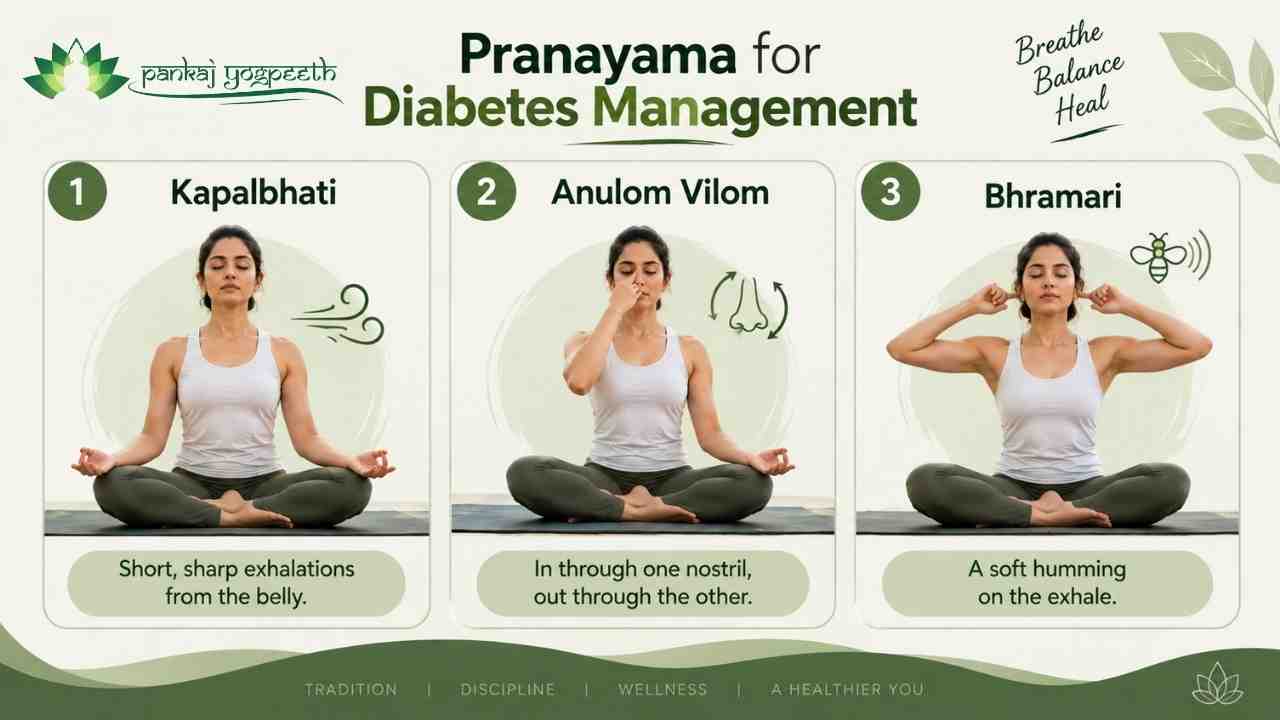
Breathing practices work directly on that alarm. Three are worth learning:
- Kapalbhati: short, sharp exhalations from the belly. Stimulates the digestive region. Keep it slow and stop the moment it feels forced.
- Anulom Vilom: in through one nostril, out through the other, then reverse. Nothing hurried. The steadiest of the three.
- Bhramari: a soft humming on the exhale. The one to reach for at night, when the mind will not put the day down.
Begin with Anulom Vilom if you are new to breathing practice.
Should Pranayama Come Before or After Your Asanas?
After. By then, the body is warm, the breath has already deepened on its own, and sitting still comes easily. Do it before, and you spend the first minutes settling a body that has not yet moved. One exception. If you are practising only breathing on a rest day, any time will do. Some of these suit everybody.
What Precautions Should Diabetic Patients Take Before Practising Yoga?
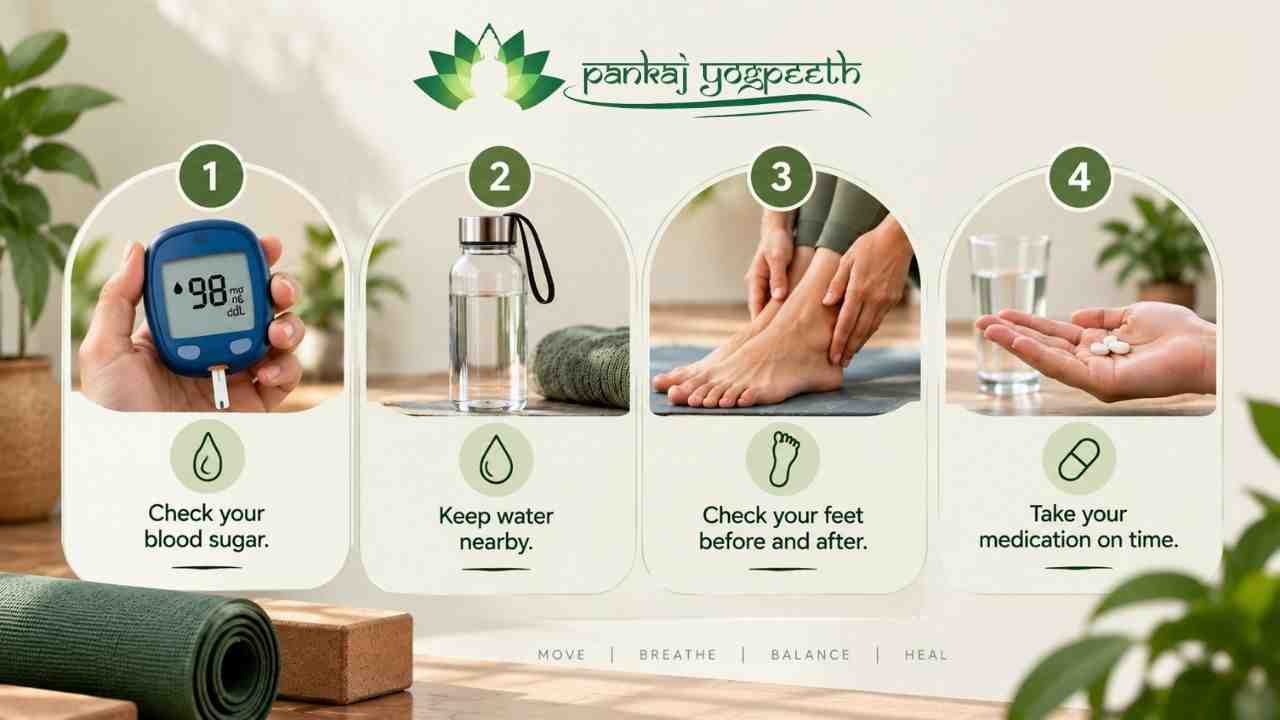
A few small habits keep the practice safe, and they take less than five minutes. Before you step onto the mat:
- Check your blood sugar, especially if you take insulin.
- Keep water within reach and drink through the session.
- Look at your feet before and after, and practise barefoot only if the skin is unbroken.
- Take your medication at its usual time, not at a time that suits your practice.
What should you do if your reading is low before practice? Eat something small and wait. A fruit, a few nuts, and twenty minutes. Practising on a low reading is the one situation where doing nothing is the wiser choice. Foot care deserves its own word. Diabetes can dull sensation in the feet, so a small cut or a blister may go unnoticed for days.
Look, rather than rely on what you feel. And stop if you feel dizzy, unusually short of breath, or shaky. That is information, not failure.
Which Yoga Poses Should Diabetic Patients Avoid?
Not many, but a few need care. Deep inversions are the main ones. If you have any eye complications from diabetes, particularly retinopathy, keep the head above the heart and leave inversions aside until a doctor and a teacher have both said otherwise. Strong, rapid breathing practices should also be softened if blood pressure is raised.
Is Yoga Safe if You Are Taking Diabetes Medication?
Yes, with one thing understood.
Yoga can lower your readings, and your medication is already doing the same work. Together they can bring the level down further than either would alone. That is not a reason to stop practising.
It is a reason to tell your doctor you have started, so your dose can be reviewed if it needs to be. Learning this well is easier with someone watching.
Where Can You Learn Yoga for Diabetes Properly?
You can begin alone.
Most people do. But a health condition changes what is at stake. A pose held slightly wrong for a week is a habit. Held wrong for a year, it is an injury. And no screen can tell you which poses to leave out on a morning when your reading is not where it should be.
At Pankaj Yogpeeth in Rishikesh, a Yoga Alliance Registered Yoga School, the teaching is grounded in classical Hatha foundations. More than seven verified gurus, over five hundred graduates, and philosophy and anatomy taught alongside the practice. You learn why a twist reaches the pancreas, not only that it does.
| What you face | Practising alone | Learning under a teacher |
|---|---|---|
| Getting the alignment right | Learned from a screen, often unnoticed if wrong | Corrected as it happens, before it becomes a habit |
| Knowing what to leave out | Guesswork, especially with a health condition | Adjusted to your body and your reports |
| Building a routine | Easy to begin, easy to drop | Held steady by a set rhythm and a teacher's eye |
| Understanding the why | Poses copied without meaning | Philosophy and anatomy taught alongside practice |
| Staying safe | You notice the strain only after it arrives | A teacher sees it before you feel it |
You need not wait for a teacher to begin. The practice simply deepens when someone is watching.
How Do You Begin Yoga for Diabetes Today?
You begin the way everyone begins. Sit down. Breathe for five minutes. That is a practice. It is not the practice you will have in a year, but it is the one that makes that year possible. Nothing here replaces your medicine, and nothing here promises a cure. What yoga offers is quieter and, in its own way, larger.
A body that moves again. A mind that stops bracing. A morning that belongs to you before the day claims it.
The readings will follow, slowly, in their own time. But that is not really the reason to begin. The mat is on the floor. The house is still quiet. Everything you have read here waits for one small decision, and only you can make it.