You feel tight in the chest, as if something is sitting on it. When you breathe out, you hear a tiny whistling sound. You are breathing faster than you should be, working for air that should come easily.
If this sounds like you, then pranayama for breathing problems is worth understanding. These yoga breathing exercises are easy, free, and you can practice them sitting in a chair.
This guide teaches you seven approaches, simple procedures, which to apply for which problem, what the study actually indicates, how to fit them into your week, and who should avoid which one. Most of the articles promise that these will heal your lungs. The research says something more useful than that.
How Does Pranayama Improve Breathing and Lung Function?
Most people don’t think of breathing as a skill because it seems to happen automatically. But it’s one. How does Pranayama for lungs work? Three things improve at once.
- Your main breathing muscle wakes up: Your diaphragm is below your lungs and does most of the work. Most adults do this incorrectly, instead breathing into the upper chest, shallow, fast and taxing. Yogic breathing brings the control back to the diaphragm.
- You use more of your lungs: Shallow breathing only fills the lower part of the lungs. All of it is reached through slow, deep breathing exercises for the lungs. Two things get better: More surface area is used to get oxygen into your blood Less wasted air in the breath in and out
- Your body stops panicking: A long exhale switches on the peaceful side of the neurological system. This is important, because a lot of shortness of breath is not a lung disease at all. It’s fear that makes you breathe faster, feel more breathless, and feel more terrified.
Pranayama breathing stops the cycle. These three things are real. But the outcomes they give are not the results most articles promise.
Is Pranayama Scientifically Proven for Breathing Problems?
Yes, but not like most websites will tell you. It is worth knowing this before you start, because it helps you know what to expect. In one difficult study, patients with significant lung disease practised pranayama for 30 minutes twice a day for three months.
Their symptoms got much better. They could walk farther. They coughed less, had less chest tightness and had more energy. But when doctors assessed their actual lung strength with a breathing machine, little changed.
So what does this mean for you? Pranayama affected the way these patients breathed, what they could accomplish, how they felt, more than it changed what a machine could measure. That's still a genuine possibility.
Climbing stairs is more important in real life than any number on an exam. Studies in patients with moderate asthma and in healthy adults do reveal higher lung capacity values.
Can pranayama increase lung capacity? Yes, sometimes. It depends on how healthy your lungs are to start. Be careful of any publication that reports a single improvement number as reality. It isn't.
What the Research Does and Doesn't Show
| Outcome | Evidence | What to expect |
|---|---|---|
| Symptom relief | Strong | 8 to 12 weeks |
| Walking distance | Moderate | Modest gains |
| Anxiety breathlessness | Strong | Days to weeks |
| Lung capacity on tests | Mixed | Depends on condition |
| Replacing medication | None | Never |
With expectations set honestly, here are the seven techniques worth learning, and they are not interchangeable.
7 Best Pranayama for Breathing Problems
These seven pranayama breathing techniques cover practically all kinds of breathing problems. Learn them in order; each one leads to the next.
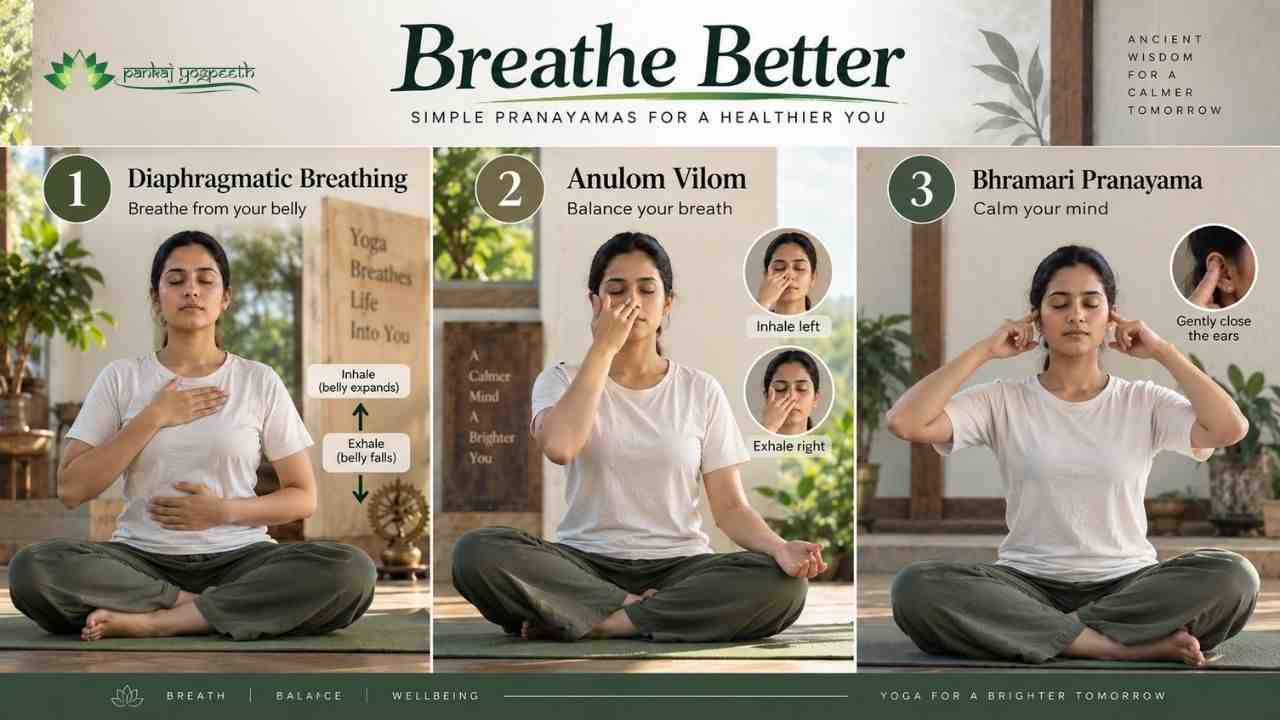
1. Diaphragmatic Breathing (Sukhasana with Pranayama)
This is the most basic kind of pranayama for beginners, and all the rest is built on it. It trains your body to breathe from the diaphragm rather than the chest.
- Sit cross-legged on a folded blanket with your spine tall
- Hands on your knees, shoulders relaxed
- Inhale through the nose for 4 counts, allowing the belly to expand
- Breathe out slowly for 6 counts; let it fall
- Repeat for 5 to 10 minutes
It feels right when your stomach moves before your chest. Put a hand on your stomach to see. Best for: everyone, especially beginners and those recovering from illness.
2. Anulom Vilom (Nadi Shodhana Pranayama)
Anulom vilom pranayama is the most recommended breathing exercise for lung health and a great all-round starting point once you can breathe from the belly.
- Close your right nostril with your right thumb
- Then Inhale through the left nostril for 4 counts
- Close the left nostril with your ring finger
- Release thumb. Exhale through the right for 6 counts
- In through the right, switch and out through the left
That’s one round. Keep going for 5-10 minutes. There are many people who ask whether pranayama and anulom vilom are the same. They are not, anulom vilom is a form of pranayama, not another name for it. Feels right when: both nostrils feel equally open at the conclusion.
A near relative: Surya Bhedana, which uses the same finger positions but inhales exclusively through the right nostril. It is warming and energising. Skip it if you have high blood pressure.
3. Bhramari Pranayama (Humming Bee Breath)
Bhramari pranayama for breathing problems is the quickest way to slow down a breath that has raced with concern or terror. The humming does the trick.
- Sit up straight with your eyes closed
- Put your hands on the tragus, the little flap of cartilage in front of each ear canal
- Slowly breathe in through the nose
- Breathe out with a quiet, even hum, with closed lips
- Repeat 5 to 7 times
The humming vibration creates nitric oxide in your nasal passages and, within a few breaths, turns on the calm side of your nervous system.
Feels correct when: you feel the vibration in your face, not simply hear the sound. Best for: pranayama for anxiety, chest tightness and those times when you can’t catch your breath. For the comprehensive technique, check out our full Bhramari Pranayama tutorial.
4. Ujjayi Pranayama (Ocean Breath)
Ujjayi pranayama for breathing automatically slows your breathing down. The soft throat sound offers you something to follow on to.
- Sit up straight and breathe through your nose
- Tighten your throat slightly in the back, as if you were whispering
- Breathe out through the nose gently, like a soft, ocean-like sound
- Keep the sound going on the way in as well Keep going for 5 to 10 minutes
Feels correct when: the sound is even both ways, never strained. Good for: building breath awareness and steadying long, demanding days.
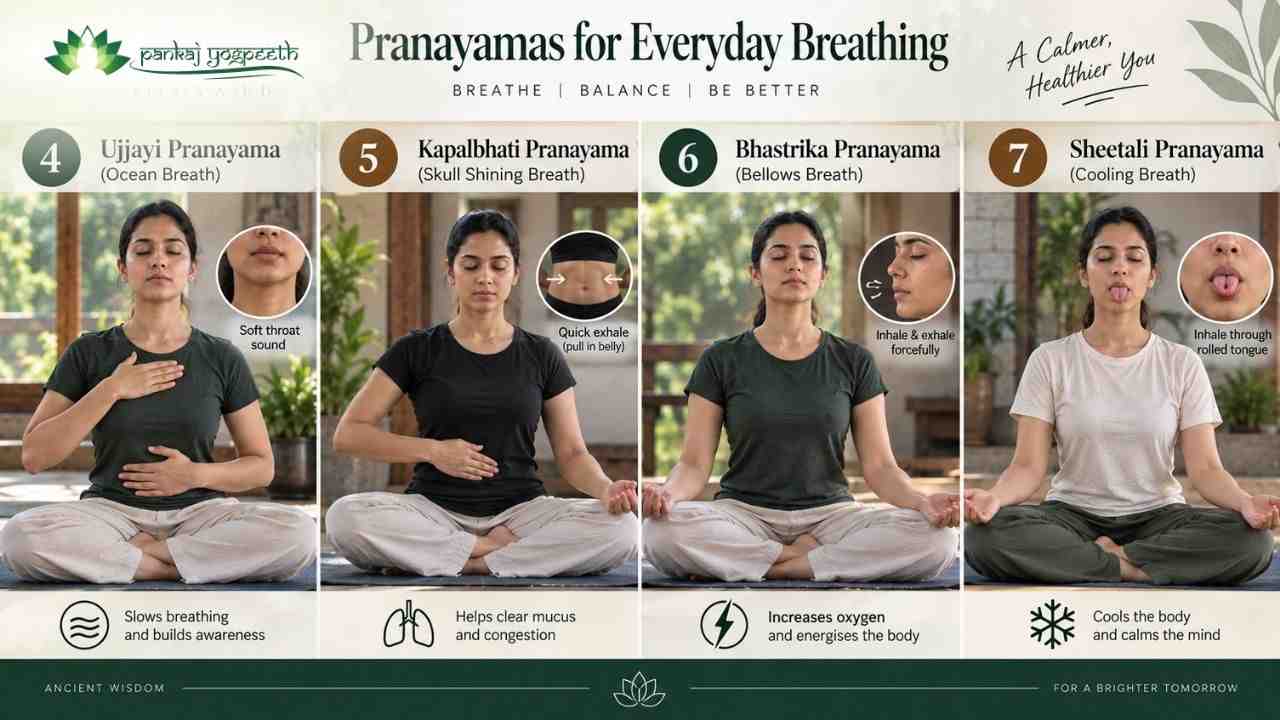
5. Kapalbhati Pranayama (Skull Shining Breath)
Kapalbhati pranayama for breathing problems clears mucus and congestion in the air passages. First, read the caution; it is the most powerful strategy here.
- Hands on your knees, sit tall
- Normal breath in Suck in the belly and push the air out sharply through the nose
- Let it inhale on its own, and then repeat. Start with just 30 seconds
Do not do this during an asthma attack, uncontrolled hypertension, pregnancy, recent abdominal surgery or with any heart conditions.
Feels right when: your tummy is doing all the work and your shoulders are totally still. Other Best for: Pranayama for sinus problems, congestion and cough/cold recovery.
6. Bhastrika Pranayama (Bellows Breath)
Bhastrika pranayama is commonly confused with Kapalbhati. The difference: In Kapalbhati, only the out-breath is powerful. In Bhastrika, the in-breath is as well as the out-breath.
- Sit upright and take a few normal breaths
- Take a deep breath through your nose
- Forcefully exhale through the nose
- Keep a steady beat, then rest
- Start with 10 rounds, then stop
Same warnings as Kapalbhati. If you get dizzy, stop immediately.
Feels right when: You get lightheaded, and the rhythm stays constant. Great for: Increasing oxygen uptake and warming up a sluggish body.
7. Sheetali Pranayama (Cooling Breath)
Sheetali pranayama cools the body and calms an anxious mind. Good for hot weather or after hard work.
- Roll your tongue into a tube, or press your teeth together with lips parted if you cannot roll it Inhale slowly through your mouth
- Close your mouth and exhale through your nose
- Repeat 5 to 10 times
Feels right when: the incoming breath is distinctly cool. Avoid when: you are congested, or the weather is chilly. Seven techniques, yet you don't need all seven. Which one is correct depends on what your breathing is actually doing.
Which Pranayama Is Best for Your Breathing Problem?
Seven techniques are a lot to choose from. When you compare them to what your breathing is actually doing, it isn't. Look up your circumstance in the table below, then read on to find out why.
Match the Technique to Your Problem
| Problem | Best technique | Avoid |
|---|---|---|
| Asthma (stable) | Anulom Vilom, Bhramari | Kapalbhati in a flare |
| Anxiety breathlessness | Bhramari, Ujjayi | Bhastrika |
| Sinus, congestion | Kapalbhati, Bhastrika | Sheetali |
| Low lung capacity | Anulom Vilom, Ujjayi | — |
| Poor sleep, apnea | Bhramari, Anulom Vilom | Bhastrika at night |
| Post-illness recovery | Diaphragmatic, Ujjayi | Forceful techniques |
The pattern is simpler than the table makes it seem. The fast, tight breathing needs to be slowed down; humming and ocean breathing do that. Forceful techniques clear blocked or mucus-heavy breathing.
And which pranayama increases lung capacity best? The slow ones. Every day for weeks. Here, patience wins over power. Pranayama for asthma has one hard-and-fast rule.
Gentle tactics are safe and helpful when you are stable. Forceful ones make things worse during a flare-up. Slow belly breathing. Stick with it till it goes. One honest note on pranayama for sleep apnea.
That's worth having because it can increase your sleep quality and your awareness of your breath. But it doesn't repair the airway obstruction that causes the apnea.
Keep doing what your doctor told you to do. It leaves the question of how you build it into a week, whether any of it works, and which one to do.
How to Do Pranayama Properly: Rules, Sequence and a Beginner Plan
Doing pranayama wrong is like doing nothing. A rushed or tense practice can make you feel more dizzy and anxious than when you started. A few basic rules keep all that from happening.
Should you do pranayama before or after asana? Later. The sequence that works is movement first, breathing second, meditation last. First, your body must settle before you ask your breath to slow, and your breath must settle before you ask your mind to.
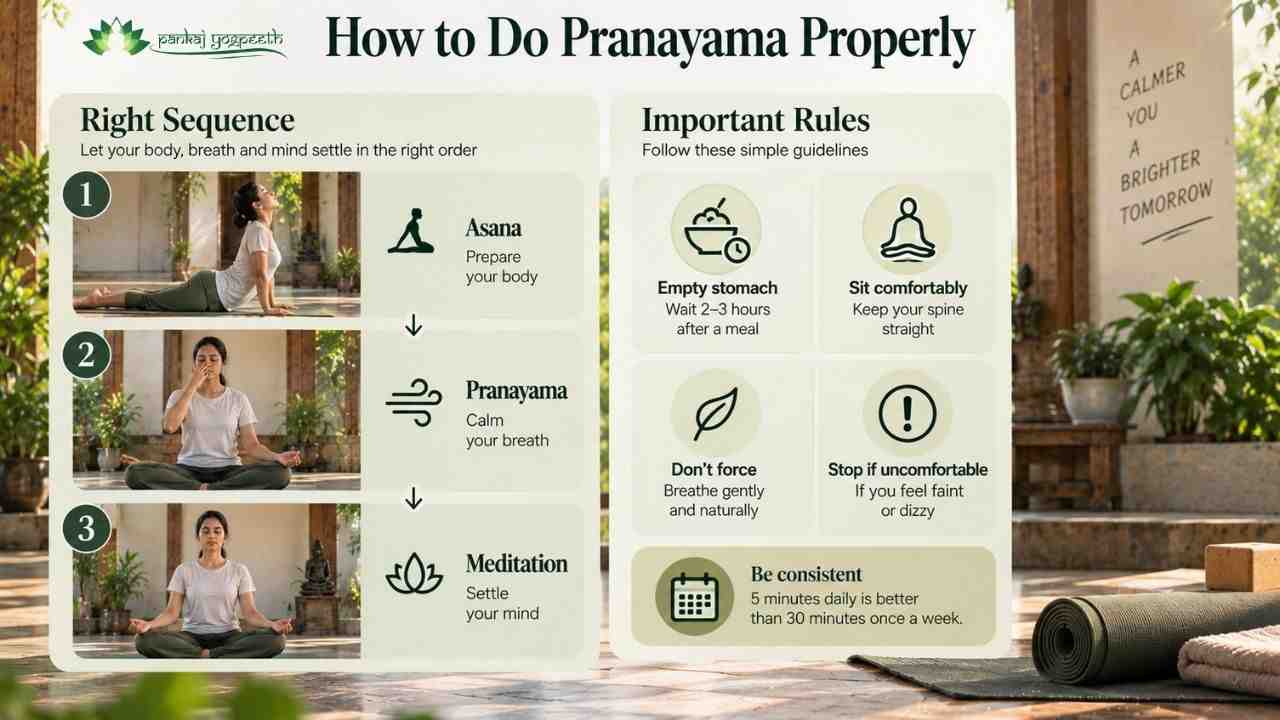
The other pranayama tips and rules are short and worth following to the letter:
- Hungry stomach. Wait two to three hours after a meal
- Sit up straight. Sitting on a blanket cross-legged or in a chair with feet flat
- Never force it. Strain cancels out the benefit completely
- Stop if you feel faint. Light-headedness suggests you went too far
And one last thing is more important than all the above. Five minutes a day is better than thirty minutes once a week. Each study with actual outcomes was conducted for a minimum of 8 to 12 weeks of daily practice.
4-Week Plan Pranayama for Beginner
| Week | Practice | Daily time |
|---|---|---|
| 1 | Diaphragmatic breathing | 5 min |
| 2 | Add Anulom Vilom | 10 min |
| 3 | Add Bhramari | 12 min |
| 4 | Add Ujjayi | 15 min |
You stay at week 4 for two months before you even think of Kapalbhati or Bhastrika. Forceful tactics need a stable base to support them. That evolution is sluggish by design, and the reason is the portion that most articles skip altogether.
Pranayama Precautions and Who Should Avoid Certain Techniques
Breathing exercises are generally safe for most people, but not for everyone. Pranayama precautions go into two categories: regulations for everyone and conditions that make some techniques inappropriate.
The universal rules are easy: Don't strain. If you start feeling lightheaded, stop. Don't hold your breath longer than is comfortable. Don't do any of the strong-armed things when you've got a full stomach.
Can you do pranayama with a blocked nose? Not the nostril techniques, skip Anulom Vilom till it clears. Bhramari and Ujjayi are also great choices when you have a stuffy nose, so try those instead.
Some disorders require extra caution: uncontrolled high blood pressure, cardiac issues, pregnancy, epilepsy, recent surgery, and any current infection. If you are on such a list, talk with your doctor before you start, and discuss the corrective tactics.
And the most important rule: pranayama enhances your treatment; it does not substitute it. Never change an inhaler or a prescription without your doctor's advice.
Who Should Avoid Which Technique
| Condition | Avoid | Safe alternative |
|---|---|---|
| Active asthma flare | Kapalbhati, Bhastrika | Slow diaphragmatic |
| High blood pressure | Bhastrika, Surya Bhedana | Anulom Vilom |
| Pregnancy | Forceful techniques | Bhramari, Ujjayi |
| Heart conditions | Kapalbhati, Bhastrika | Doctor's clearance first |
| Blocked nose | Nostril techniques | Bhramari |
| Recent surgery | All forceful work | Wait for clearance |
Every rule above exists because breath work goes wrong quietly, which is why it was never meant to be learned alone.
Why Pranayama Is Learned Better Under Guidance
Getting these yogic breathing techniques a bit incorrect is not the same thing as getting them a little less right. It frequently undermines their whole purpose. Kapalbhati performed to the improper rhythm can produce the very anxiety it is supposed to alleviate.
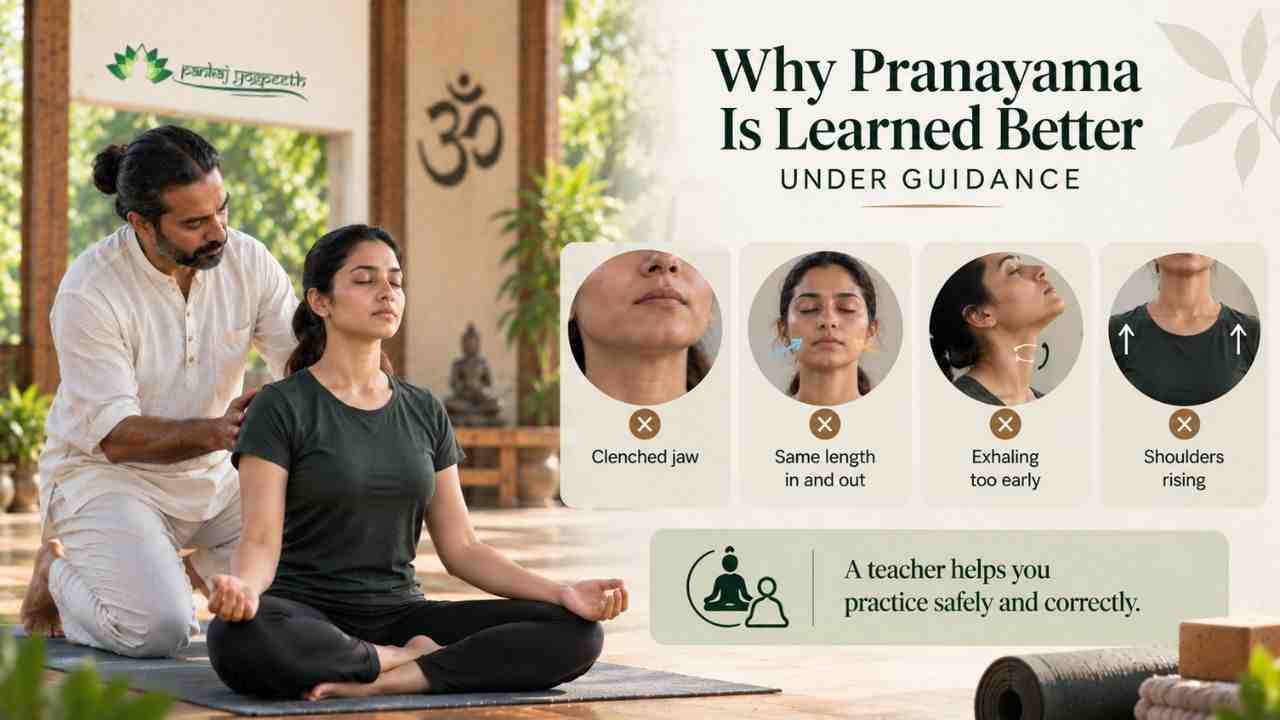
If you do Anulom Vilom superficially, you are not going to get any significant benefit at all. You just go through the motions for weeks and wonder why nothing is changing. The mistakes are minor and practically impossible to discover on your own:
- A clenched jaw without you knowing it
- Your in-breath and out-breath being the same length
- Exhaling at the peak of the inhalation
- Shoulders rising on each breath in
You have a teacher alongside you who catches them all at once.
Conclusion
You don't have to use all seven techniques. Belly breathing first, then Anulom Vilom, then Bhramari for when your breath is running away from you. Be real about what to expect. Your symptoms and your stamina will alter long before any test result does, and that is still worth having.
Begin tomorrow morning. Five minutes of belly breathing. No more. Next week add Anulom Vilom. The stairs will not cease to be stairs. But somewhere around week six you'll see you got to the top without thinking.
Learn to teach the breath, not merely to do it. Our 200-hour and 300-hour Yoga Teacher Training in Rishikesh at Pankaj Yogpeeth includes the entire pranayama course under direct supervision.