Yoga Teacher Training in New Zealand What Should You Know Before You Enroll?
If you've been researching yoga teacher training in New Zealand, you've probably noticed it's not often on the shiny "train on a beach" lists. That's the point. Those who train at this place tend to worry more about consistent teaching standards, small class sizes and a well-run, safe course than about a tropical setting. There is much to admire beyond the postcard.
This guide explores what really matters to your call: is a course worth the price, what formats are on offer, where are the main schools based, what does a 200-hour yoga teacher training in New Zealand actually cost, what styles can you study, how to spot a valid school and the visa aspect of getting there. The tips come from years around Yoga Alliance classes and the teachers who run them. And by the end you'll know exactly what to weigh up before you enroll.
Is Yoga Teacher Training in New Zealand Worth It Compared to India or Bali?
Let's be straight. Yoga teacher training in New Zealand costs more than the same course in India and often more than in Bali, too. What you pay for is not the scenery; it is how the courses are run: small groups, careful teaching and clear safety standards. That is the real value here, and why people happily pay a bit more.
So how do you know the extra spend is worth it? It comes down to what you walk away with. An excellent course gives you confidence and the ability to teach effectively. A weak one leaves you with just a piece of paper. Here is the honest breakdown:
- Right fit: a certificate you can use, the courage to speak in front of a class, and a real start over.
- Not right: a certificate that gets lost in a drawer.
- The honest trade: It costs more than India, but the safety and quality make up for it.
New Zealand vs India vs Bali for a 200-Hour Course
Most persons contemplating a 200-hour yoga teacher training will find themselves comparing the same three names: New Zealand, India and Bali. So no clear winner here as everyone attracts a different kind of trainee. If you compare yoga teacher training in New Zealand vs India, or adding Bali to the mix, the trick is to match the place to what you want from the course, not the other way round. A short look below shows where each one actually belongs.
| Destination |
Feel |
200-hour cost (approximate) |
Best for |
| New Zealand |
Grounded, education-led |
NZ$2,800–$6,500 and up |
Standards and safety |
| India |
Deepest tradition |
Lower entry point |
Most depth per dollar |
| Bali |
Retreat immersion |
Mid to high |
A transformation setting |
| Australia |
Structured, regulated |
Similar to New Zealand |
Same system, closer to home |
It's easy to understand. India wins because of its low prices and long history. Bali is more of a gateway, and Australia's system is very similar to that of its neighbour. People who are willing to pay a little more for a safe, well-run race should go to New Zealand. It should be your choice if that sounds like you.
If you can agree that the course is worth it, the next step is to figure out how it works.
Which Yoga Teacher Training Format in New Zealand Fits Your Schedule?
It's helpful to know that yoga teacher training in New Zealand mostly comes in two forms before you look at any schools. One tells you to clear your schedule and start. The other one works with a job and a normal week. On paper, neither is better; they're just better for different people. How long you have to give it decides the best choice.
Which one do you really think is best for you? That answer is more important to you than any brochure. The full immersion method is worth it if you can take a month off from work. You can get the same certificate without turning your life upside down if you can't balance everything.
Full-Time Residential Training in New Zealand
New Zealand's residential yoga teacher training lasts for three to four weeks. You live on-site, and your room and course materials are covered. Most of the time, you cook your own meals. People who want to get deep without being distracted should go there.
Part-Time and Weekend Courses in New Zealand
Getting trained as a yoga teacher in New Zealand takes place over several months of weekends. This yoga teacher training over the weekend in New Zealand is good for people who live there or have a job, but your room is not included.
| Factor |
Residential intensive |
Part-time or weekend |
| Length |
3 to 4 weeks |
3 to 6 months |
| Best for |
Visitors wanting full immersion |
Locals working around a job |
| Accommodation |
Included |
Not included |
| Meals |
Often self-catered |
Self-arranged |
| Pace |
Fast and deep |
Slow and steady |
This is the short story. Of course, residential courses are faster and more intense, but you have to set aside time to do them. Part-time classes take longer, but they are easy to fit into your daily life. Pick the one that works best with your plan.
Now that the format is clear, the next question is where in the country these courses truly take place.
Where the Best Yoga Schools in New Zealand Are Based
Yoga teacher training is not evenly spread throughout New Zealand. There are a few main areas where most schools are located, mostly in larger cities. There are also a few quiet places in countryside areas. You can plan your trip, budget, and setting better if you know where they are located.
Does the town where you learn really make a difference? It’s more than you think. In the city, you will be near the shops, public transportation and other students. In the country, you will be away from all of that and be able to focus and relax. There is no right or wrong answer; it all depends on how you feel.

Training in Auckland and the North Island
The main place in New Zealand to learn how to be a yoga teacher is in Auckland. This is where most of the registered schools are, so there is a huge range of styles, teachers, and start dates all in one city.
If you want a choice, yoga teacher training in Auckland lets you compare several classes side by side before making a decision. There are a few smaller towns on the rest of the North Island, but Auckland is still the best place to start your search.
Wellington, Christchurch and Queenstown Options
People in Wellington and Lower Hutt tend to be personal and community-led. In beautiful locations, you can do part-time study in Christchurch, Dunedin and Queenstown. If you want classes with a view, yoga teacher training in Wellington or Queenstown is a good choice. The list ends with a few peaceful getaways in the country.
| Region |
Character |
Format bias |
| Auckland |
Most schools to choose from |
Part-time and residential |
| Wellington and Lower Hutt |
Smaller, community-led |
Mostly part-time |
| Christchurch, Dunedin and Queenstown |
Fewer schools, scenic |
Part-time |
| Rural retreats |
Full immersion, remote |
Residential |
It is easy to see the pattern. Choose from many things in Auckland, get to know people in Wellington, enjoy the scenery in the southern places, and find peace in the country retreats.
Choose the place that makes you feel like you want to during your weeks of yoga teacher training.Once a location is chosen, the price tag is usually the next thing that people look at.
How Much Does Yoga Teacher Training in New Zealand Cost?
This part is what decides for most people. How much does it cost to become a yoga teacher in New Zealand? A part-time school in the city costs between NZ$2,800 and NZ$3,800. A full residential program costs more because you get a room. In that range, you can find a 200-hour yoga teacher training in New Zealand, though it mostly depends on whether or not housing is included.
Do you really get more for the extra money? Not all the time. If the teachers aren't good, a low price isn't an offer, and a high price only makes sense when there's a good reason, like top teachers or full training. These things are usually part of a fee:
- Part-time classes in the cities cost between: NZ$2,800 and NZ$3,800, but this doesn’t include food and accommodation.
- Residential intensive costs range from: NZ$3,800 to NZ$6,500, including the room and all supplies.
- Most of the time: things like meals in residentials, mats and accessories, and local trips cost extra.
Entry Fees and Levies on Top of Your New Zealand Course Fee
In addition to the course itself, the government charges a few fees. It costs NZ$17 to get the NZeTA service via the official app, or NZ$23 via a web browser. Each person also has to pay an extra NZ$100 for the International Visitor Tax. Both are paid at the same time when you apply.
How to Train Affordably in New Zealand
You can get yoga teacher training in New Zealand at a very affordable price if you plan. Try to find payment plans, work-study jobs, or times when the school isn't as busy. And be honest with yourself: if money is an issue, an international course might be the better deal.
| Cost item |
Amount |
| Part-time city course |
NZ$2,800 to NZ$3,800 (excluding room) |
| Residential intensive |
NZ$3,800 to NZ$6,500 and up (including room and materials) |
| NZeTA processing fee |
NZ$17 by app, NZ$23 by web browser |
| International Visitor Levy |
NZ$100 per person |
| Meals in residentials |
Usually self-catered |
When you add the fees and other small costs to the course fee, you get the full price, not simply the headline price. That number shows how different schools rank. Once you know how much you can spend, it's easier to figure out what you want to study and for how long.
Which Yoga Styles and Course Hours New Zealand Schools Teach
You aren't restricted to just one style because most schools here teach more than one. Sometimes a course will mix a few of them, which is helpful while you figure out what you like to teach. Which style works best for a trainee who is just starting? Usually a mix because it lets you try each one out before making a choice. Most of the time, you'll see these styles:
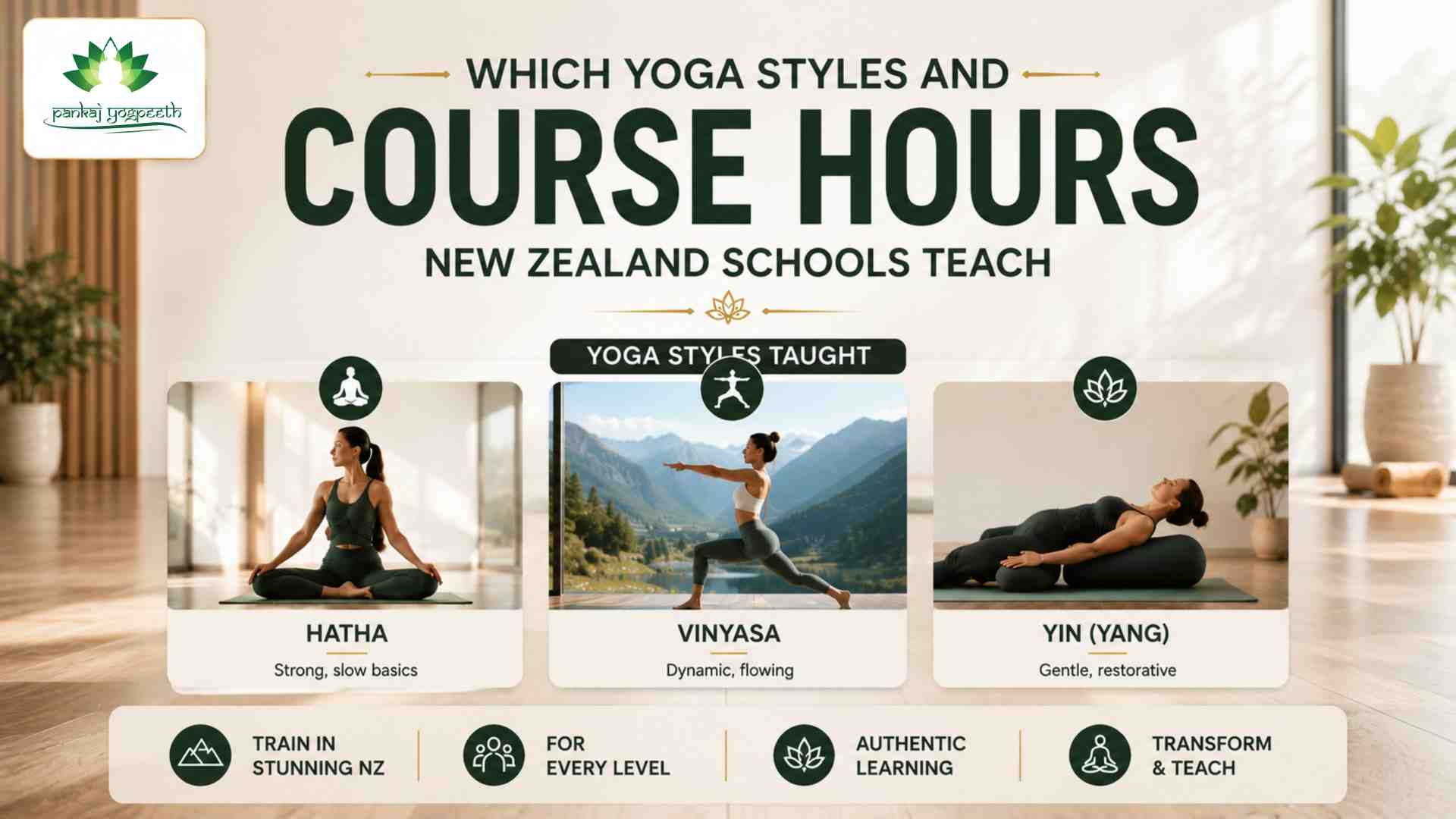
- Hatha: strong, slow basics that are great for building a strong base. There are many places in New Zealand where you can get hatha yoga teacher training.
- Vinyasa: classes are energetic and flow well, with lots of movement. One of the most common types of yoga teacher training in New Zealand is vinyasa.
- Yang: gentle, healing work that keeps the stronger styles in check.
There are a few studios in New Zealand, mostly in Auckland, that also offer hot yoga teacher training. So you can do that if you want to.
| Course |
Typical length |
Best for |
| 100-hour |
10 to 14 days |
A taster or top-up |
| 200-hour (RYT-200) |
3 to 4 weeks or part-time |
Becoming a certified teacher |
| 300-hour (RYT-300) |
3 to 6 weeks |
Building on an RYT-200 |
100, 200 and 300-Hour Courses in New Zealand
It don't matter how long you practice. How many hours tells you what the course is for. Because each level is made for a different type of student, the hours don't really matter when they happen. Instead, they matter more about where you are on your road.
Which amount of hours is enough to start teaching? If you know ahead of time that it's the 200-hour requirement, you won't have to pay for more than you need or fall short of what the organisations expect. First, make sure the level fits your goal. Then, look at different places.
100 hours: a short taster or top-up for 10 to 14 days. You can try it out before committing to the whole course, or you can learn one skill at a time, like Yin or meditation, to add to what you already know. It doesn't give you the right to teach by itself.
200-hour: the main certification, which is run over 3 to 4 weeks full-time or spread across part-time weekends. People who reach this level are certified to teach, and it's also where most people start. This is the one lesson you should take.
300-hour: is the next level, and takes 3 to 6 weeks. If you already have a 200-hour yoga teacher training certificate in New Zealand, you can add another 300 hours to your training and learn more about basic sequences, alignment and philosophy. It's good for teachers who have worked for a while and want to learn more.
The 200-hour is the most important for most people just starting because it is the official teaching license. The others are there so you can taste them first or look deeper later. It doesn't matter how many hours you know if the school behind them isn't real.
How Do You Check a Yoga Alliance School in New Zealand Is Genuine?
Not every school with a certificate really deserves it. A quick check will keep your money safe because some people let their registration end and still keep the logo up. How can you tell the difference between a real school and one that looks like one? Don't believe the ads and check the facts for yourself. A couple of minutes now saves you months of regret later, a lot of trouble later on. Before you pay, read this:
If you want to find a school, don't trust the logo on their page; look for it in the official Yoga Alliance directory site instead.
- Named lead teacher: their work hours and knowledge should be clear to everyone.
- Open syllabus: A real school gives out its full course outline without being asked.
- Independent reviews: look past pages that only show hand-picked five-star phrases.
A few more signs finish it off. A school that takes its students seriously will have small class sizes and a clear, written refund policy. A school that doesn't take its students seriously will have unclear prices and no written policy. You are safe when you find Yoga Alliance-certified yoga teacher training in New Zealand that checks all of these categories.
Yoga Alliance and Yoga New Zealand Registration
These two groups both care about how good a school is, but they do things in very different ways. The global register is Yoga Alliance, and its RYT credential is what lets you teach in other countries. This means that New Zealand's yoga teacher training is recognised around the world.
As an extension of Yoga Australia, Yoga New Zealand adds respect for the country where it is based. These are often the only things you need to know about how to pick a yoga school in New Zealand. With a reliable school in mind, the last useful step is to plan your trip and get in.
Best Time, Visas and Travel for New Zealand Yoga Training
New Zealand runs on southern-hemisphere seasons, so summer falls from December to February, the busy, warm period for training. There are studio courses all year, but the winters on the South Island are very cold, so the best time to become a yoga teacher in New Zealand varies depending on where you choose to train.
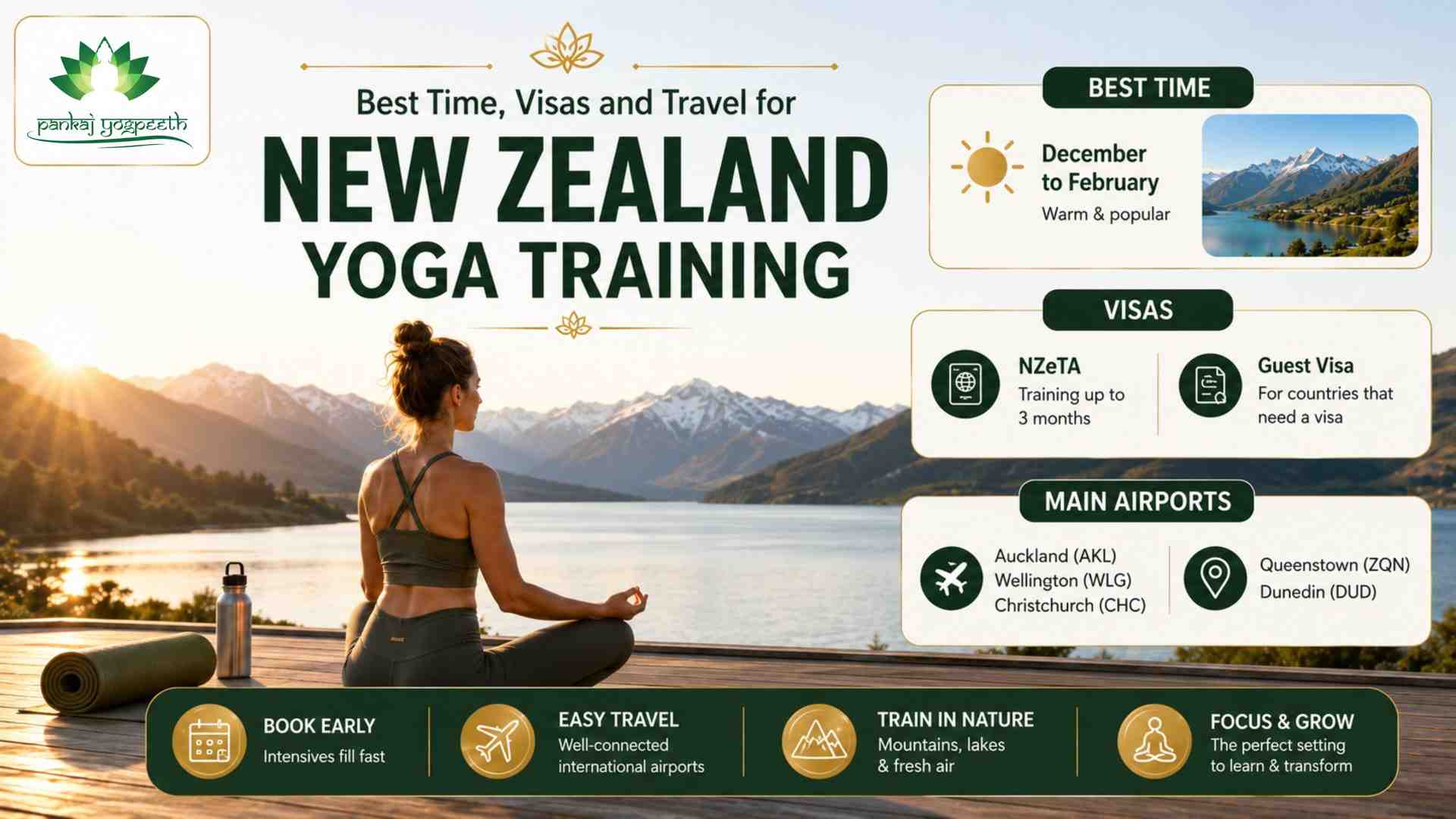
What time of year is best for long journeys and warm weather? Summer is great, but intensives fill up quickly, so book yours early. Before you book a trip, do these things:
- Peak season: December to February, Book intensives early.
- Visa-waiver route: a NZeTA covers schooling up to three months, so a three- to four-week 200-hour course is fine.
- Countries that need visas: apply for a guest visa, which will be checked against your passport.
NZeTA, Visas and Airports for New Zealand Training
The most common question is: Do I need a visa to train to be a yoga teacher in New Zealand? For most short courses, you only need an NZeTA, as this allows you to train for up to three months. If your country is not on the number of countries that do not require a visa, then get a guest visa instead.
When flying, you can land at Auckland (AKL), Wellington (WLG) or Christchurch (CHC). For the South Island, you can use Queenstown (ZQN) or Dunedin (DUD). It's important to be honest about the types of trainees that New Zealand doesn't work well with.
Should You Train in New Zealand or at the Roots with Pankaj Yogpeeth?
New Zealand is a great place to study part-time or on weekends if you live there, work, and want to. If you are after depth, though, it's a different call. Are you really interested in ease of use or the history of the practice? That answer shows you two ways to go.
Yoga Teacher Training in India and Nepal with Pankaj Yogpeeth
If you want to know more, go to the source. India, especially Rishikesh, is a great place to learn how to be a yoga teacher because it has a long history, full ashram education, and more depth per dollar.
Next is Nepal. In Pokhara, there is the same true yoga teacher training, but it is quieter there. If you want to immerse yourself fully, Pankaj Yogpeeth has courses in Rishikesh and Pokhara. Each course has a different road and a different goal.
Choosing the Right Yoga Teacher Training in New Zealand for You
It all comes down to one question: do you want the training to give you A basic certification, a fresh start, or a truly solid base to teach? Choose the school based on your level, budget, and real reason for going, not the one with the nicest brochure.
Go ahead and become a yoga teacher in New Zealand if it works for you. If you'd rather get to the roots, Pankaj Yogpeeth offers full immersion courses in Pokhara, Nepal, and the Indian cities of Rishikesh and Varkala. The goal is the same: to be a proud teacher.