How to Become a Certified Yoga Teacher in India: Training, Certification & Career Guide
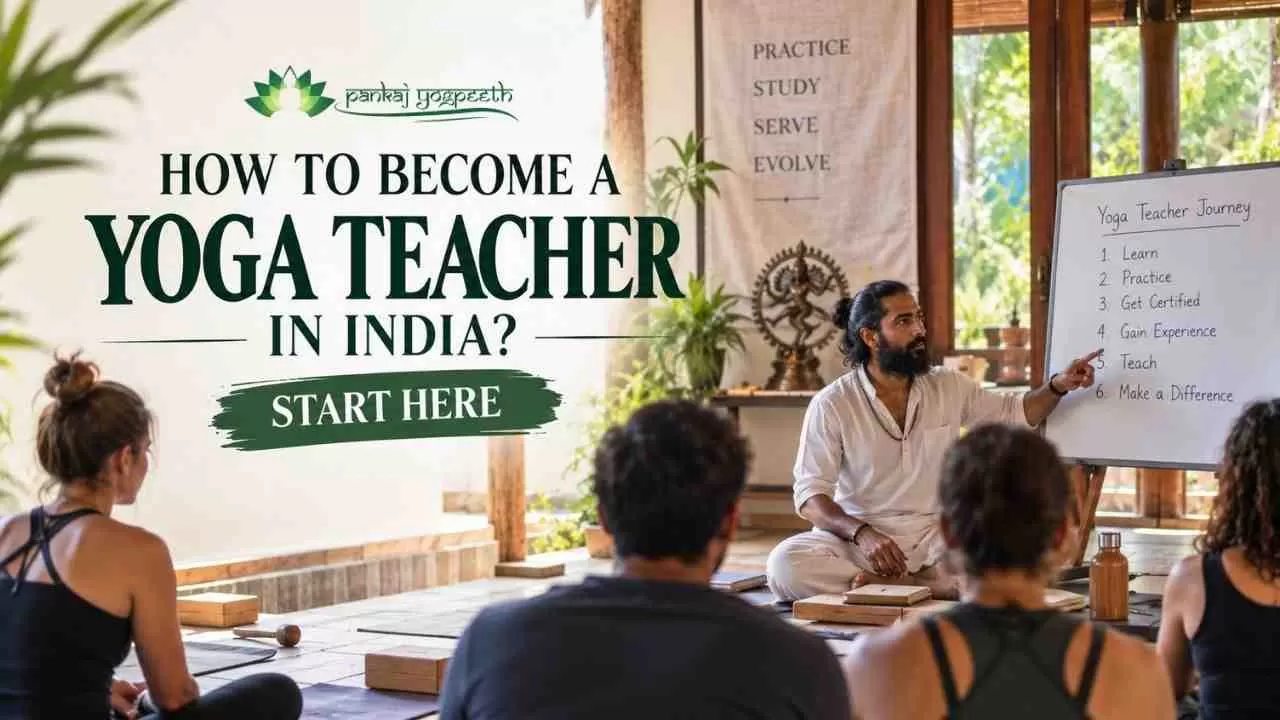
You've been training for a couple of years now. Somewhere along the way, a friend mentioned it, or your teacher did: you should teach this. And since then you've been going around the same issue, how to become a certified yoga teacher in India, only to find every website says something different.
Some believe you need to be registered with Yoga Alliance. Others talk about some government certification you've never heard of. Some argue you don't need a yoga instructor certificate at all.
This guide breaks things down. Which yoga teacher training is really worth it, how long it takes, how much it costs, what the work looks like after, etc. We cover both sides, since most articles only cover one. But start here. A lot of people think there is a license for it. There isn't any.
How to Become a Yoga Teacher in India: 6 Steps
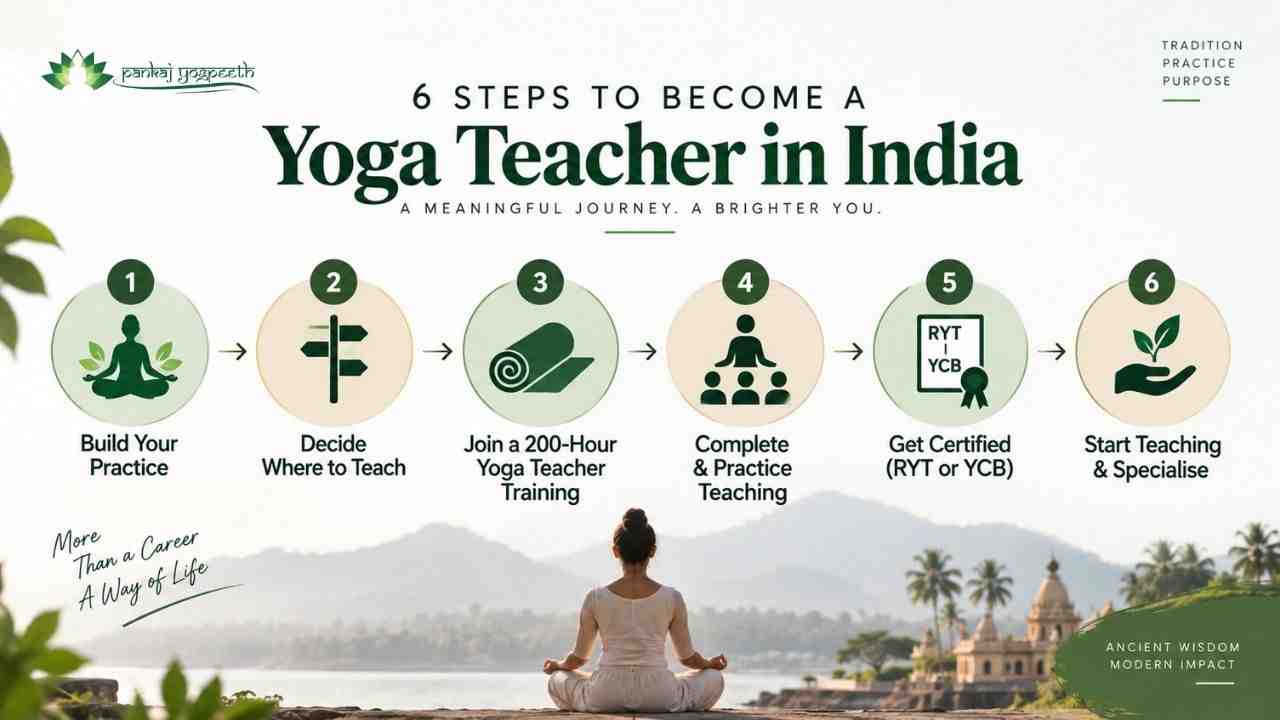
To get certified as a yoga teacher in India, you have to do a 200-hour yoga teacher training course from a Yoga Alliance-registered school and then register as an RYT. Or, if you want to teach at Indian institutions, go the official YCB route. Here is the complete journey before we get into any of it in detail:
- Create a consistent personal practice. Sign up after six months of regular practice. Not to be a master of postures, only so that your body isn't learning everything for the first time.
- Choose where you wish to teach. Online, Indian studios, government and school roles, abroad. This one question will determine your whole certification journey.
- Choose your 200-hour yoga teacher training course in India or anywhere else, residential, part-time or online.
- Complete the training and practice teaching. The certificate is from the finish. The confidence is in teaching in front of people.
- Become a RYT, or take the YCB exam. Two separate systems according to step two.
- Teach first, then specialise. Prenatal, therapy, yin- that's where the money is; that's down the road.
Six steps sound quite easy. Step two is where almost everyone gets lost, because it relies on a question that most websites get wrong.
Do You Need a Certification to Teach Yoga?
No, most countries do not require you to be certified to teach yoga. But you need one to join a studio, gym or get insurance – so it’s necessary in practice, even if not in law.
The Truth About Yoga Teacher Qualification Requirements
And this is what amazes people. There is no licensing authority for teaching yoga in India, the US, or much of the world. No exam you have to pass. No registration you are legally bound to hold. So, I mean, you could teach a class tomorrow.
But that's not the question to ask. The real yoga teacher qualification you need isn't a legal license but professional reputation. No one will stop you from teaching.
There will be plenty of people who won’t want to hire you. If someone is inquiring about eligibility for yoga instructor duties, they are usually referring to the second thing, with the first assumed.
Why Studios and Students Still Ask for Certification
So why become certified? You can’t get hired by studios without it. Insurance companies want confirmation you have been trained, and you need insurance to teach just about anywhere.
Because a professional yoga instructor knows what adjustments are safe for a hypermobile or pregnant student, and without that expertise you might seriously damage someone.
Becoming a certified yoga teacher doesn’t make you legal. “It makes you employed, insurable and safe.” If no government is issuing yoga licenses, who is in charge of deciding what “certified” means? In India, the answer is twofold, and the one you need depends on where you wish to teach.
Yoga Alliance Certification: What RYT 200 Actually Means
Yoga Alliance is a voluntary registry, not an accreditation agency. If you complete a course at a Registered Yoga School, you are entitled to register yourself as a Registered Yoga Teacher.
How RYS and RYT Registration Works
There are two abbreviations that cause most of the confusion here. RYS = Registered Yoga School. RYT = Registered Yoga Teacher It's a simple process: you do a yoga teacher training course with a RYS, get your certificate, and then register yourself as a RYT.
Yoga Alliance doesn't certify you; the school does. Yoga Alliance simply lists you. People fall foul of two things. You pay your yoga certificate registration cost separately from the course fee.
And before you sign up, check out the school yourself on the Yoga Alliance database instead of trusting a logo on their homepage. A RYT 200 certification in India is as powerful as a RYT 200 acquired anyplace else. This is what makes it a truly international yoga credential.
RYT vs CYT: What's the Difference?
CYT means certified by any school. RYT means listed in the Yoga Alliance directory. One is verifiable by anyone. The other is not. What do E-RYT 200 and E-RYT 500 mean.
The "E" is for experienced: two years plus 1,000 hours of teaching. Things to know when picking a school: your main trainer should have it.That is how most overseas students do. But if you want to teach in Indian schools, hospitals or government jobs, a second system kicks in, and it works nothing like the first.
Government of India Yoga Certification: The YCB Route Explained
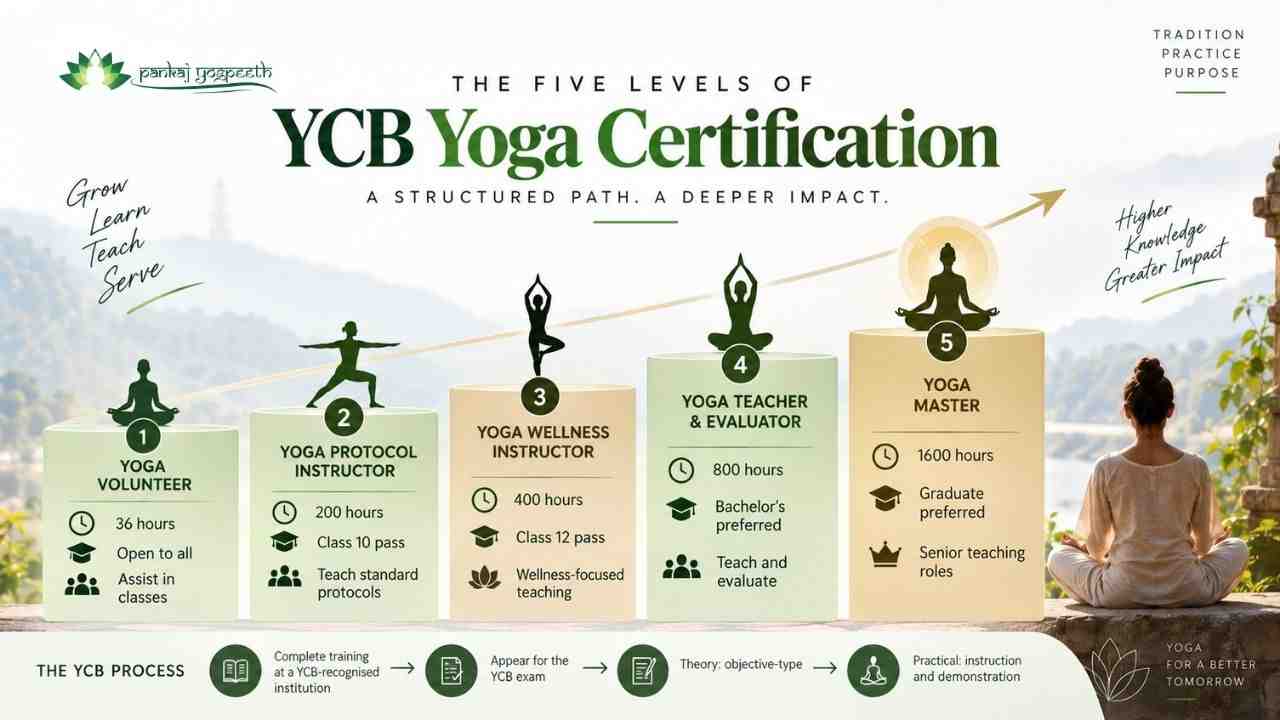
Under the Ministry of AYUSH, the Yoga Certification Board certifies yoga professionals in India across five levels. You have to pass a separate YCB exam to get certified, and the certification is valid for five years.
The Five Levels of YCB Yoga Certification
Most people who are looking for a yoga certification course by the Government of India don't realise it is nothing like private training. AYUSH yoga certification has five levels, from Yoga Volunteer to Yoga Master, and each level has its own training hours and educational requirements. Here's the part that catches people out, the test is independent of the training:
- You complete your hours at a YCB-recognised institution
- Then sit the board's exam independently
- Theory papers are objective-type
- Practical exams examine instruction and demonstration, usually around an hour
So, how do you become a Government of India certified yoga trainer? Train and then get checked. Not one or two steps.
YCB Certification Levels Explained
| Level | Training hours | Educational eligibility | What it qualifies you for |
|---|---|---|---|
| Yoga Volunteer | 36 hours | Open to all, under 75 | Assisting in group classes and workplace sessions |
| Yoga Protocol Instructor | 200 hours | Class 10 pass | Teaching standard yoga protocols |
| Yoga Wellness Instructor | 400 hours | Class 12 pass | Preventive and wellness-focused teaching |
| Yoga Teacher & Evaluator | 800 hours | Bachelor's degree preferred | Teaching and evaluating practitioners |
| Yoga Master | 1600 hours | Graduate preferred | Senior teaching and training roles |
Check the Yoga Certification Board website for current requirements before applying.
How to Renew Your YCB Certification
This one has an expiry date, unlike a private certificate. Each YCB certificate is valid for five years from the date the results are declared. Renewal is through the Continuing Yoga Education program, which takes two to three days:
- Attend in person at a leading yoga institution, or
- Complete it virtually, submitting a report on students you've trained
After your first CYE, the committee may certify you for life, or may invite you to take a second one
Yoga Alliance or YCB: Which Should You Choose?
That's a matter of location. Yoga Alliance means teaching overseas, online or at studios abroad. The Indian government indicates YCB. Jobs, school appointments, AYUSH-linked roles.
Many Indian teachers have both. One distinction worth emphasising clearly, because most articles get it wrong, is that a Yoga Alliance certificate never expires. A YCB certificate does this. Both approaches lead through the same door: a teacher training course. Which brings us to the question that beginners get stuck on: how many hours do you really need?
200, 300 and 500 Hour Yoga Teacher Training: What's the Difference?
A 200-hour yoga teacher training is the mandatory first step. The 300-hour builds on that and can’t be taken initially. The 500-hour certification is only the two together.
What a 200 Hour Yoga Teacher Training Covers
This is where everyone begins. No shortcuts, no exceptions, no advanced entries. A 200-hour yoga teacher training in India is often a 21- to 28-day residential course that covers:
- Asana technique and alignment
- Meditation and Pranayama
- Human Anatomy & Physiology
- Yoga-Philosophy
- Teaching methodology and teaching practice
The only difference is that last portion, between a yoga teacher training course in India and your own practice. You already know how to do the poses. This is where you learn to cue them, to stand up front and talk thirty bodies into a shape you can't touch. If you are comparing possibilities, our 200-hour yoga teacher training in Rishikesh is designed in this way.
When to Do a 300 Hour Yoga Teacher Training
You must have done your 200-hour to do the 300-hour. No exceptions here. It’s more sophisticated in sequencing, treatments and working with actual limits, the pregnant student, the reconstructed knee, the seventy-year-old. My one honest recommendation: teach for the first 6 months. A 300-hour advanced yoga teacher training assumes you’ve seen real students, and it feels very different when you have.
Is a 500 Hour Certification Worth It?
Plus 300 equals 500 in one long course or over several years. More and more established studios are requesting it. But it is not a beginning, and it is important to be honest: a 500-hour yoga certification course makes you a better teacher. It won’t increase your revenue by the same amount.
200 vs 300 vs 500 Hour Training Compared
| Level | Duration | Prerequisite | Core focus | Qualifies you to |
|---|---|---|---|---|
| 200-hour | 21–28 days | None | Foundations, teaching basics | Teach general classes |
| 300-hour | 25–30 days | Completed 200-hour | Advanced sequencing, therapeutics | Teach advanced and specialised classes |
| 500-hour | 45–60 days | None if combined | Both levels together | Teach at senior studio level |
Knowing what course you need is one thing. Another thing is whether you are ready to step into one. This is where most people silently disqualify themselves for no good reason.
Eligibility for Yoga Teacher Training: What You Actually Need
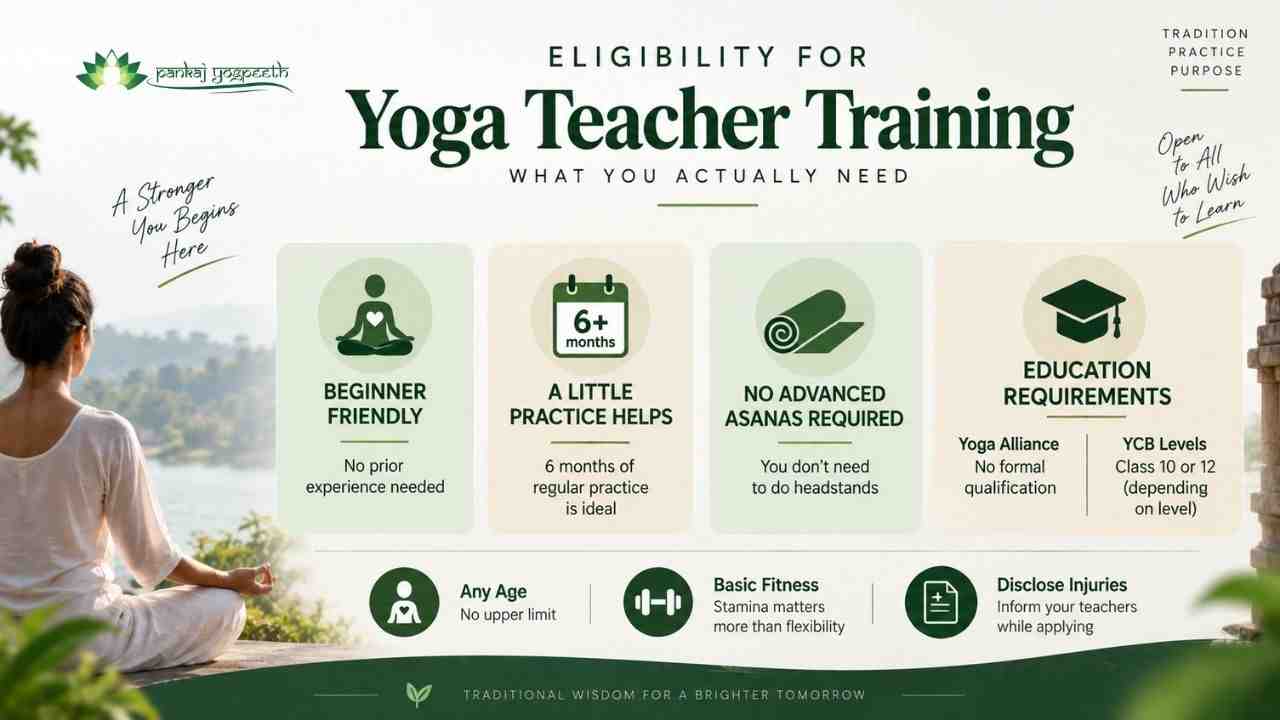
Most yoga teacher training courses in India accept complete beginners. While Yoga Alliance paths don't require a formal qualification, YCB levels do have their own educational requirements.
Do You Need Prior Experience to Join a Yoga Teacher Course?
Not officially. Most schools will take you with absolutely no background. That said, six months of constant practice goes a long way toward making the first week simpler; your body isn't learning everything for the first time while also trying to understand anatomy courses.
What you don't need is advanced asanas. Nobody checks if you can do a headstand. As stated previously, official qualifications for yoga instructor jobs apply exclusively through the government route: Class 10 for Protocol Instructor, Class 12 for Wellness Instructor. Yoga Alliance side, qualifying for yoga teacher training is mainly about willingness.
Age, Fitness and Flexibility: What Really Matters
Flexibility is a matter of practice, not a need. Stamina is very important. You do it twice a day for weeks, and that is what tyres people out, not the postures. Most schools have no upper age limit. Don't hide injuries. Tell about them when you apply. Teachers work with what they know.
How to Prepare Before Your Course Starts
Make it a daily practice, even if it's just a few minutes. Try a few styles to find what fits you. Read Patanjali before someone assigns it as homework. Ready is one question. Available is another, because everyone arrives at the same two questions: how long will this take, and what will it cost?
How Long Does It Take and How Much Does It Cost?
Residential 200-hour yoga teacher training in India is a three- to four-week yoga course. Part-time is three to six months, while YCB pathways range from three months to over a year. The real answer to how long it takes to become a yoga instructor depends totally on the format:
- Residential intensive – 3 to 4 weeks, normal
- Indian style 3-6 months alongside a career - part-time or weekend
- Online self-paced - months to a year anywhere
- YCB routes - 3 months part-time for entrance levels, up to 15 for higher ones
But there's a longer arc that nobody talks about. It's normally one to two years from your first serious lesson to teaching with real assurance. The yoga training course runs for a couple of weeks.
What Yoga Teacher Training Costs in India vs Abroad
You can only compare costs across countries if you compare what's included. Most yoga training in India includes lodging, meals, course materials and props in one residential price. Western programs normally charge tuition alone, and you pay rent and meals on top of it.
This is why how much it costs to become a yoga instructor in India varies so significantly. Online is the cheapest, Indian residential is average, and Western studio programs are the highest. And this is the key reason why overseas students come here for the best yoga training in India instead of training at home.
Costs Beyond the Yoga Course Fee in India
Create a separate budget for RYT registration, teaching insurance, travel and visa, your own mat and props, and continuing education afterwards.
Time and Cost by Training Format
| Format | Typical duration | Usually included | Best suited to |
|---|---|---|---|
| Residential in India | 3 to 4 weeks | Stay, meals, materials, props | Full immersion, career changers |
| Part-time or weekend | 3 to 6 months | Tuition only | Working professionals |
| Online self-paced | Months to a year | Recordings, live calls | Remote learners, parents |
| YCB pathway | 3 to 15 months | Training only, exam separate | Indian institutional roles |
The certificate will be ready in 3 or 4 weeks. What follows is the part nobody prepares you for.
Yoga as a Career in India: What Comes After Certification
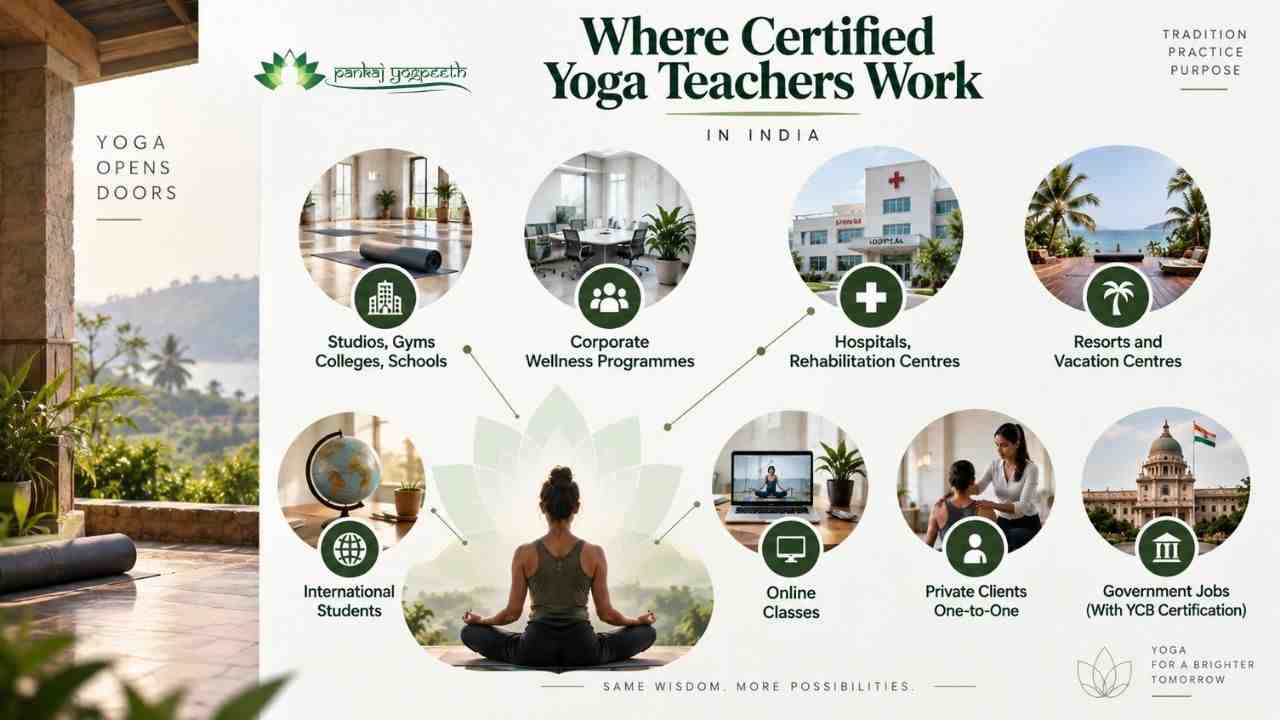
Certified yoga teachers in India work in schools, corporate wellness programs, studios, hospitals, retreats, and online. Your income will depend on the city you are in, your level of certification and whether you teach privately.
Where Certified Yoga Teachers Work in India
Yoga is more than most people think in India as a career:
- Studios, gyms Colleges, Schools
- Corporate wellness programmes
- Hospitals, rehabilitation centres
- Resort and vacation
- International Students
- Online Classes
- Private clients one-to-one
- Government jobs that require YCB certification
How Much Do Yoga Teachers Earn in India?
Most Indian yoga teachers in the field hold two or three of these at a time, rather than one full-time post. No one can give you a figure, but it's worth knowing the framework. Studios pay a flat rate per class, a per-student rate, or a combination of both.
Yoga instructor pay in India varies by city, certification level and number of private clients you carry. Indian norms are below Western rates. But the cost of living is too. The model of instructors who make it work: many revenue streams, not one employer.
Specialisations That Increase Your Value: This is where the yoga career blossoms. Yoga therapy, anatomy, prenatal, yin, and children's yoga training courses boost your earning potential. Therapy and prenatal have the highest rates, simply because there are fewer teachers in them.
Career Paths for Certified Yoga Teachers
| Path | Certification needed | Typical setting | Income structure |
|---|---|---|---|
| Studio teacher | RYT 200 | Urban studios, gyms | Per class or per student |
| School yoga teacher | YCB certification | Schools, colleges | Salaried |
| Corporate wellness | RYT 200 or 500 | Offices, virtual sessions | Contract or per session |
| Yoga therapist | Therapy specialisation | Clinics, one-to-one | Per session, higher rate |
| Online teacher | RYT 200 | Remote, global students | Subscription or per class |
| Retreat instructor | RYT 500 preferred | Resorts, retreat centres | Per retreat, stay included |
Yoga Teacher Training in India with Pankaj Yogpeeth
If you have read this far, you have probably already determined that the certification is worth the effort. All that's left is to decide where. Pankaj Yogpeeth offers Yoga Alliance-accredited yoga teacher training in India at two locations: Yoga teacher Training in Rishikesh, in the foothills of the Himalayan mountains, and Varkala, on the coast of Kerala.
We provide 100, 200, and 300-hour courses at both, so you may start where your practice really is, not where a brochure claims you should be. We also provide classes in Pokhara, Nepal, for students who desire to train outside India. Same curriculum, same faculty, three completely distinct working settings.