
The teacher walks past your mat and puts a brick next to you. No word on what it is for. Everyone else seems to know something you don't know. Yoga blocks are the most common object in any yoga class, yet the least described. Most individuals spend years putting one under a hand, never learning how to use blocks effectively.
This guide includes everything you need to know about choosing the best yoga block for beginners, adjusting the height correctly, positioning it for standing, seated, and resting poses, easing tight hamstrings and hips, and when to lower it. You'll also see the small mistakes that will silently negate the yoga block benefits you want. A block was never supposed to make a position easier. It's there to keep the position correct.
Why Is the Block the First Prop Every Yoga Teacher Reaches For?
Most places have straps and bolsters at the back. The blocks stay by the door. Ask yoga teachers why they use blocks, and the first thing they’ll tell you is it’s simply because a block brings the floor closer to your hands so your spine can stay long instead of folding at the waist.
Here’s the short version. What a yoga block does in practice is easiest to see side by side, so here are five familiar poses shown both ways:
| Pose | Without a Block | With a Block | What You Gain |
|---|---|---|---|
| Standing fold | Spine rounds | Hands on two tall blocks | Folds from the hip |
| Triangle | Chest turns down | Block outside front foot | Chest stays open |
| Cross-legged sitting | Pelvis tips back | Sit on one low block | Spine lifts, breath opens |
| Bridge | Lower back over-arches | Block under the sacrum | Lift without compression |
| Camel | Neck strains | Tall blocks beside ankles | Backbend from upper spine |
Read the final column by itself, and a pattern starts to form. Not a single line about getting lower, deeper. The advantages of a yoga block are length, space, and steady breathing, and it is here that learning how to use yoga blocks really begins.
Do You Still Need Blocks Once You Become Flexible?
Yes, and more often than before. Are yoga blocks only for beginners? No, not at all. Open bodies tend to sink past their own safe limit, and a block gives them something solid to push against instead.
That contact changes a loose stretch into a form you can truly maintain and control. It is the one long-time students keep closest to the mat, out of all the yoga props in a yoga class.
How Does a Teacher Spot That You Need a Block Before You Do?
Teachers look at the back, not the hands. When the lower spine begins to round, when a heel lifts off the mat, when a breath suddenly falls quiet, the body has hit its limit. These are all the body borrowing from somewhere else to retain its form. These symptoms come long before a student is aware of them, which is why the block generally comes unexpectedly.
Yet all this depends upon one thing: that the block under your fingers is the proper one for your body type.
Which Yoga Block Is Right for Your Body and Practice Style?
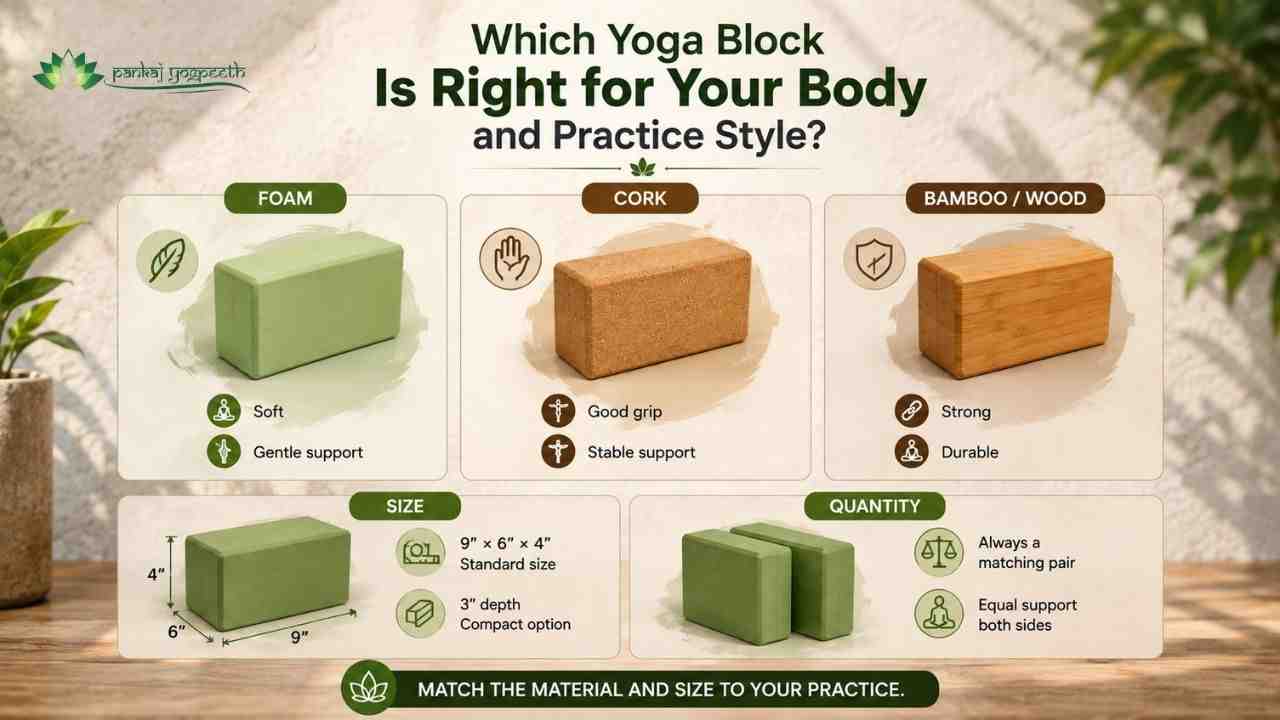
Every block on a shop shelf is very much the same. There's a difference, but you only feel it if you put your weight on one. They differ in weight, grip, and strength, and the best yoga block for beginners is really a matter of matching that substance to how you actually practice.Here's the shorter version, split by what each one is for.
- Foam: light, soft, good for restorative work, yin and sensitive wrists or knees.
- Cork: a little heavier with a natural grip, good for hot yoga, standing balance and weight-bearing hands.
- Bamboo or wood: strongest and longest-lasting, good for sitting support and everyday studio use.
- Size: 9×6×4 inches is the working default; the 3-inch depth is good for smaller frames and travel.
- Quantity: always a matching pair, for symmetrical positions require equal support on both sides.
The size and material of your yoga block are significantly more important than the label on the package.
What Size and How Many Blocks Do Beginners Need?
The standard yoga block size 9x6x4 is suitable for most bodies and offers three heights from one block. Smaller hands grab the 3-inch depth, while taller people generally prefer the 4-inch. Is one yoga block enough? Usually you need a pair, not a single one, to support both hands or both thighs.
Which Block Holds Up Best Under Regular Weekly Practice?
Repeated weight-bearing is exactly what cork and wood handle best. Foam softens gradually, and the change is subtle enough that most people never notice it. A block that gives under the hand stops teaching alignment and starts to hide it.
Firmer material gets better the more you practice it as a long-term option, even at the greater price. But having the correct block is only half the battle. What you do with it in the seconds before you move is equally important.
How Do You Set the Right Block Height Before You Move?
Actually, one block is three props in one. Flip it over, and the yoga block's tall, medium, and low settings provide a unique height each time, and each one asks something different of your body. Deciding how high to position your yoga block before getting into a position means you don’t have to modify it mid-pose when your balance is already unstable.
| Setting |
Approximate Height |
Where It Usually Goes |
You Have Chosen Right When |
| Tall - block stood on end |
9 in / 23 cm |
Under the hands in standing folds, triangle, half moon |
Shoulders stay down and the chest stays broad |
| Medium - block on its long side |
6 in / 15 cm |
Under the hands in low lunge, under the sacrum in bridge |
Hips stay level with no pinch in the lower back |
| Low - block lying flat |
4 in / 10 cm |
Under the sit bones, under the head, held between the thighs |
The spine lifts without effort and the breath stays smooth |
| Two blocks stacked |
Varies by pose |
Supported fish, reclined backbends, raised seated work |
The ribs open with no strain at the front of the neck |
The actual test is in that last column. Read that again. Correct yoga block placement was never about inches. It’s about what remains easy in the body when the block is below you.
What Tells You the Block Is Too High or Too Low?
Your body does it before your mind does it. How do I know if my yoga block is too high? If the shoulders creep up to the ears, watch and drop a setting. If the spine rounds instead, the block sits too low and needs to be raised.
Why Does the Right Block Height Change From One Week to the Next?
Range fluctuates with sleep, warmth and time of day. The height of a yoga block that felt just perfect last week can feel too tall on a cold morning, and too low again after a long practice. Bodies aren't as steady as they look from the outside. Stepping on the mat and checking the height each time keeps the support honest, not habitual.
It stops you clinging to a setting long after your body has quietly moved past it. But height addresses half the question. The block is in a different place when you come down to the floor from standing.
How do yoga blocks help with balance in standing poses?
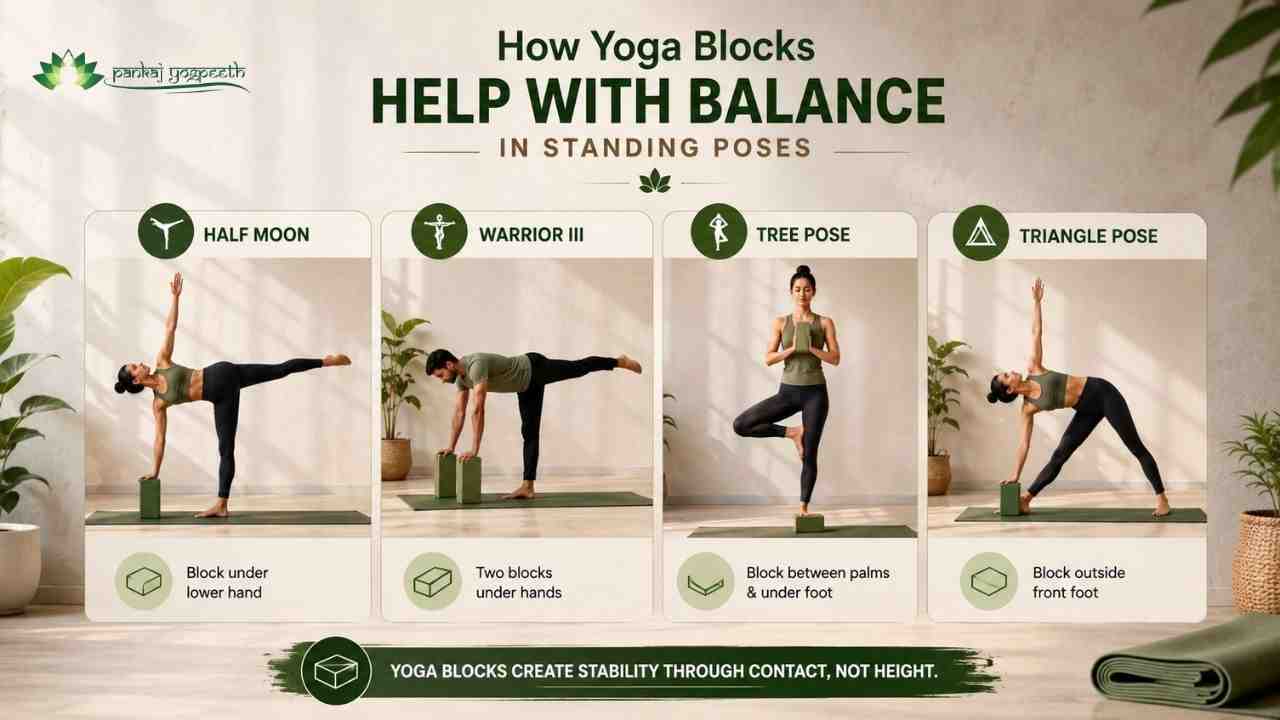
Balance is not simply a leg problem. Most wobbles originate when the torso rotates, and the eyes lose a fixed point to work off. A block on the ground. You get both back at once. Place a tall block under your lower hand for a yoga block for half moon pose, somewhat ahead of the shoulder rather than right under it.
That minor change allows the chest stack to open and not pitch to the floor, and the standing leg has less to adjust. Warrior III works in the same manner with two tall blocks under the hands. The hips are level, the raised leg is parallel, and you can hold it long enough to learn something.
A block between the palms at the chest in yoga block for tree pose provides the arms something to do, stabilising the whole torso. The elevated foot can also be placed on a low block next to the standing ankle for beginners.
Most of the triangle changes revolved. If you don't use a block, the lower shoulder falls, and the twist is into the lower back. The spine has the length to rotate through with a tall block outside the front foot. Yoga Blocks for Balance Work by Contact, Not Height. The floor is not a target anymore, but something to press into.
How Do Blocks Ease Tight Hamstrings, Hips, and Shoulders?
Most people have one place that locks up the pose before the rest of the body is ready. Forcing it rarely helps. Tight muscles tighten even more if they feel unsupported. Yoga blocks for flexibility work the opposite way: give the area something to rest on, and it will let go on its own. And each tight space has a setup that works for it. Here are the ones you need to know.
| Tight Area |
Pose |
Block Setup |
Suggested Hold |
What Should Ease |
| Hamstrings |
Uttanasana |
Two tall blocks beneath the hands |
5–8 breaths |
The pull behind the knees, while the spine stays long |
| Hips and inner groin |
Supta Baddha Konasana |
One low block under each outer thigh |
2–3 minutes |
Inner thighs soften and the knees settle downward |
| Lower back |
Setu Bandhasana |
One low block beneath the sacrum |
1–2 minutes |
Compression releases along the lumbar spine |
| Shoulders and chest |
Supported fish |
Medium block under the mid-back, low block under the head |
2–3 minutes |
The collarbones widen and the shoulders open |
| Knees and ankles |
Virasana |
One low block beneath the sit bones |
1–2 minutes |
Pressure lifts out of the knee joint |
| Inner thighs |
Utkatasana or bridge |
Block squeezed between the thighs |
5–8 breaths |
The legs engage and the knees track straight |
Note that all the longer holds are from the resting forms. A yoga block for stiff hips is a matter of time, not effort. The same goes for yoga blocks for tight shoulders. Same rule for lower back support with a yoga block: settle in, then wait.
Which Setup Helps When Your Hamstrings Refuse to Lengthen?
Bring the floor up instead of pushing yourself down. If your hamstrings are tight, use two tall blocks under your hands for Uttanasana to keep your back long as you fold. If the spine is still rounded, bend the knees slightly, length is more important than straight legs here. This should be a stretch in your back thighs, not your lower back.
Why Do Hamstrings Tighten Again Between Sessions?
Most bodies are asymmetrical in shape, and usually one side opens earlier. Instead of matching both, set the block a bit higher on the tighter side. Working the tight side keeps the pelvis level and stops the open side taking over. That little variation is typical, and it does begin to narrow with consistent practice.
Good support is supposed to be time-limited. But the thing practically nobody teaches you is knowing when to break it.
When Should You Lower the Block or Set It Aside?
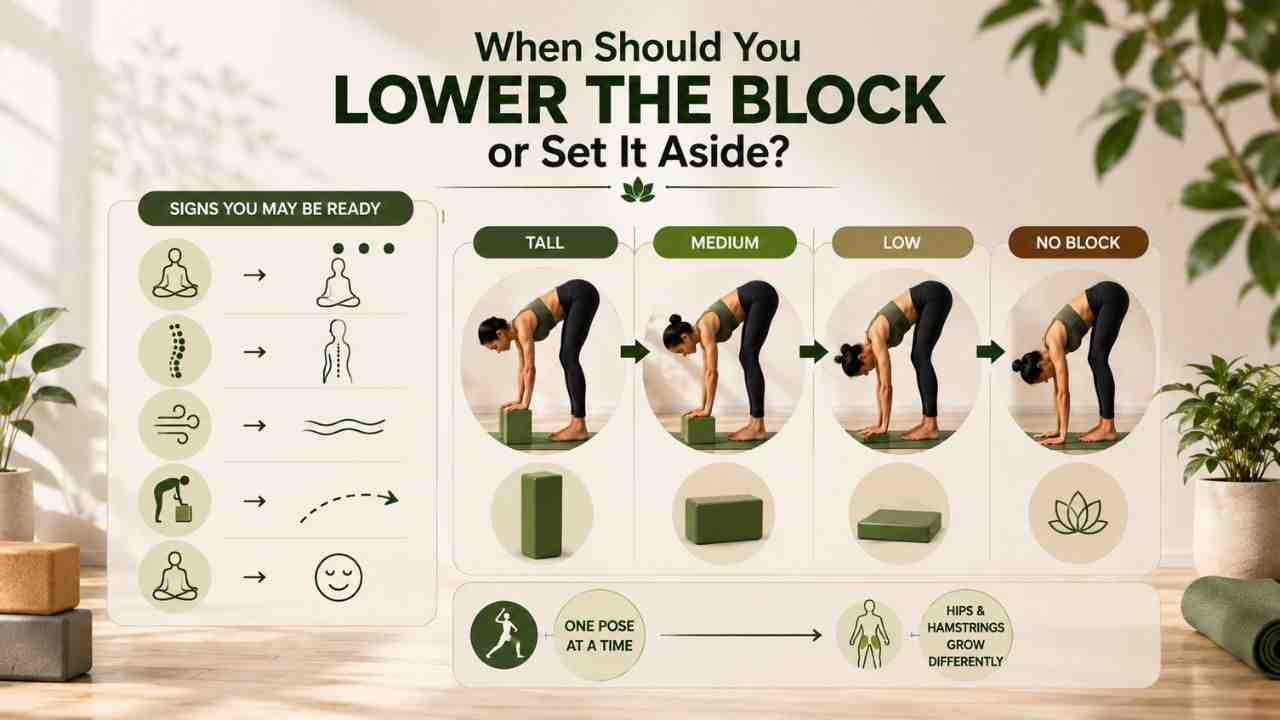
This thing nobody ever seems to mention. Blocks are handed out on day one and then sit at the same height for years, long after the body underneath them has changed. Yoga block progression is just the practice of asking yourself from time to time if you still require the setting you began with.
Then the block, almost unnoticed, no longer serves as support and becomes a ceiling. Nothing feels incorrect, and that’s exactly why it’s overlooked. Your body knows the answer before you thought to ask a question. The signs are silent, but they exist.
- You hold the shape for five complete breaths, not holding the block.
- The spine stays long all the way through, not only on the first breath.
- The breath stays constant rather than catching at its deepest point.
- You find yourself hanging over the block, instead of resting on it.
- The coming out of the pose felt controlled, not a release of stress.
Two or three in a bunch is enough to work with. To step down, drop one setting at a time, tall to medium, medium to low, testing each for a few weeks. Change a single pose at a time, because hamstrings and hips don’t often expand at the same pace.
Why Do Senior Practitioners Still Keep Blocks on the Mat?
Do advanced yogis use blocks? Most do, and often more than beginners. Open bodies can easily move past their safe range, and the block gives them a solid surface to push against instead of collapsing into the joint. The question of when to stop using a yoga block assumes the block is a phase you pass through. It isn't. It stays useful at every level, and the motivation for seeking it only shifts from availability to accuracy.
What Happens If You Drop the Height Too Soon?
Old habits are hard to die. The spine starts to curve, and the breath gets short, and the shape you so carefully crafted starts to slide. Nothing big happens wrong, but you just stop learning anything from the position.
Watch the breath, not the reach, for it changes first and tells you most. Moving back up a setting for a few weeks is progress, not failure. All of it rests on one thing: a block that won't shift under you, applied the way it should be used.
What Are the Most Common Yoga Block Mistakes to Avoid?
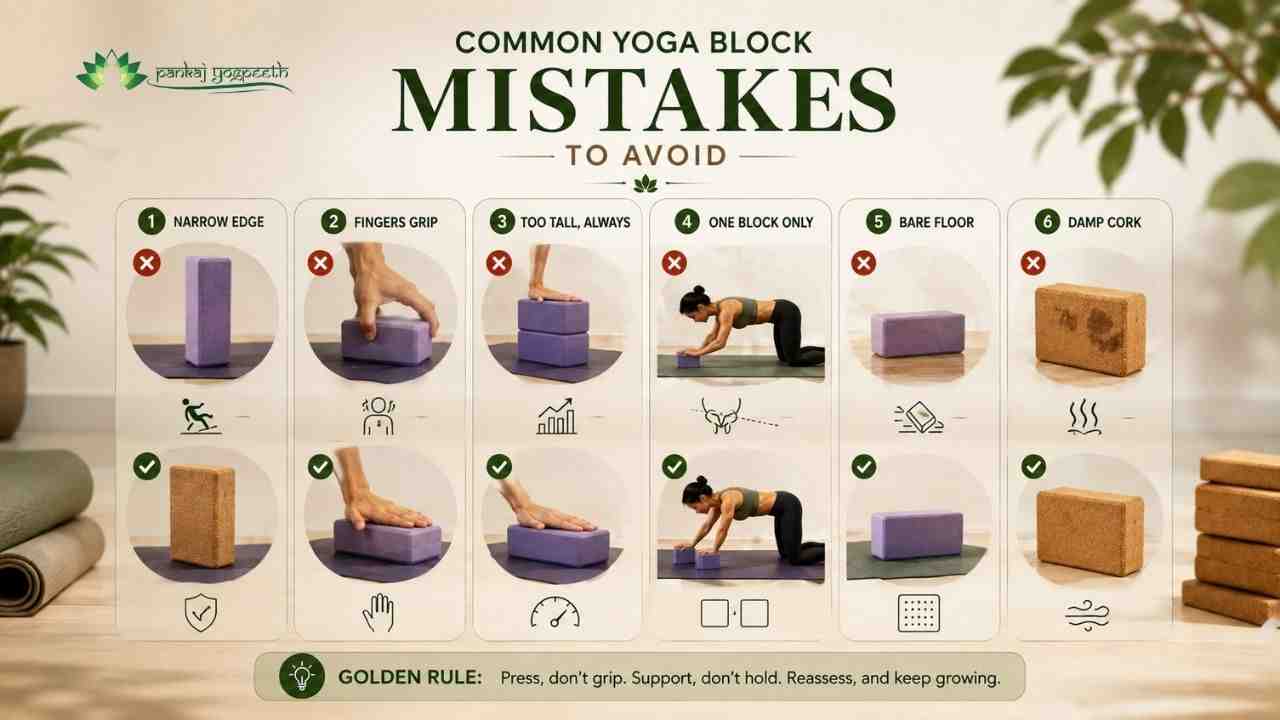
Most yoga block mistakes are small and easily overlooked. No one falls over. It just does not work anymore, and the block is blamed for not helping.
Almost all common mistakes when working with yoga blocks come down to two things: the block sitting somewhere it can't support you, or your hand asking it to do a job it wasn't meant to do. Six turn up more than any others. Here they are, with the fix for each.
| Mistake | Why It Happens | What Goes Wrong | Correct Setup |
| Standing a foam block on its narrow edge | Chasing maximum height | The block folds or skids under load | Use cork or wood whenever the block bears weight |
| Gripping the block with the fingers | Fear of losing balance | The shoulder tightens and the chest closes | Press the whole palm down and root through it |
| Keeping the tall setting from habit | Never reassessing your range | Progress quietly stalls | Test the medium setting every few weeks |
| Using one block where two belong | Owning only a single block | The pelvis tilts and the shape turns uneven | Practise with a matching pair |
| Setting a block on bare polished floor | Practising without a mat beneath | The block slides mid-pose | Always place blocks on a mat or textured surface |
| Storing cork blocks damp | Leaving quickly after hot practice | The cork crumbles and holds odour | Wipe dry and air fully before storing |
Just read down that final column; there's nothing difficult in it. Teachers correct the grasp above all, since if the fingers are tight around the edge, the block is being held rather than pressed, and the shoulder pays the price. That last line matters, too, because learning how to clean a cork yoga block can keep it tough and in shape for years to come.
What Does the Block Finally Teach You About Your Practice?
A position never got any easier with a block. It made the shape real. That is not the same thing. Every time you dropped to a lower setting, something had changed in your body, and you were probably the only one who noticed. That is what learning to use yoga blocks correctly really provides: not a longer reach, but a truer sense of where you stand.
Learn to read the body, not just the pose. Spotting a rounding spine, a lifting heel, or a breath gone quiet, and knowing which prop a student needs before they ask, is learned in a room with real bodies in it. That skill sits at the centre of Yoga Teacher Training at Pankaj Yogpeeth in Rishikesh.