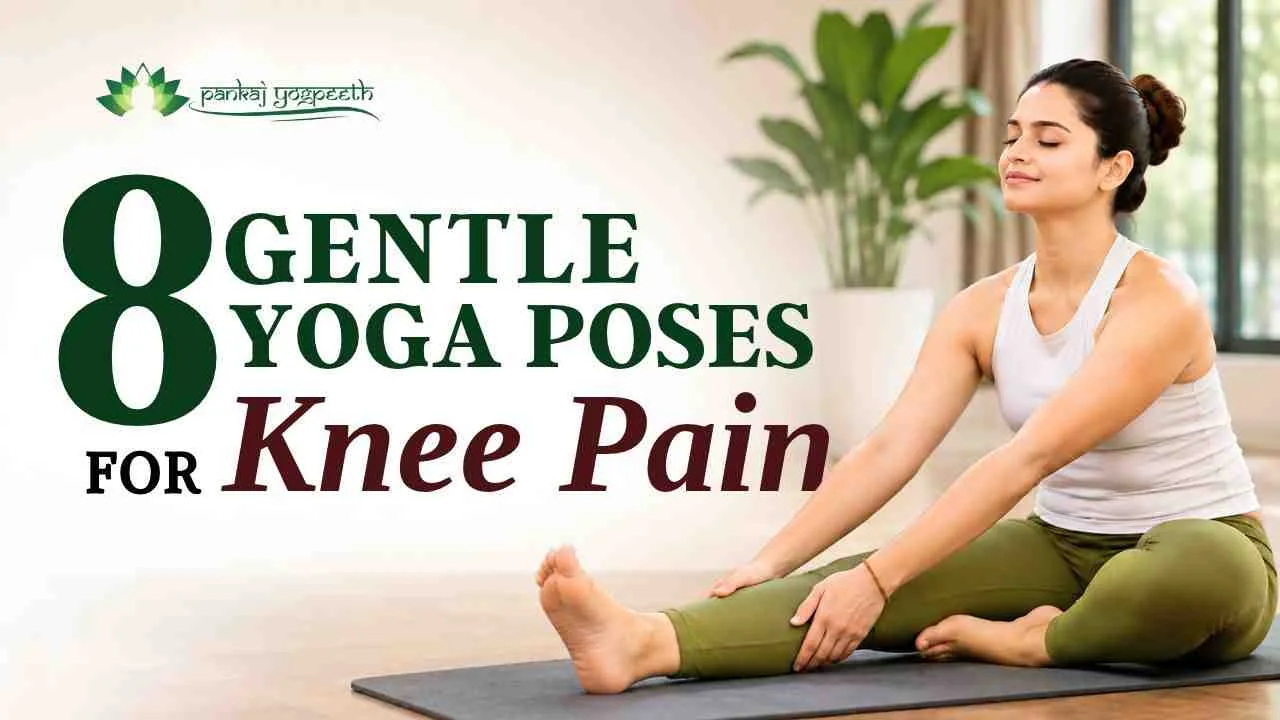
Stairs are usually where it shows first. Your knees feel stiff on the way down; they ache after a long day on your feet, and a yoga class brings up one worry: that bending and kneeling will only make things worse. For many people, gentle yoga for knee pain can help, especially with knee osteoarthritis, which is where most of the research has been done. What matters is choosing the right poses and adjusting them to suit your knees.
This guide covers 8 poses that keep pressure off the joint, movements worth avoiding, a simple 15-minute routine, and signs you should see a doctor first. Practising yoga with bad knees is possible, and starting slowly makes it much safer.
Does Yoga Help Knee Pain? What the Research Shows
Most research on yoga and knees has focused on one condition: knee osteoarthritis, the gradual wear-and-tear discomfort many people begin to notice in middle age. The data is strongest there, so any honest answer about "is yoga good for knee problems?"
Is Yoga Good for Arthritis in the Knees?
A 2024 PLOS ONE review that aggregated 8 trials of 756 participants with knee osteoarthritis gives the clearest answer. Yoga participants experienced less pain and stiffness and performed better than those in the comparison groups.
That same review showed weaker evidence for everyday activities and overall quality of life, so yoga can't help with everything. That still fits with mainstream medical advice. In the UK's NICE guideline, exercise is a core treatment for osteoarthritis, as is weight management where warranted. Gentle yoga is a low-impact way to get that exercise and can be a good option for knee discomfort when the poses suit your joints.
What Yoga Can and Can’t Do for Your Knees
Reality matters more here because yoga can transform how your knee feels and moves, and many people find that regular practice helps loosen stiff joints.
- It mixes slow movement, holding and breathing, which is a little different from plain stretching.
- It won’t repair damaged cartilage or heal a torn meniscus, and it’s not a replacement for physiotherapy.
Also, in 2024, a study in Rheumatology International found several yoga trials to be low quality. So yoga for knee pain is worth a try as long as you see it as one useful technique. But before trying any poses, see whether yoga is right for your knee today.
Before You Start: When to Skip Yoga and See a Doctor
Most stiff, achy knees are okay to move lightly. But a few symptoms mean it's time to get a proper check before you roll out your mat. Before practising, get medical counsel if:
- A knee that feels hot, red or swollen, especially if you feel feverish
- You can't put weight on the leg and straighten the knee
- Your knee locks, gives way, or clicks uncomfortably
- Pain began after a fall or twist in the past several weeks
- After a few weeks, the pain still hasn’t improved
These signs align with NHS guidelines for knee pain.
Can You Do Yoga With an Injured Knee or After Surgery?
After a meniscus tear, ligament injury or knee replacement, your surgeon’s or physiotherapist’s plan comes first. Practising yoga with injured knee ligaments or cartilage may fit in later as part of rehab, once they say it’s safe.
So take generic knee injury yoga recommendations, including this guide, as something to discuss with them, as they know your knee and can tell you what moves are right for it.
If you ask, can you do yoga with bad knees and none of the warning signs above apply, let pain be your guide. Usually, a little soreness that settles off quickly after practice is okay. If you feel sharp pain, or a sensation that increases or continues, stop. You may feel some joint pain when you first start exercising, so start slowly, says NICE. If you’re good to go, a few easy practices make every pose safer.
How to Practise Yoga Safely With Bad Knees
In this guide, we'll improve every posture by adding a few knee-friendly practices. It takes a minute to learn, and soon it's automatic. Your knee should not fold inward. When you bend, your knee should point over your second toe.
If you can't see your toes when you bend your knees, you've gone too deep. Locked knees put a load on the joint, so always keep a mild bend when you stand. Keep props close, they make positions work for your body.
The most helpful yoga props for knee pain are simple: a blanket folded beneath the knees, a strap for stretching, and a wall or chair for balance. Yoga blocks for knee pain also help by lifting the floor so you don't have to bend as much. Check out our guide to using yoga blocks correctly to see where to place them.
Older readers can do most standing postures with the support of a chair or wall. That support makes yoga for knee pain in old age much more practical, which is why yoga for knee pain for seniors generally starts in a chair. So before diving into each one, here are all 8 positions, at a glance.
8 Yoga Poses for Knee Pain at a Glance
| Pose | Position | What It Works | Easier Option |
|---|---|---|---|
| Dandasana with thigh engagement | Seated | Thigh muscles | Rolled towel under the knees |
| Supta Padangusthasana | Lying | Hamstrings, calves | Strap; other knee bent |
| Supta Matsyendrasana | Lying | Hips, outer thigh | Pillow between the knees |
| Setu Bandhasana | Lying | Glutes, hamstrings | Smaller lift; block under the hips |
| Ardha Shalabhasana | Face down | Glutes, back of the thigh | Blanket under the thighs |
| Tadasana | Standing | Alignment, thighs | Back against a wall |
| Utkatasana (shallow) | Standing | Quads, glutes | Wall support, small bend |
| Virabhadrasana II (short stance) | Standing | Hips, thighs, balance | Short stance, hand on a chair |
5 Gentle Yoga Poses for Knee Pain That Take Weight Off the Joint
You’ll perform these five yoga poses for knee pain while seated, lying down or lying face down, so that your knee supports little or no body weight. Start here even if you have practised before. This is easy yoga for knee pain go-to on bad days and a gentle method to ease into yoga for knee joint pain.
Dandasana (Staff Pose) to Switch On Your Thighs
Weak thigh muscles provide less support for the knee. You can do these seated without bending the joint at all, making them among the easiest knee pain exercises yoga offers.
- Sit with legs out straight, hands beside hips.
- Gently squeeze your thighs, keeping your knees unlocked.
- Hold for 5 sec, then relax and repeat five times.
If the back of your knees are sensitive, put a rolled towel under them. If squeezing causes pain in the front of your knee, stop.
A Strap-Supported Hamstring Stretch: Supta Padangusthasana
Tight hamstrings can pull back on the knee. As you lie on your back, this is one of the few yoga stretches for knee pain that doesn’t place any weight on the joint.
- Lie down with both knees bent and feet flat.
- Wrap a strap around one foot and lift that leg toward the ceiling.
- Hold for 30-60 seconds, keeping the lifted knee soft, then switch.
Keep the other foot flat on the floor the whole time if you feel it behind the knee rather than in the thigh.
Lying Twist (Supta Matsyendrasana) for Tight Hips
Stiff hips can place additional stress on the knees. This twist stretches the hips and outer thighs. The floor supports your entire body.
- Lie on your back with both knees bent and your arms wide open.
- Slowly drop both knees to one side.
- Breathe there for a minute and switch sides.
A pillow between or under your knees can make the twist more comfortable. If twisting irritates your knee, skip it.
Bridge Pose to Build Glute and Hamstring Strength
When you walk or climb stairs, your glutes and hamstrings support the knee. The bridge is a great exercise to do with your knees bent at an easy angle.
- Lie on your back, knees bent and feet hip-width apart.
- Keep your knees straight up toward the ceiling.
- Press down through your feet and elevate your hips slightly.
- Lower slowly after 20 seconds.
If you are on a supported version, sit your hips on a block. If your knees wander inward or you feel pain in the front of the knee, stop.
Half Locust: Back-of-Thigh Work Without Knee Pressure
Lying face down works the back of the thighs with no weight on the knee. It’s a quiet one, easy to miss in the midst of the knee discomfort yoga asanas.
- Place your forehead on your hands and lie down.
- Hold the leg straight and lift it a few centimetres.
- Hold for a breath or two and descend. Three times each side.
A folded blanket under your thighs helps to take the pressure off your kneecaps. Stop if your lower back pinches up. When these become effortless and pain-free, you can add a little standing strength.
3 Standing Yoga Poses to Strengthen Your Knees
Only move on to these when the first five are pain-free. Standing sends your body weight into the knee, so these yoga poses to strengthen knees require a little more of the joint, and they build more, too.
Standing Tall in Tadasana Without Locking Your Knees
Most people don’t realise they lock their knees when standing still. Tadasana promotes a softer standing style. Every standing pose after builds on that.
- Stand with your feet about hip-width apart, your weight evenly distributed on both feet.
- Keep a small bend in your knees.
- Take a breath and lift through your chest.
If you feel unsteady, stand with your back against a wall.
Wall-Supported Chair Pose for Quad Strength
Your quads take a lot of strain off the knee joint. This is one of the safest yoga asanas for knee strengthening to do first, as it is done leaning against a wall.
- Stand with your back against a wall and your feet a step forward.
- Knees over toes, slide down a few centimetres.
- Hold for 15 seconds and come back up three times.
If you have pain in the front of the knee, stop.
Short-Stance Warrior II for Hip and Knee Control
Strong hips keep the knee from falling inward. This Warrior II uses a short stance and a chair to help you focus on control.
- Turn sideways to a chair with one hand on it.
- Stand with your feet a little apart, turning the front foot outward.
- Bend the front knee so it's over the ankle, but not past it.
- Hold for a few breaths and change sides.
For runner’s knee yoga, remember that a physio plan will typically include hip strengthening, so ask yours first. This type of work is the core of yoga for knee strength. But some typical yoga poses can be too much for an aching knee.
Yoga Poses and Movements to Avoid With Knee Pain
Everyone's knees are different, so think of these as safe moves, not a list of poses that are beyond limits. There are many yoga poses that involve kneeling or deep knee bends that are more than a painful joint can handle.
| Movement | Example Poses | Why It Can Hurt | Try Instead |
|---|---|---|---|
| Deep kneeling | Vajrasana, Virasana, Balasana | Full knee bend plus body weight on the joint | Sukhasana on a blanket, or Supta Baddha Konasana with pillows |
| Forcing the knees to rotate | Padmasana, Pigeon Pose | Twisting strain when the hips are tight | Lying Twist (Supta Matsyendrasana) |
| Deep squats and lunges | Malasana, deep Utkatasana | High load in deep flexion | Shallow, wall-supported Chair |
| Kneeling on the back knee | Low Lunge, Camel Pose | Direct pressure on the kneecap | Thick padding, or skip |
| Locked straight knees | Trikonasana with locked knees | Strain at the back of the knee | Micro-bend in the front knee |
Chair Pose is on both lists for a reason. A shallow, supported Chair improves strength, while a deep one overloads the knee.
Why Do My Knees Hurt During or After Yoga?
Knee pain from yoga is mainly caused by how a position is done, not the pose itself. The most prevalent reason is diving too deep. Other common causes include kneeling on a thin mat, letting the knee slide in, and rushing through flows with no time to build alignment.
Once you treat the problem, most sore knees after yoga settle down, with the swaps in the table above. If you have knee pain, you can typically continue with yoga with those alterations. If the pain returns, go back to the warning signs at the start of this guide and get your knee checked out. This is how you combine the safe positions.
A 15-Minute Gentle Yoga Sequence for Knee Pain
This yoga sequence for knee pain is the same as the poses above. Start with lying postures to ease in, then move to standing strength, and finish with a few minutes of rest.
| Order | Pose | Time | Note |
|---|---|---|---|
| 1 | Dandasana with thigh engagement | 1 min | 5 slow, gentle squeezes |
| 2 | Supta Padangusthasana | 1 min each leg | Use a strap |
| 3 | Supta Matsyendrasana | 1 min each side | Pillow between the knees |
| 4 | Setu Bandhasana | 3 × 20 sec | Rest between lifts |
| 5 | Ardha Shalabhasana | 3 lifts each leg | Blanket under the thighs |
| 6 | Tadasana | 1 min | Soft knees |
| 7 | Utkatasana at a wall | 3 × 15 sec | Shallow bend |
| 8 | Virabhadrasana II (short stance) | 1 min each side | Hand on a chair |
| Close | Shavasana, bolster under the knees | 3 min | Closing rest |
It is best to start off by doing three or four sessions a week of 15 minute yoga for knee pain. Let the next morning tell the tale: if your knee is a little stiffer or sorer than usual, ease off for a day.
On warm days, only do the reclining poses (1 to 5); skip the standing poses. When you're done, roll to the side before sitting up. Why? Our method for getting out of shavasana. If you want a longer rest, try yoga nidra. Also, the type of class you choose is important.
Which Type of Yoga Is Best for Knee Pain?
Slower approaches let you set up each pose before you hold it, which is what a painful knee needs. That's why hatha yoga for knee pain is an excellent place to start, and our hatha vs vinyasa guide compares the two. Iyengar yoga for knee pain is also a good option, as the style is known for using blocks, straps and chairs.
Good for restorative and moderate classes on flare days. Skip the extended kneeling holds with yin yoga for knee discomfort, because yin holds you in each posture for minutes at a time.
Fast vinyasa, power and hot yoga allow little time for adjustment, so save them for when your knee feels stronger. Whatever you book, notify your teacher about your knee before class. The Arthritis Foundation offers good advice on choosing the right class.
Conclusion: Move Gently, and Let Your Knees Set the Pace
Yoga for knee pain works best when you keep it simple. Choose low-load poses, adjust them to your body, and the practice may ease pain and stiffness, especially if you have osteoarthritis. Start with the five sitting and lying poses. Add the standing ones gently, over weeks, not days, and stop if you experience severe pain.
Progress here looks like easier stairs and less morning stiffness, and depth will arrive in its own time. If you want a professional to check your alignment, meet a teacher at Pankaj Yogpeeth.
Read next
Helpful resources
Good to know
Questions, answered
01How long does it take for yoga to help knee pain?
It varies from person to person. In research on knee osteoarthritis, effective yoga programmes often ran for around 8 weeks, so give regular practice at least a couple of months before judging the results.
02Can yoga make knee pain worse?
It can, if you go too deep, kneel on a hard floor or let your knee drift inward. Choosing low-load poses and using props keeps the risk low, and sharp or lingering pain is always a sign to stop.
03Which yoga pose is best for knee pain?
No one position fits every knee. Start with Bridge Pose and a shallow, wall-supported Chair Pose, which engage the muscles surrounding the knee without deep flexion.
04Is Vajrasana good for knee pain?
Vajrasana fully bends the knee and puts body weight on it, hence it commonly worsens injured knees. If you prefer to sit, instead of sitting, sit on a folded blanket in a cross-legged stance, and only try Vajrasana when you are comfortable kneeling.
05Is yoga safe for knee pain in older adults?
For many older persons it is, especially with chair or wall support and a teacher who understands about the knee condition. If you have any health conditions, talk to your doctor before you start.
06Should I do yoga during a knee pain flare-up?
Keep to the gentle lying poses or simply rest until the flare settles. Skip standing poses on those days and return to them gradually.
07Is walking or yoga better for knee pain?
Both can help, and they go well together. Walking promotes general fitness and yoga offers mobility, muscle control and a calmer technique to move a hurting joint.
08Do I need a special yoga mat for sore knees?
A thicker mat helps. A folded blanket under your knees works just as well . Either makes floor positions a lot more comfortable for sensitive joints.
09Is Surya Namaskar safe if I have knee pain?
The standard sequence includes lunges and quick movements that can strain a painful knee. Practise it slowly with the knees softly bent, or leave it out until the gentler poses feel easy.
10Can I practise yoga for knee pain at home?
Yes. The 15-minute routine in this guide is designed for home practice with a mat, a strap, a blanket and a wall. A few classes with a qualified teacher can help you check your alignment first.